
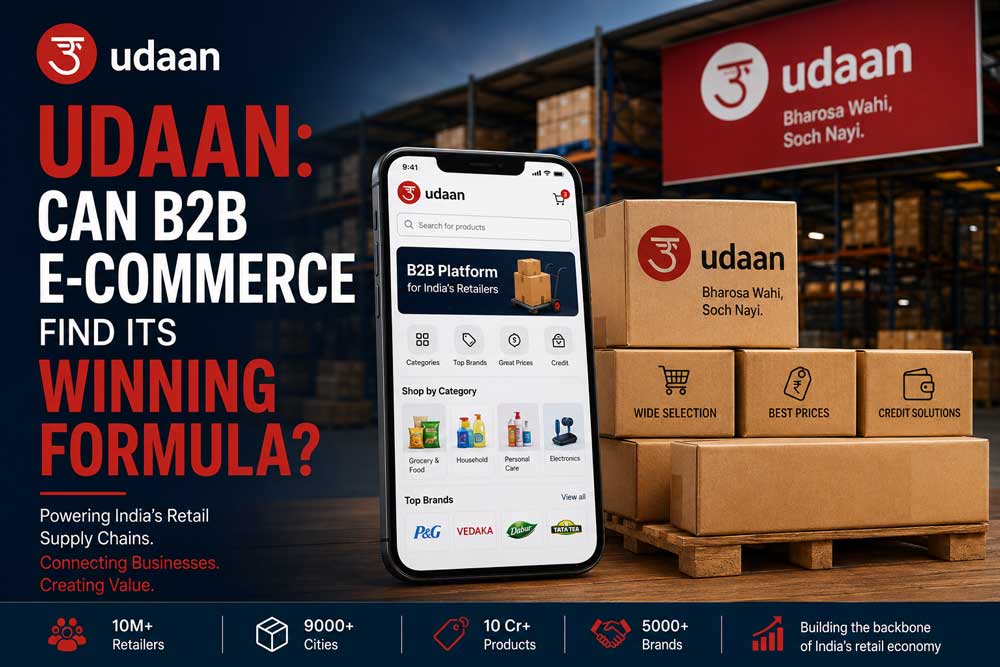
Udaan: Can B2B E-Commerce Find Its Winning Formula?
Share this article
India's B2B e-commerce opportunity remains enormous. Millions of small retailers still depend on fragmented distributors, local wholesalers and traditional supply chains. Udaan was built to digitise that system.
But its journey also highlights a difficult truth about B2B commerce: scale does not automatically create a profitable business.
After years of expanding aggressively, Udaan is now pursuing a very different strategy—fewer markets, stronger local density and tighter control over unit economics.
From National Scale to Local Density
Udaan originally attempted to build a nationwide B2B marketplace across numerous categories and cities. That strategy generated significant scale but also required substantial capital.
The company has since narrowed its footprint and concentrated on essential categories such as FMCG, groceries and its HoReCa business.
Its B2B commerce platform now focuses heavily on helping retailers source products, manage orders and access business credit.
This is strategically important.
Instead of asking, "How many cities can Udaan serve?", management is increasingly asking, "How profitable can each operating cluster become?"
The Numbers Show a Turnaround—But Not Yet a Victory
Udaan's FY25 revenue fell nearly 20% to ₹4,561 crore, following its exit from selected businesses. However, its net loss narrowed by around 37% to ₹1,055 crore.
More recently, the company said revenue had grown at roughly 25% CAGR between Q4 CY23 and Q1 CY26, while contribution margins improved by nearly 500 basis points and EBITDA burn fell by around 70%.
That suggests Udaan is sacrificing some top-line scale to improve the quality of its economics.
CEO Vaibhav Gupta has said the company expects to reach net profitability within 18 months, making profitability the central milestone rather than simply another funding round.
Private Labels Could Improve Margins
One potentially important lever is private-label products.
Udaan said private labels now contribute around 15–25% of staples sales across its operating cities.
Private labels can provide better margins and greater control over pricing and product availability than simply reselling established brands.
For a B2B platform operating on relatively thin margins, even modest improvement in gross margins can materially change the economics.
The Balance Sheet Remains the Biggest Question
There is, however, an uncomfortable part of the story.
Udaan's offshore holding company faced creditor proceedings after a $170 million convertible-note default, even as the company pursued restructuring and fresh financing.
In July 2026, Udaan announced a $160 million financing package involving fresh equity, private credit and debt-to-equity conversion to strengthen its balance sheet ahead of a potential IPO.
This means the turnaround cannot be judged only by operating metrics.
Udaan must prove that improving unit economics can eventually translate into sustainable cash generation and a healthier capital structure.
Can Udaan Find Its Winning Formula?
Udaan's second act looks very different from its first.
The company is no longer chasing maximum geographic coverage. It is focusing on density, essential products, private labels, financing and profitability.
That may ultimately prove to be the right formula for Indian B2B commerce.
The bigger lesson for investors is clear: the winner in B2B e-commerce may not be the company with the largest network, but the one that can build the strongest economics around each retailer.
Tags