
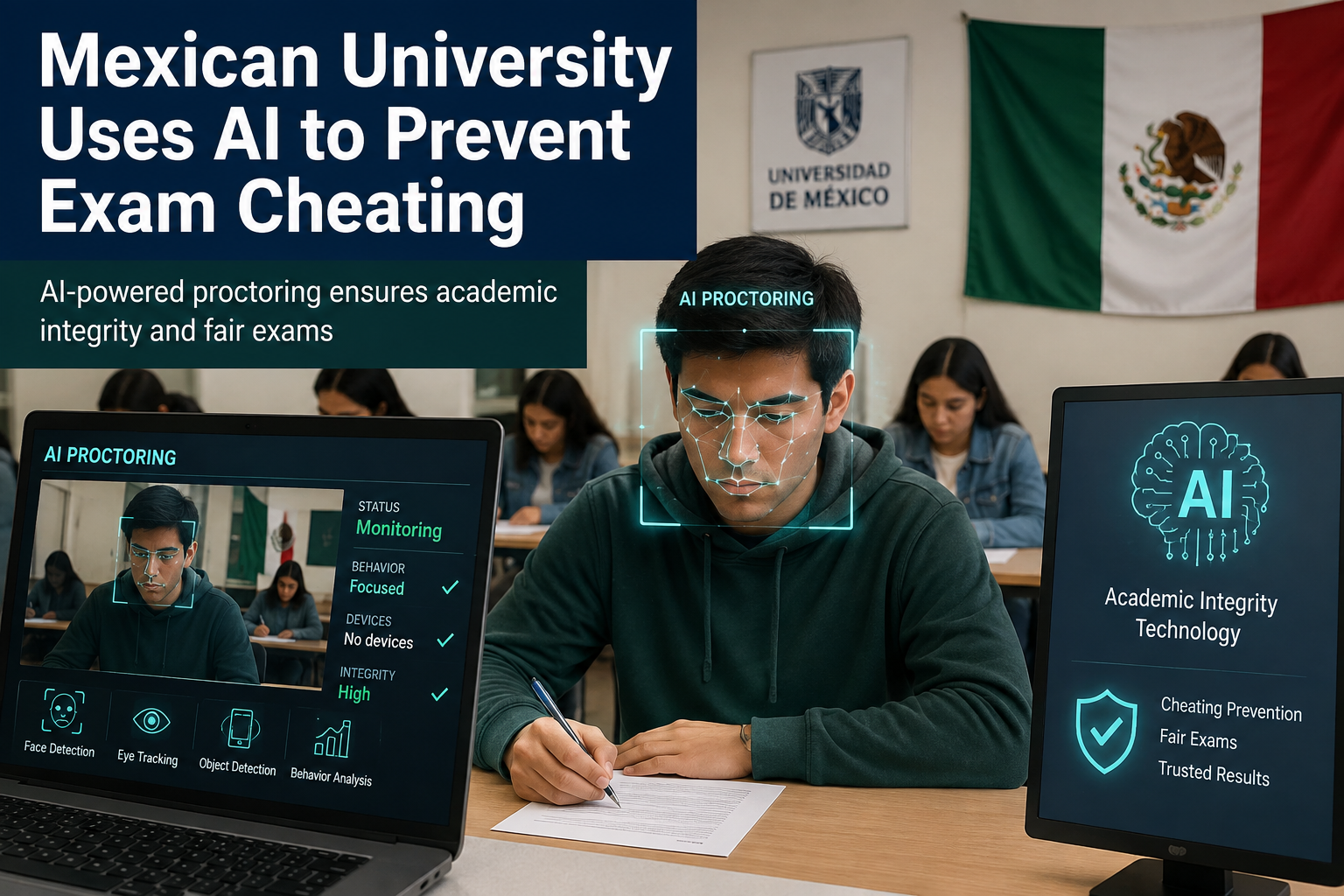
Mexican University Uses AI to Prevent Exam Cheating
Share this article
Mexico City: Mexico's prestigious National Autonomous University of Mexico (UNAM) is facing one of its biggest admissions challenges after its first large-scale online entrance examination raised concerns over widespread AI-assisted cheating. Despite deploying artificial intelligence-powered monitoring tools to detect dishonest behavior, the university has announced that thousands of applicants may need to retake their exams following suspiciously high scores.
The university conducted online entrance exams for more than 158,000 applicants during May and June 2026. Candidates were required to complete the test using a specially secured browser while keeping their webcam and microphone active throughout the examination. AI-based monitoring software, supported by human supervisors, was used to identify suspicious activity.
AI Monitoring Could Not Stop Suspected Cheating
UNAM's remote proctoring system was designed to detect unusual movements, unauthorized absences from the screen, additional people in the room, and other suspicious behavior. The platform also restricted access to other applications and websites during the exam.
The monitoring system identified approximately 3,000 applicants who violated examination rules, resulting in their immediate disqualification. However, university officials later discovered that the overall exam results appeared highly unusual, suggesting that many other candidates may have found ways to bypass the security measures.
Unusually High Scores Raised Alarm
The biggest concern emerged after the admission results were released.
According to university data, 16.3% of applicants scored 100 or more correct answers, compared with an average of 3.5% during the previous five years. The dramatic increase prompted education experts and university administrators to question whether generative AI tools such as ChatGPT had been used during the online examinations.
Several academic programs also recorded unusually high cutoff scores, leaving many students who believed they had performed well without admission offers.
University Orders Review
In response, UNAM established a 16-member technical commission comprising experts in education, artificial intelligence, assessment, and law to investigate the irregularities.
The university announced that applicants whose scores fall within the historical admission range may be required to take a new written examination to verify the legitimacy of their results. A new exam date has not yet been announced.
AI Presents New Challenge for Education
The incident highlights the growing challenge educational institutions face as generative AI becomes increasingly capable of answering complex examination questions.
Although AI-powered remote proctoring systems can monitor eye movements, browser activity, microphones, and webcams, experts note that they cannot always detect the use of secondary devices such as smartphones or another computer positioned outside the camera's view.
The controversy has intensified global discussions about whether traditional online examinations remain reliable in the age of advanced artificial intelligence and whether universities should redesign assessments to focus more on in-person testing, oral examinations, and practical evaluations.
What's Next?
UNAM is expected to complete its investigation before finalizing admissions for the upcoming academic year. Depending on the commission's findings, thousands of applicants could be asked to sit another entrance examination, making the case one of the most significant AI-related academic integrity incidents reported to date.