
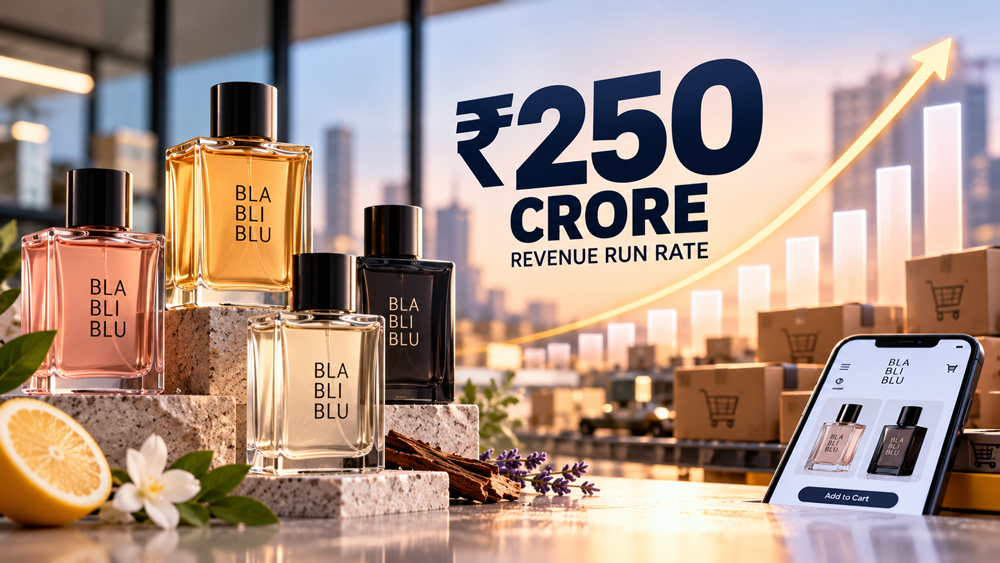
Bla Bli Blu Hits ₹250 Crore Revenue Run Rate and Turns EBITDA-Positive
Share this article
Gurugram-based fragrance startup Bla Bli Blu has reached an annualised revenue run rate of ₹250 crore and turned EBITDA-positive within roughly a year of its launch in July 2025. The milestone highlights the growing opportunity for emerging consumer brands in India's fragrance market.
The company had reported an annualised revenue run rate of ₹100 crore around six months earlier. Its latest growth reflects sales across e-commerce and quick-commerce channels, along with a product strategy focused on making premium-style fragrances more accessible to Indian consumers.
Bridging the Gap Between Affordable and Premium Fragrances
Bla Bli Blu entered a market where consumers often face a choice between inexpensive mass-market perfumes and higher-priced international fragrance labels. The brand positioned its products between these segments, offering fragrances designed around different personalities and moods at more accessible prices.
This positioning reflects a broader shift in India's consumer market, where brands are using product differentiation and premiumisation to attract shoppers. The trend is also visible in India's changing premium FMCG market, particularly in beauty and personal care.
One part of Bla Bli Blu's approach is a ₹399 trial pack, which can be redeemed against the purchase of a full-sized 100 ml bottle. The offer allows customers to experience a fragrance before committing to a larger purchase, addressing a common challenge in online perfume shopping.
E-commerce and Quick Commerce Drive Growth
The startup attributes its growth to sales across e-commerce and quick-commerce channels. Its flagship fragrance, Old Money, reportedly sells around 4,000–5,000 bottles a day and has performed strongly on platforms including Blinkit and Amazon, according to company-reported figures.
The brand is also expanding sales through Zepto, Flipkart, Myntra and Meesho. Alongside online distribution, it is building an offline presence through retail and kiosk chains and modern trade partners.
This multi-channel approach gives the brand several ways to reach customers. E-commerce supports product discovery and broader selection, while quick commerce offers convenience and faster delivery. For fragrance brands, trial packs and accessible pricing can help reduce the barrier created by customers being unable to smell a product before ordering online.
Why EBITDA Profitability Matters
Turning EBITDA-positive is an important milestone for a young consumer brand. EBITDA measures earnings before interest, taxes, depreciation and amortisation. A positive result indicates that earnings on this measure have moved above zero, but it does not necessarily mean the business is profitable after all expenses or that it generates positive cash flow.
Bla Bli Blu's reported milestone suggests that its sales and operating model have reached an important stage. Its next challenge will be sustaining those economics as it expands distribution, marketing and product availability.
What Other Startups Can Learn
Bla Bli Blu's growth offers several lessons for emerging consumer businesses:
Identify a clear market gap: Positioning between mass-market and premium products gives customers a specific reason to consider a new brand.
Reduce the first-purchase barrier: Trial packs can encourage customers to experiment before committing to a full-size product.
Use multiple sales channels: Combining marketplaces, quick commerce and offline retail can broaden customer access.
Listen to customer feedback: Consumer insights can help brands refine products and improve repeat purchases.
Track profitability alongside growth: Revenue milestones matter, but operating economics determine whether expansion can be sustained.
These approaches are not guaranteed to work for every brand. Their effectiveness depends on product quality, customer acquisition costs, repeat purchases, distribution expenses and competition.
What's Next for Bla Bli Blu?
The company has opportunities to build on its momentum by strengthening repeat purchases, expanding offline distribution and developing adjacent fragrance and personal-care products. It has also begun building an international business, including sales in the United States.
Its future performance will depend on whether the brand can maintain demand while preserving margins as it reaches more customers.
Bla Bli Blu's progress demonstrates how a focused product proposition and a multi-channel distribution strategy can help a young consumer brand scale. The next test is turning early momentum into durable, profitable growth.
Tags