
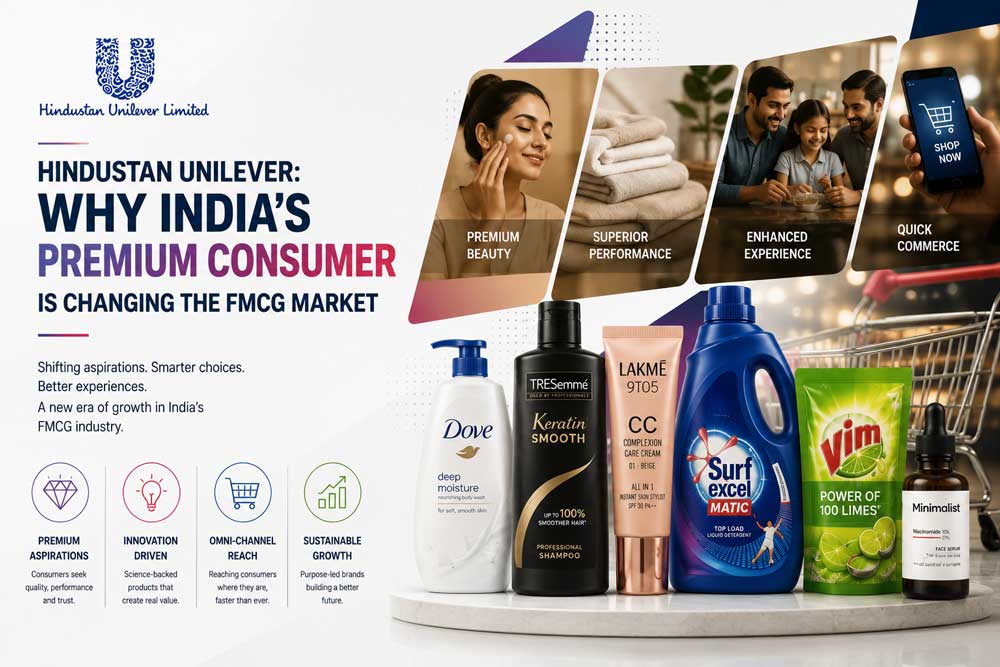
HUL: How Premium Consumers Are Reshaping India's FMCG
Share this article
India's FMCG market is entering an interesting phase. Consumers are still highly price-conscious, but they are increasingly willing to pay more for products that offer better performance, convenience, health benefits or a more aspirational experience.
For Hindustan Unilever (HUL), India's largest FMCG company, this shift could become one of its most important growth opportunities.
The interesting part is that premiumisation is not replacing value consumption. Both are happening at the same time.
India's Consumer Is Becoming More Selective
The traditional FMCG assumption was simple: sell affordable products to as many households as possible.
That model remains important, but consumer behaviour is becoming more segmented.
HUL itself describes the Indian market as showing a dual pattern of value-seeking alongside selective premiumisation. Consumers continue to look for affordable packs and strong value, while spending more on categories where they perceive meaningful benefits such as efficacy, wellbeing, convenience or sensory experience.
This creates a "two-speed" FMCG market.
Consumers may trade down on an everyday necessity while simultaneously paying a premium for skincare, premium detergent, nutrition or personal-care products.
For FMCG companies, understanding where consumers are willing to pay more is therefore becoming more important than simply increasing prices.
HUL Is Betting Heavily on Premiumisation
HUL has made premiumisation a central part of its growth strategy.
In FY2025-26, the company said approximately 42% of its Indian portfolio was positioned in premium segments, with a stated ambition to increase that share to 50%.
The company has also committed up to ₹2,000 crore of investment in manufacturing capacity for fast-growing premium categories, particularly across Beauty & Wellbeing and Home Care liquids.
This is more than a product strategy.
It is a margin strategy.
Premium products can potentially generate higher realisations and better profitability while giving consumers a reason to move upward within the same brand family.
Beauty Is Showing the Shift Clearly
HUL's Beauty & Wellbeing business illustrates how premiumisation is changing consumer behaviour.
The company reported strong momentum in premium segments such as skin cleansing, bodywash and deodorants during FY26. Its premium and "masstige" portfolio has expanded fourfold, while Minimalist reached an annual revenue run rate of more than ₹850 crore. (HUL Performance Highlights)
The growth of brands such as Dove, TRESemmé, Lakmē and Minimalist reflects a broader consumer trend: people increasingly want products designed for specific needs rather than generic products that simply perform a basic function.
This is particularly visible among younger consumers, who discover products through creators, social media, quick commerce and digital communities.
Home Care Is Also Moving Up the Value Ladder
Premiumisation is not limited to beauty.
HUL's Home Care business delivered high-single-digit underlying volume growth in FY26, while its liquids portfolio crossed ₹4,000 crore in revenue and recorded strong double-digit underlying sales growth. (HUL Performance Highlights)
Products such as liquid detergents, fabric conditioners and specialised cleaning solutions can command higher prices because consumers increasingly associate them with convenience and better performance.
This is strategically important.
The future of FMCG may not require consumers to buy more products. It may require consumers to buy better versions of the products they already use.
Digital Commerce Is Accelerating the Shift
The rise of quick commerce and modern retail is also helping premiumisation.
Consumers can now discover new products, compare variants and purchase specialised products almost instantly.
HUL is responding by strengthening its presence across digital commerce and "channels of the future," while using more targeted consumer segmentation and digital-first marketing.
This gives premium brands a faster route from product launch to consumer adoption.
It also changes the competitive landscape.
A smaller digital-first brand can build awareness quickly, meaning established companies such as HUL can no longer rely solely on distribution scale.
The Risk: Premiumisation Cannot Become Overpricing
There is a major catch.
Consumers may be willing to pay more, but they still expect visible value.
If premium products become simply more expensive versions of familiar products, consumers can easily switch to competitors or private labels.
This is why innovation matters.
HUL's strategy increasingly combines premium pricing with science-backed benefits, improved formats, stronger branding and more targeted consumer propositions.
The premium product must answer one question clearly:
Why should I pay more?
Investor Perspective
For investors, premiumisation could improve HUL's growth quality because it can raise realisations without depending entirely on volume expansion.
HUL delivered ₹63,763 crore of turnover and 5% underlying sales growth in FY2025-26, with underlying volume growth of 4% and EBITDA of ₹15,054 crore.
The challenge is maintaining that growth while investing heavily in innovation and premium capacity.
Investors should therefore watch premium portfolio growth, volume growth, margins, market share and the return generated from new capacity.
The Bigger FMCG Shift
India's consumer story is becoming more complicated than "premium versus mass."
It is increasingly about selective premiumisation.
The same household can demand low prices in one category and premium products in another. Companies that understand those differences can capture more value without abandoning affordability.
For HUL, that could be a powerful advantage.
Its portfolio already stretches from mass-market products to premium beauty, personal care and home-care offerings.
The company's next growth cycle will depend on how effectively it moves consumers up the value ladder without losing the trust that made its brands mass-market leaders in the first place.
Original Analysis
The central argument is that India's premium FMCG opportunity is not simply driven by rising incomes. It is being driven by selective willingness to pay for better outcomes—performance, convenience, wellness, science and experience. HUL's challenge is to monetise this shift while keeping its mass-market relevance intact.
Tags