
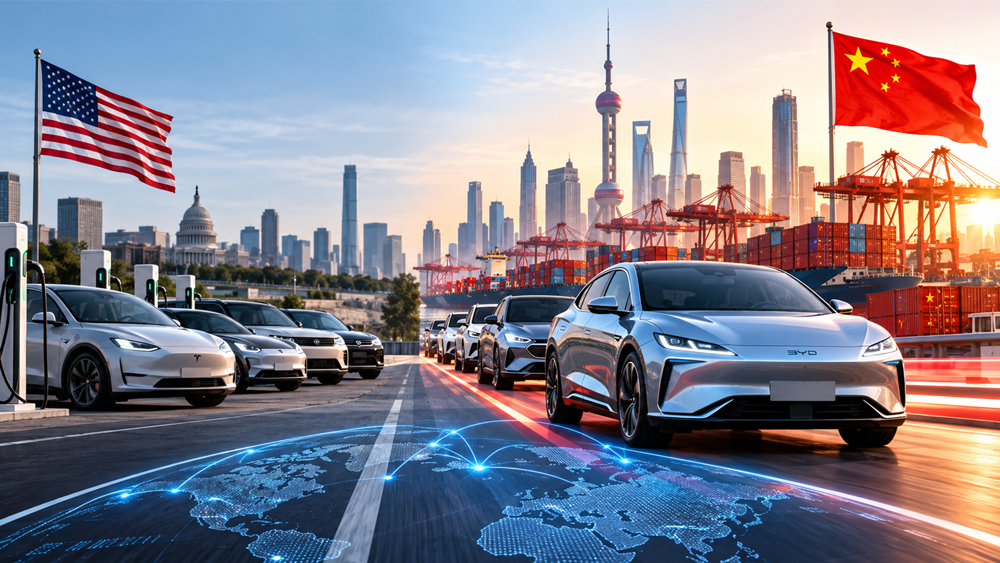
US Falls Behind in the Global EV Race: Why China Is Pulling Ahead
Share this article
The global electric vehicle (EV) industry is entering a new phase of competition, and the United States is facing a growing challenge. While American companies helped popularise electric cars and develop advanced battery technologies, China has built a powerful manufacturing ecosystem that is reshaping the industry.
The difference is increasingly visible in consumer adoption, vehicle production, battery supply chains and international expansion. The United States remains an important market for electric mobility, but changes in government incentives and slower demand growth are making it harder for American manufacturers to maintain momentum.
China Has Turned EV Manufacturing Into a Strategic Advantage
China's lead extends beyond the number of electric cars sold. The country has developed a connected industrial ecosystem covering battery materials, battery cells, vehicle manufacturing, components and charging technology.
According to the International Energy Agency's Global EV Outlook 2026, China accounted for nearly 55% of new car sales being electric in 2025. It also produced approximately 16 million electric cars, representing nearly three-quarters of global electric car production.
Companies such as BYD and other Chinese manufacturers benefit from large-scale production, intense domestic competition and a wide range of vehicles across different price segments. These factors help companies reduce costs, introduce new models and compete in overseas markets.
China's growing influence in the global electric vehicle market reflects a broader industrial strategy: establish scale at home, strengthen supply chains and use that foundation to expand internationally.
The United States Faces a Demand Challenge
The US electric vehicle market has developed differently. Tesla established a strong position in the industry, while traditional automakers including General Motors and Ford invested heavily in electrification. However, high vehicle prices, charging concerns, consumer preferences and uncertainty around government support have complicated the transition.
The IEA reported that US electric car sales declined by 2% in 2025, while sales in China and Europe continued to expand. The expiration of federal clean-vehicle tax credits for vehicles acquired after September 30, 2025, removed an important purchasing incentive for eligible consumers.
Policy changes can affect more than showroom demand. Automakers make long-term decisions about factories, battery plants, suppliers and research based on expectations about future sales. When those expectations change, companies may delay investment or adjust production plans.
The challenge for American manufacturers is to make electric vehicles attractive to a wider range of buyers without depending entirely on government incentives.
Battery Supply Chains Remain a Major Weakness
Batteries are among the most strategically important components of an electric vehicle. Their cost, performance, charging speed and durability influence both vehicle pricing and consumer confidence.
China has built a significant advantage in battery manufacturing and the processing of materials used in battery cells. This concentration gives Chinese manufacturers access to established suppliers, industrial infrastructure and large production volumes.
The United States is investing in domestic battery research and manufacturing, but building a competitive supply chain takes time. It requires investment in materials processing, component production, skilled workers and large-scale manufacturing.
American companies must also improve battery chemistry, production efficiency and recycling systems to reduce costs and strengthen supply security. Research into alternative chemistries could help, but commercial success will depend on whether new technologies can be manufactured reliably and affordably at scale.
Europe Is Becoming an Important Battleground
Europe offers another view of the changing EV race. Electric car sales across the region rose by more than 30% in 2025, reaching approximately 4.2 million vehicles, according to the IEA.
Chinese automakers are expanding into Europe with competitive pricing and increasingly broad product ranges. European manufacturers are responding with new models, revised pricing strategies and investments in their own electric platforms.
For American companies, this creates an additional competitive challenge. They must compete not only with established European brands but also with Chinese manufacturers that are improving their international distribution and after-sales support.
Trade restrictions can influence where vehicles are sold, but tariffs alone cannot replace competitive manufacturing, attractive products and efficient supply chains.
What American Automakers Need to Do
The United States still has important strengths, including engineering expertise, established automotive brands, software capabilities, research institutions and a substantial domestic market.
To improve its position, the industry needs to focus on five priorities:
Lower vehicle costs: Develop affordable models that appeal to mainstream buyers rather than concentrating only on premium segments.
Strengthen battery production: Expand competitive domestic supply chains while diversifying sources of critical materials.
Improve charging access: Make public charging more reliable, convenient and predictable.
Maintain investment consistency: Give manufacturers and suppliers clearer long-term signals for planning factories and product development.
Compete globally: Improve manufacturing efficiency, product choice and customer service instead of relying primarily on trade barriers.
Success will depend on turning technological capability into vehicles that customers can afford and want to buy.
Conclusion: The EV Race Is About Industrial Scale
The United States has not lost its ability to innovate, but it risks losing ground in the industrial race to make electric vehicles affordable and widely available. China's advantage comes from the scale of its manufacturing ecosystem, strong battery supply chains and intense domestic competition.
The next phase of the EV industry will be shaped by production costs, battery technology, consumer demand, public policy and international trade. American automakers can remain competitive, but doing so will require sustained investment and a stronger focus on affordability and manufacturing execution.
The central lesson is that leadership in electric mobility is not determined by invention alone. It also depends on who can manufacture efficiently, build resilient supply chains and deliver products that succeed in the global marketplace.
Editorial note: The article is framed as an industry analysis rather than claiming that the US has lost the entire EV race. The figures cited refer to 2025, as reported in the IEA's 2026 outlook.
Tags