
Tesla: Is the EV Market Still Its Biggest Opportunity?
Share this article
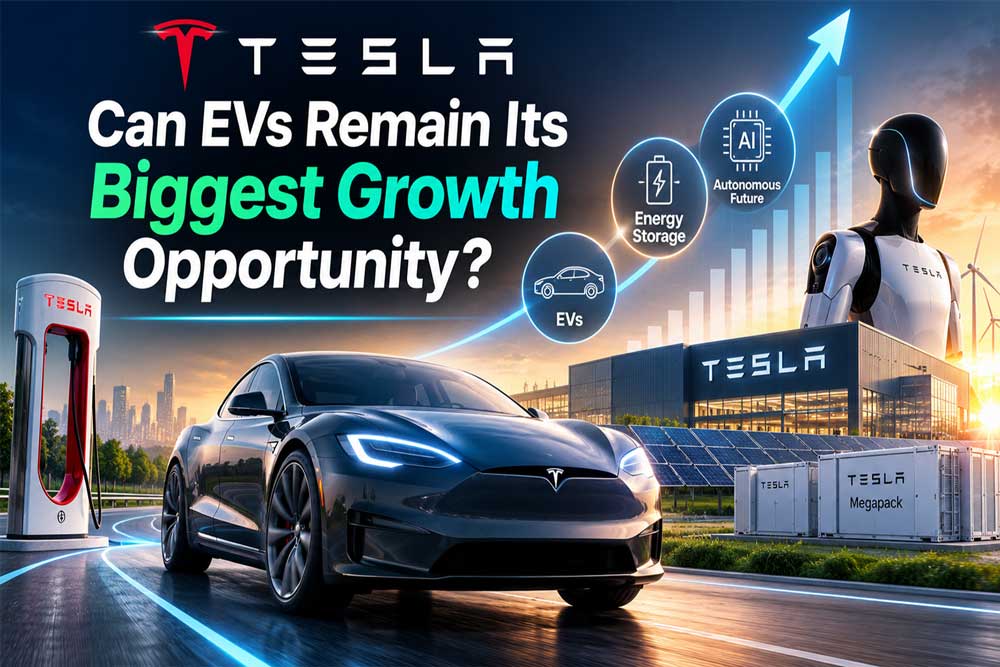
For this article, I’ve taken a more analytical angle: EVs remain Tesla’s core business, but energy storage, software and autonomy could increasingly determine where the company’s next major growth comes from. This avoids treating vehicle-delivery growth alone as the whole Tesla story.
Tesla: Can EVs Remain Its Biggest Growth Opportunity?
Tesla built its global identity around electric vehicles. The company helped turn EVs from a niche technology into a mainstream automotive category and created one of the world's most recognisable electric-car brands.
But Tesla's next growth cycle raises a more difficult question: Can electric vehicles remain the company's biggest growth opportunity, or will energy, software and artificial intelligence eventually become more important?
The answer may depend on how quickly Tesla can move beyond selling cars.
EVs Still Drive Tesla's Scale
Electric vehicles remain the foundation of Tesla's business.
In 2025, Tesla produced approximately 1.65 million consumer vehicles and delivered 1.64 million, although total automotive revenue declined 10% to $69.5 billion.
The numbers reveal an important challenge.
Tesla can continue selling millions of vehicles while finding it increasingly difficult to generate the same level of revenue growth. Competition has intensified, product cycles matter more and global EV markets are becoming crowded with manufacturers offering increasingly capable alternatives.
Tesla's advantage therefore needs to evolve from simply being an EV pioneer into becoming a technology and software-driven automotive platform.
The Next EV Opportunity Is Not Just More Cars
Tesla's future automotive opportunity could increasingly depend on what it earns from each vehicle after the initial sale.
Features such as Full Self-Driving, connectivity, Supercharging, insurance and other services can potentially create recurring revenue from Tesla's installed vehicle base.
Tesla reported $12.5 billion in Services and Other revenue in 2025, up 19% year over year. (sec.gov)
That is strategically important.
A traditional car manufacturer largely monetises a vehicle when it is sold and serviced. Tesla is attempting to create a model where the vehicle remains an economic platform throughout its useful life.
The success of this strategy could determine whether Tesla remains primarily an automaker or becomes something closer to a technology company with an automotive foundation.
Energy May Be the Underestimated Opportunity
Tesla's energy business deserves much more attention.
Energy generation and storage revenue increased 27% to $12.8 billion in 2025, while energy-storage deployments reached 46.7 GWh.
The opportunity could become even larger as electricity demand rises from data centres, AI infrastructure, industrial electrification and renewable-energy deployment.
Tesla's Megapack and Powerwall products position the company in a market that is fundamentally different from passenger vehicles.
Unlike cars, large-scale batteries can become infrastructure assets with long operating lives and software-controlled economics.
Tesla's Autobidder platform, for example, can autonomously optimise battery assets and participate in energy markets, turning storage hardware into a software-enabled energy business.
This creates an intriguing possibility:
Tesla could eventually make money not only from selling batteries, but from managing the electricity flowing through them.
AI Could Change the Equation Again
Tesla's most ambitious opportunity may ultimately be artificial intelligence.
The company says it is investing in AI, FSD, Robotaxi and Optimus as part of a longer-term shift toward software and fleet-based profits. Tesla launched its Robotaxi service in June 2025 and continues to develop its purpose-built Cybercab autonomous vehicle.
If autonomous driving becomes commercially viable at scale, Tesla could potentially move from selling vehicles to operating a transportation service.
That would dramatically change the economics.
A privately owned Tesla generates revenue primarily when a customer purchases it and later buys services. A robotaxi could potentially generate revenue repeatedly throughout the day.
However, this remains a high-risk opportunity rather than an established business model.
2026 Shows the Transition
Tesla's first half of 2026 illustrates the changing mix.
In Q1, Tesla delivered 358,023 vehicles and deployed 8.8 GWh of energy storage. In Q2, deliveries increased to 480,126 vehicles, while energy-storage deployments reached 13.5 GWh. (ir.tesla.com)
For the first half of 2026, Tesla generated approximately $50.6 billion in total revenue, including $35.5 billion from automotive sales, $5.3 billion from energy-generation and storage sales, and $8.3 billion from services and other. (sec.gov)
The takeaway is clear: automotive remains overwhelmingly important, but Tesla's non-automotive businesses are becoming too large to ignore.
Investor Perspective
For investors, the biggest mistake would be to value Tesla only through vehicle deliveries.
The more important questions are:
Can Tesla defend EV margins as competition increases?
Can software become a meaningful recurring-revenue business?
Can energy storage grow faster than automotive?
Can Robotaxi move from technology demonstration to profitable commercial scale?
Can Tesla generate attractive returns on its enormous AI and manufacturing investments?
The company ended 2025 with $44.1 billion in cash and investments, giving it considerable financial capacity to pursue these opportunities.
But financial capacity does not guarantee execution.
Can EVs Remain Tesla's Biggest Growth Opportunity?
Probably in the near term—but perhaps not forever.
EVs will remain Tesla's largest business and the foundation on which its other businesses are built. Yet the company's most valuable future growth could increasingly come from what happens after the car is sold.
Energy storage could provide a second large hardware business. Software could create recurring revenue. Autonomous vehicles could potentially create a transportation network.
That makes Tesla's real strategic opportunity much bigger than electric cars.
Tesla's next growth story may not be about selling more vehicles. It may be about turning every vehicle, battery and AI system into a continuously monetised platform.
Original Analysis
The central argument is that Tesla's EV business remains its essential growth foundation, but the company's long-term upside increasingly depends on monetising the ecosystem around the vehicle—particularly energy storage, software and autonomous mobility. The key investor question is whether these newer businesses can eventually generate higher incremental returns than simply selling more cars.
Tags