
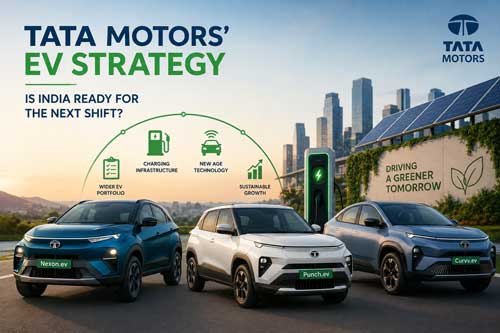
Tata Motors' EV Strategy: Is India Ready for the Next Shift?
Share this article
India's electric-vehicle market is moving from an early-adopter story toward a mainstream automotive transition. For Tata Motors, which established an early lead in electric passenger vehicles, this shift presents both a major opportunity and a new competitive challenge.
The question is no longer whether Indians will buy EVs. The bigger question is how quickly EVs can become a mainstream choice—and whether Tata Motors can defend its lead when competition is getting stronger.
Tata Motors Has Built an Early EV Lead
Tata Motors has spent several years building its EV portfolio around models such as the Nexon.ev, Punch.ev, Tiago.ev and Curvv.ev, followed by the Harrier.ev.
The strategy has produced significant scale. Tata Motors recorded 92,120 electric passenger-vehicle wholesales in FY2026, up 43% from FY2025. Its cumulative EV sales crossed 300,000 units during FY2026.
The company also retained its position as India's largest electric passenger-vehicle manufacturer. In Q1 FY27, Tata.ev held around 39% of India's electric passenger-vehicle registrations, according to VAHAN data.
That leadership matters because Tata has already built manufacturing capabilities, customer familiarity and an expanding charging ecosystem.
But leadership today does not guarantee leadership tomorrow.
India's EV Market Is Finally Getting Larger
India's passenger EV market is showing signs of moving beyond a niche segment.
Electric passenger-vehicle penetration increased from approximately 2.5% in FY25 to 4.5% in FY26, according to Tata Motors Passenger Vehicles management. The company expects penetration to reach around 7.5–8% by the end of FY27.
FY26 also saw India's electric passenger-vehicle registrations rise more than 80%, while the overall passenger-vehicle market reached a record level.
This is an important change.
For years, EV adoption was constrained by high prices, limited charging infrastructure, range concerns and battery-related uncertainty. As products improve and more manufacturers enter the market, consumers are increasingly evaluating EVs as a normal alternative to petrol, diesel, CNG and hybrid vehicles.
The Competition Is Changing Tata's Advantage
Tata Motors' biggest EV advantage was once its lack of serious competition in mass-market electric cars.
That advantage is disappearing.
Mahindra, JSW MG Motor and other manufacturers are expanding their EV portfolios, while Maruti Suzuki has entered the electric SUV segment with the e Vitara.
In Q1 FY27, Tata's EV market share was about 39%, followed by Mahindra at 24.3% and JSW MG Motor at 19.9%. Together, the three manufacturers accounted for more than 83% of electric passenger-vehicle registrations.
The implication is clear: Tata no longer needs to convince consumers that EVs exist; it needs to convince them that its EVs are better.
That requires improvements in range, software, charging convenience, design, performance, safety and ownership experience.
The Next Battle Will Be About Product Quality
Tata's strategy is increasingly moving beyond simply adding EV versions of existing models.
Its corporate strategy calls for a wider EV portfolio across price points and body styles, greater use of dedicated EV architectures, stronger technology and improved charging infrastructure. Tata has also outlined an ambition of reaching 20% EV penetration within its portfolio by FY27 and more than 30% by FY30.
This could be critical.
The next generation of Indian EV buyers may be less willing to compromise simply because a vehicle is electric. They will compare EVs on the same dimensions as conventional cars—and increasingly expect better technology and ownership experience.
The Hidden Challenge: Supply
One of the more interesting developments is that Tata Motors is now reporting situations where EV demand is running ahead of supply.
Management has indicated that demand for the Harrier.ev has been roughly twice the company's available supply, while demand for the updated Punch.ev has also increased sharply.
This creates an unusual problem for an automaker: the immediate challenge may not be generating demand but converting demand into delivered vehicles.
If supply constraints persist, competitors could capture customers who are ready to switch to electric.
Investor Perspective
For investors, EV volumes alone should not be the deciding metric.
The more important questions are whether Tata can maintain healthy margins, reduce battery and component costs, improve manufacturing utilisation and generate attractive returns on the large investments required for EV technology.
Tata's FY2026 corporate financial performance also highlights why capital discipline matters. The company's annual report shows significant investment requirements across new products, software-defined vehicles, advanced technologies and powertrains.
EV leadership is valuable only if it eventually translates into profitable market leadership.
Is India Ready for the Next Shift?
India probably is—but the transition will not happen overnight.
EV adoption is accelerating, but petrol, diesel, CNG and hybrids will continue to coexist for years. India's diverse income levels, charging infrastructure and regional driving patterns make a single-powertrain future unlikely in the immediate term.
That makes Tata Motors' multi-powertrain strategy sensible.
The company does not need every Indian consumer to switch to an EV immediately. It needs to ensure that when consumers do decide to switch, Tata remains one of the strongest choices available.
The next phase of India's EV market will therefore be less about creating awareness and more about winning mainstream consumers.
Tata Motors has built the lead. The real test now is whether it can turn that early advantage into a durable EV franchise before the rest of India's auto industry catches up.
Original Analysis
The central argument is that Tata Motors' EV challenge has shifted from market creation to competitive defence. Rising EV penetration gives Tata a larger opportunity, but growing competition means future success will depend on product quality, supply capacity, margins and return on EV investment—not simply EV sales volume.
Tags