
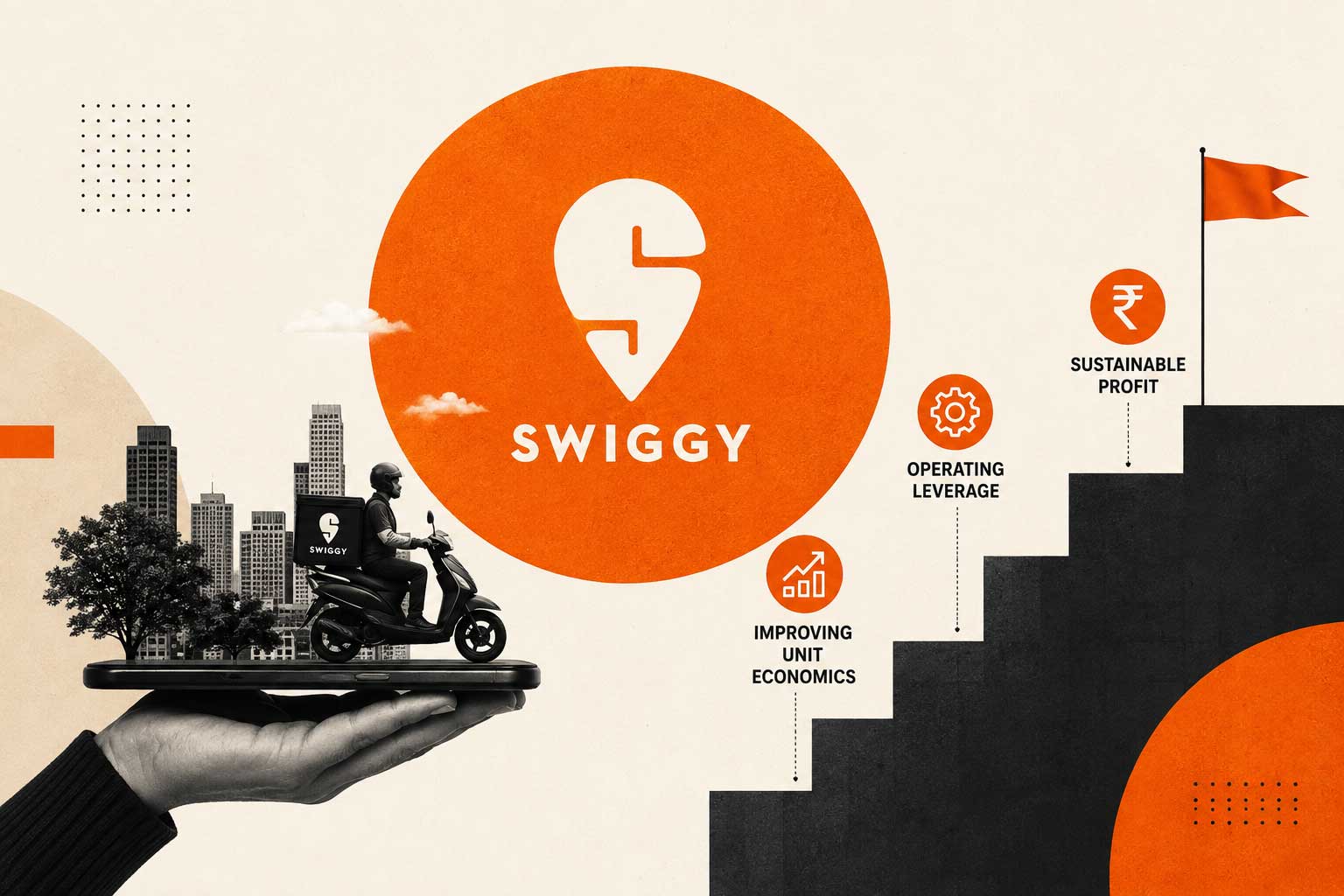
Swiggy’s Next Growth Challenge: Can Scale Deliver Sustainable Profit?
Share this article
Swiggy has spent years proving that Indian consumers will pay for convenience. The harder question now is whether the company can turn that convenience into durable, repeatable and sustainable profit.
That question has become more important as Swiggy enters a new phase. Its food-delivery business has already demonstrated meaningful profitability, while Instamart is rapidly approaching contribution-margin breakeven. At the same time, the company is targeting an extraordinarily ambitious FY31 vision: approximately ₹2.5 lakh crore in consolidated Gross Order Value (GOV) and ₹10,000 crore in adjusted EBITDA.
The numbers suggest that Swiggy is moving from a "growth at any cost" model toward disciplined scale. But there is an important catch: getting bigger is no longer the main challenge. Getting bigger without recreating the costs of the growth race is.
From Growth Story to Profitability Test
Swiggy's FY26 performance provides an important starting point.
For the year ended March 2026, Swiggy's consolidated revenue reached approximately ₹23,053 crore, compared with ₹15,227 crore in FY25. However, the company still reported a consolidated loss of roughly ₹4,154 crore.
That contrast captures Swiggy's central problem.
Revenue is growing rapidly, but revenue growth alone does not guarantee economic value creation.
The company's businesses are also at very different stages of maturity.
Food delivery is increasingly behaving like a mature platform business. Instamart, meanwhile, is still operating in a capital-intensive market where customer acquisition, dark-store expansion, assortment and delivery economics remain critical.
This creates an unusual situation: Swiggy's strongest profit engine and its biggest growth engine are not currently the same business.
Food Delivery Has Already Shown the Model Can Work
Swiggy's food-delivery operation is arguably the clearest evidence that scale can eventually improve economics.
In Q4 FY26, food-delivery GOV grew 22.6% year over year to ₹9,005 crore, while adjusted EBITDA reached ₹297 crore. The business's adjusted EBITDA margin improved to 3.3% of GOV.
That is significant because food delivery was once widely viewed as structurally difficult to make profitable.
The improvement comes from several factors:
Greater order density
Larger baskets
Better delivery utilization
Advertising revenue
Higher customer engagement
Operational efficiencies
More disciplined spending
Swiggy's FY25 annual report had already shown the direction of travel: food delivery GOV increased 16.4%, while the business achieved its first full-year profitability with an adjusted EBITDA margin of 2%.
The lesson is important: scale can create profitability when incremental orders improve utilization faster than incremental costs.
But this lesson cannot automatically be transferred to quick commerce.
Instamart Is the Real Profitability Test
Instamart is where Swiggy's next chapter will be decided.
Quick commerce requires a fundamentally different cost structure. Instead of simply matching restaurants and consumers, Swiggy has to maintain a network of dark stores, inventory, employees, technology, logistics and increasingly broad product categories.
That makes scale both an advantage and a potential trap.
In Q4 FY26, Instamart's GOV increased 68.8% year over year to ₹7,881 crore. Average order value rose 32.8% to ₹700, while contribution margin improved to -1.8% of GOV. Yet the business still recorded an adjusted EBITDA loss of ₹858 crore during the quarter.
This tells us something investors should pay close attention to:
Instamart is getting better at the order level, but the business is not yet fully profitable at the operating level.
That distinction matters.
Contribution-margin improvement is encouraging because it suggests the basic economics of fulfilling an order are becoming healthier. But corporate profitability requires much more than contribution margin.
The Break-Even Number That Matters
By Q1 FY27, Swiggy reported another major improvement.
Instamart's GOV reached ₹7,907 crore, up 40% year over year, while contribution margin improved to -0.2% of GOV. Swiggy said revenue per order had increased by ₹25 and cost per order had fallen by ₹3 since Q4 FY25. More than 45% of its store network was contribution-margin positive.
That is arguably more important than simply looking at GOV growth.
A company can grow GOV by opening hundreds of stores and spending heavily on promotions. A more valuable form of growth is when each additional unit becomes economically stronger.
Swiggy says EBITDA breakeven for Instamart requires roughly another 2.5x scale-up and an improvement in contribution margin from -0.2% toward approximately 4%.
That is the real test.
If Swiggy can achieve that improvement without dramatically increasing customer subsidies or capital expenditure, the profitability story becomes considerably more credible.
Swiggy's New Strategy: Stop Chasing Growth for Its Own Sake
The company's strategy appears to be changing.
At its August 2026 Capital Markets Day, Swiggy outlined a FY31 target of approximately ₹2.5 lakh crore consolidated GOV and ₹10,000 crore adjusted EBITDA. That implies more than 30% annual GOV growth while targeting an adjusted EBITDA margin of around 4% of GOV.
That is an aggressive target.
But there is a subtle difference between Swiggy's current ambition and the earlier quick-commerce race.
The company is increasingly emphasizing unit economics, network density, affordability and operating leverage, rather than simply adding stores and maximizing geographic reach.
For Instamart, Swiggy is targeting ₹1.5 lakh crore-plus GOV by FY31, compared with approximately ₹28,000 crore in FY26.
The implication is clear: management believes that much of the future profit will come from the combination of scale + better economics, rather than scale alone.
The Inventory Question Could Change Instamart
One of the most important developments is Instamart's planned transition toward an inventory-led model.
Reuters reported in August 2026 that Swiggy's quick-commerce business is moving from a marketplace structure toward an inventory-led approach following changes to its foreign ownership structure. The objective is to improve purchasing economics, inventory control, data utilization and wastage management.
This could become a meaningful structural advantage.
An inventory-led model can potentially give Swiggy more control over:
Product sourcing
Bulk purchasing
Inventory allocation
Pricing
Private labels
Assortment
Promotions
Wastage
But it also introduces a risk that is easy to overlook.
Better gross economics can come with greater working-capital requirements and inventory risk.
In other words, improving contribution margin does not automatically mean improving return on capital.
That is one of the most important metrics investors should watch as Instamart evolves.
The Blinkit Comparison Is Unavoidable
Swiggy is not trying to solve this problem in isolation.
Its biggest quick-commerce competitors, particularly Blinkit and Zepto, are competing for the same customers, stores, delivery partners and product categories.
This creates a dangerous possibility: if every company keeps expanding assortment, dark stores and discounts simultaneously, industry-wide economics could remain under pressure even as individual companies become more efficient.
Swiggy therefore needs something more than market share.
It needs structural differentiation.
That could come from its food-delivery customer base, cross-selling between food and quick commerce, advertising, higher-value categories, private labels and improved inventory economics.
The company's large existing consumer ecosystem could become one of its most valuable advantages.
The Hidden Asset: Cross-Platform Customers
Swiggy's food business and Instamart should not be viewed entirely as separate businesses.
The same customer may order lunch through Swiggy Food, groceries through Instamart and use Dineout for a restaurant experience.
That creates opportunities to lower customer acquisition costs and increase wallet share.
Swiggy reported 25.2 million platform monthly transacting users in FY26, up 27.2% year over year.
The strategic question is therefore not simply:
"How many Instamart orders can Swiggy generate?"
It is:
"How much more economic value can Swiggy generate from customers it already has?"
That is a much more powerful question.
The Investor Perspective: Watch Profit Quality, Not Just Profit
For investors, Swiggy's future should not be judged primarily by GOV growth.
Three indicators deserve greater attention.
1. Contribution Margin
Instamart's movement from -1.8% in Q4 FY26 to -0.2% in Q1 FY27 is encouraging.
But investors should ask whether this improvement continues without extraordinary promotional spending or temporary cost benefits.
2. EBITDA Conversion
The ultimate objective is not contribution-margin breakeven.
It is turning contribution profit into EBITDA and eventually free cash flow.
If Instamart reaches contribution breakeven but requires large ongoing investments in stores, employees and inventory, the economics may remain less attractive than the headline suggests.
3. Return on Capital
This may become the most overlooked metric.
A business that produces ₹100 crore of incremental EBITDA after investing ₹1,000 crore is fundamentally different from one that produces the same EBITDA after investing ₹200 crore.
Swiggy's next phase should therefore be evaluated on incremental returns, not simply absolute growth.
What Could Go Wrong?
Swiggy's plan is credible, but it is far from guaranteed.
The biggest risks include:
Quick-commerce price competition: Aggressive competitors can force Swiggy to sacrifice margins to protect market share.
Dark-store economics: More stores do not necessarily mean better economics if demand is insufficiently dense.
Customer subsidies: If consumers remain highly promotion-sensitive, sustainable pricing power could remain limited.
Inventory risk: The inventory-led model may improve purchasing economics but exposes Swiggy to working-capital and wastage risks.
Slower consumer spending: A weaker discretionary environment could reduce order frequency and basket sizes.
Capital allocation: Rapid expansion can destroy shareholder value if growth requires disproportionate capital.
These risks matter because Swiggy's FY31 targets require both very high growth and simultaneously improving margins.
Usually, one gets harder as the other gets bigger.
The Bigger Industry Implication
Swiggy's journey could become a test case for India's entire consumer-internet sector.
For years, startups were primarily valued on user growth, order growth and market share.
The next phase will be different.
Investors increasingly want to know:
Does each customer become more valuable over time?
Does each store become more productive?
Does each order generate more contribution?
Does additional revenue require proportionally less capital?
Does EBITDA eventually turn into cash?
That represents a fundamental change in India's internet economy.
Scale is becoming the starting point for profitability analysis—not the conclusion.
Can Swiggy Finally Make Scale Sustainable?
The answer is increasingly yes—but not yet proven.
Swiggy has already demonstrated that its food-delivery business can become profitable at scale. Its latest numbers also show that Instamart's unit economics are improving much faster than they were a year earlier. The company's cash position gives it room to continue investing, while management is explicitly targeting a shift toward profitable growth.
But the hardest part comes next.
Swiggy must prove that it can grow Instamart several times over while simultaneously improving margins, controlling capital requirements and resisting a renewed race for uneconomic market share.
Its FY31 ambition of ₹10,000 crore adjusted EBITDA is therefore less a prediction than a five-year test of operating discipline.
The most important question for Swiggy is no longer:
Can it become bigger?
It almost certainly can.
The more difficult question is:
Can every additional layer of scale make the business economically stronger rather than simply larger?
If the answer is yes, Swiggy could evolve from a high-growth consumer platform into a genuinely profitable consumer-internet company.
If the answer is no, the company may discover that in quick commerce, scale can amplify losses just as efficiently as it can amplify profits.
Primary Sources & Data Note
This analysis uses Swiggy's FY25 annual report, FY26 results and FY27 Capital Markets Day disclosures as primary-source references, supplemented by Reuters reporting for the Instamart business-model transition. Swiggy's investor-relations page provides its annual reports, quarterly financial statements and Capital Markets Day materials.
Author's Analysis: The central argument of this article is that Swiggy's next challenge is not customer or order growth alone, but the quality of incremental growth—particularly contribution margin, EBITDA conversion and return on incremental capital.
Tags