
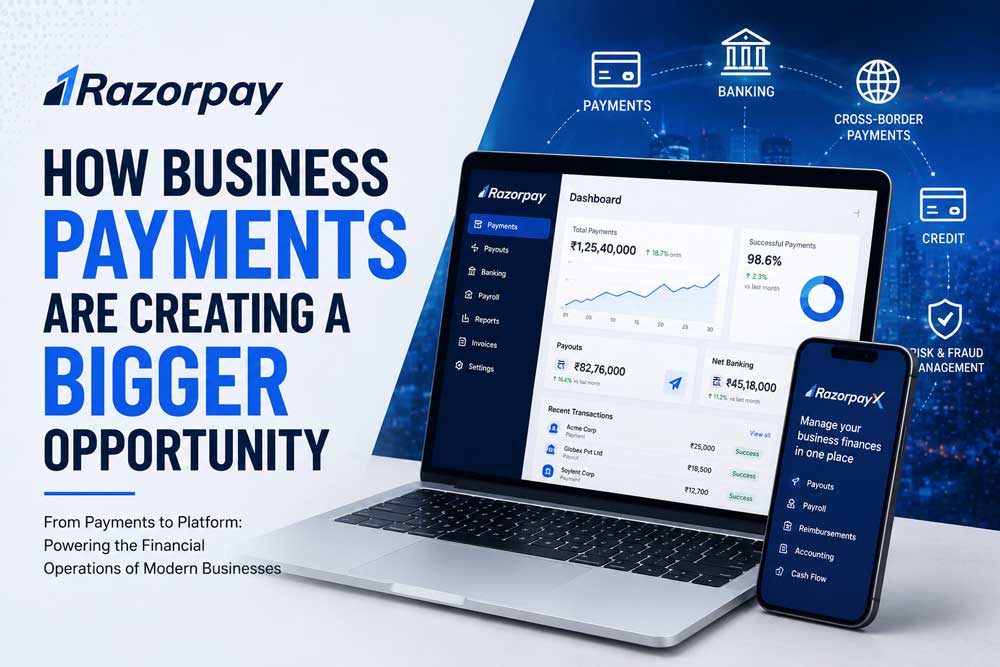
Razorpay: How Business Payments Are Creating a Bigger Opportunity
Share this article
India's digital payments boom created an enormous opportunity for fintech companies. But the next phase may be less about helping consumers pay and more about helping businesses manage money.
Razorpay is positioning itself for that shift.
The company started as a payment gateway for online businesses. Today, its platform spans payments, payouts, business banking, payroll, credit, fraud management and international transactions.
The strategic question is no longer whether Razorpay can process payments at scale.
It is whether payments can become the entry point to a much larger business-finance platform.
Payments Create the Distribution
Payments are one of the most valuable relationships a fintech can have with a business because transactions happen repeatedly.
Every payment gives a provider an opportunity to offer additional services.
Razorpay has used this advantage to build products around collections, payouts, reconciliation and financial operations. Its business payments platform is designed to handle the complete payment cycle rather than simply process a transaction.
This creates a potentially powerful model:
Payments → Business data → Financial services → Higher revenue per customer.
The more deeply Razorpay becomes embedded in a company's financial workflow, the harder it becomes for that customer to switch providers.
The Bigger Opportunity Is Business Infrastructure
Razorpay's expansion into RazorpayX shows where the company sees its future.
Businesses can use the platform for payouts, payroll, cash-flow management, vendor payments and other financial processes.
This changes the economics of the business.
A payment gateway primarily earns from transactions.
A broader financial platform can potentially earn from multiple workflows used by the same customer.
That increases customer lifetime value and creates opportunities for recurring revenue.
Scale Is Already Significant
Razorpay's FY25 consolidated revenue increased 65% to ₹3,783 crore, compared with ₹2,296 crore in FY24. Gross profit increased 41% to ₹1,277 crore.
The company nevertheless reported a ₹1,209 crore net loss, largely because of employee stock ownership expenses and costs associated with shifting its corporate structure back to India.
The numbers reveal an important distinction.
Razorpay has demonstrated strong revenue growth, but sustainable profitability remains the bigger test.
Cross-Border Payments Could Expand the Market
One of Razorpay's most interesting opportunities is helping Indian businesses sell internationally.
In December 2025, the company received the RBI's Payment Aggregator–Cross Border licence, allowing it to facilitate inward and outward cross-border payments under the regulatory framework.
Its cross-border business was growing at around 40% year over year, according to the company.
That matters because Indian startups, SaaS companies, exporters and digital brands increasingly operate globally.
If Razorpay becomes the financial infrastructure behind those businesses, its addressable market becomes much larger than domestic checkout.
AI Could Change Business Payments Again
Razorpay is also experimenting with AI-driven financial operations.
Its RazorpayX platform introduced AI agents for payouts, collections and cash-flow management, allowing businesses to initiate financial workflows through conversational instructions.
This points toward a future where businesses may not simply use fintech software to monitor transactions.
They may use AI agents to execute financial operations automatically.
That could make business payments significantly more valuable—and potentially more defensible.
Investor Perspective
For investors, the key metrics are not just transaction volume.
They should watch:
Revenue growth
Payment processing profitability
Revenue per business
RazorpayX adoption
Cross-border volumes
Credit performance
Customer retention
Operating margins
Cash generation
Razorpay's reported financial growth is encouraging, but its broader product strategy still needs to prove that additional services can produce attractive margins.
The Bigger Opportunity
Razorpay's strongest opportunity may ultimately be to become the financial operating system for Indian businesses.
Payments provide the initial relationship.
Banking, payouts, payroll, credit, international payments and AI can expand that relationship.
The company therefore does not need to win every individual payment market.
It needs to become so deeply embedded in business operations that replacing Razorpay becomes difficult.
The next chapter of Razorpay may not be about processing more payments. It could be about owning more of the financial infrastructure that businesses depend on every day.
Original Analysis
Razorpay's strategic advantage is shifting from transaction processing to workflow ownership. If it can successfully connect payments with banking, payouts, credit, cross-border transactions and AI automation, each business relationship could become significantly more valuable than a conventional payment-gateway account.
Tags