
Infosys & AI Transition Rebuilding IT Value
Share this article
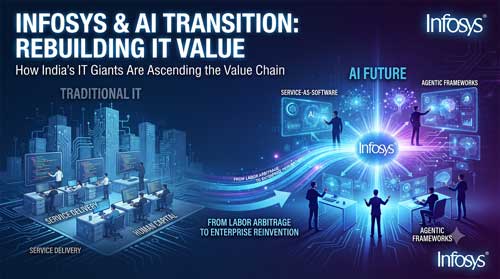
For decades, the business model of India’s IT titans was built on a straightforward premise: scale, labor arbitrage, and human capital. Enterprises across the globe outsourced application development, maintenance, and infrastructure management to tap into massive pools of skilled Indian engineers, driving down costs through linear billing models. Today, that bedrock value proposition is undergoing a radical disruption. The mainstreaming of generative and agentic artificial intelligence threatens the traditional "headcount-times-billing-rate" equation. In response, giants like Infosys are aggressively rebuilding their core identity, anchoring their future in an AI-first, value-driven framework.
The economic engine of IT services is rapidly decoupling from human headcount. When basic coding, software testing, and routine maintenance can be automated or handled autonomously by goal-driven AI agents, charging clients strictly by the man-hour loses its commercial logic. To stay ahead of this deflationary cycle, Infosys introduced Infosys Topaz, an extensive suite of AI-first services and enterprise AI assets designed to accelerate business value. Instead of offering teams of junior developers to write boilerplate code, the company packages its offerings into productized solutions, mirroring a broader industry migration toward Service-as-Software and outcome-based pricing models.
Company-specific data highlights how quickly this transition is materializing on financial balance sheets. Infosys reported that AI-driven revenues reached 8.2% of total revenues, backed by strong large-deal Total Contract Value (TCV) wins. Rather than cannibalizing top-line growth, AI integration has become a primary wedge for winning multi-million-dollar mandates. Global enterprises possess vast proprietary data estates but lack internal guardrails to scale automation safely. By focusing heavily on the enterprise AI control plane—securing data layers and ensuring compliance through responsible-by-design architectures—Infosys is capitalizing on this gap, acting as the architect that securely plugs AI models into legacy systems.
From an investor perspective, the AI transition initially sparked fears of margin compression and declining utilization rates for traditional IT. However, early financial disclosures disprove this narrative. Infosys maintained a resilient operating margin of 21.1% while scaling high-value consulting, digital transformation mandates, and proprietary platforms that command superior pricing power. High-margin non-linear revenue streams are successfully offsetting the contraction of legacy application maintenance hours.
Ultimately, Infosys' transition highlights a mature evolution. The company is successfully pivoting from being a vendor of human capital to becoming an indispensable strategic co-pilot for enterprise reinvention. By marrying deep domain expertise with autonomous agentic architectures, India’s IT bellwethers are proving that their value proposition is not fading—it is simply ascending the value chain.
Tags