
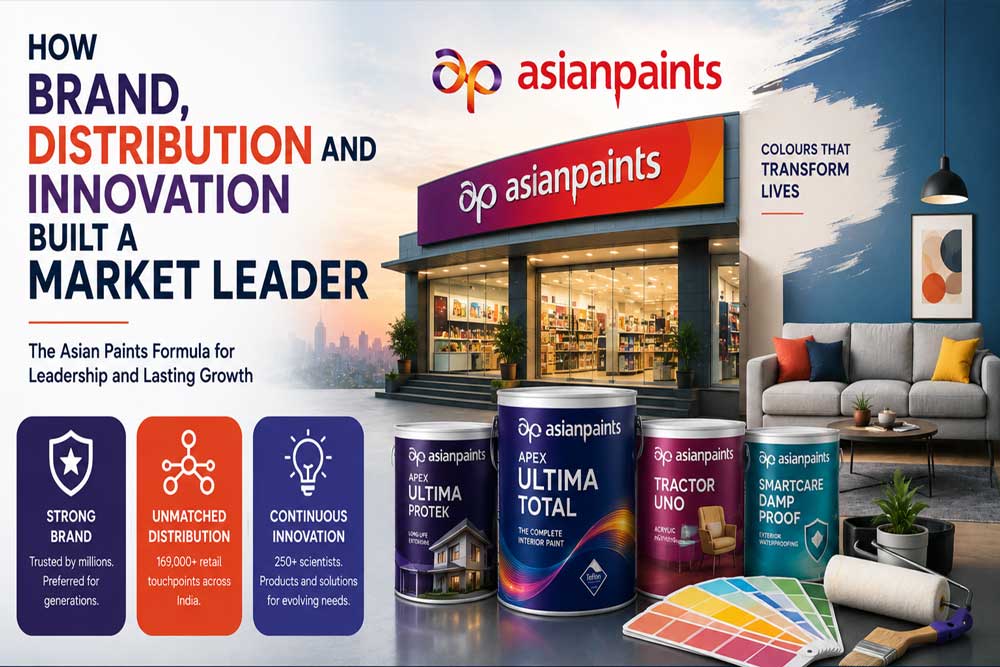
Asian Paints - How Brand, Distribution and Innovation Built a Market Leader
Share this article
Asian Paints is one of India's strongest examples of how a company can turn an ordinary consumer product into a powerful brand and distribution business.
Paint is a relatively low-frequency purchase. Consumers may buy it only when constructing, renovating or repainting a home. Yet Asian Paints has built a business that reaches millions of households and has maintained its leadership for decades.
The company's success is not simply about selling better paint.
It is about owning the customer relationship, controlling distribution and continuously expanding what the brand represents.
Brand Became the First Competitive Advantage
Asian Paints transformed paint from a largely functional product into an emotional category.
Its advertising connected colours with homes, celebrations, aspirations and personal identity. This helped make the brand relevant to consumers rather than leaving the purchase decision entirely to painters, contractors or retailers.
That distinction matters.
A strong consumer brand creates demand before a customer enters the store. Asian Paints' marketing therefore became an important complement to its distribution network.
The company's latest annual report describes its strategy as moving from simply being "present on the shelf" to building a meaningful place in consumers' minds. (Asian Paints)
Distribution Created the Real Moat
Brand awareness alone does not guarantee market leadership.
Paint must be available when customers need it, often across thousands of cities and towns. Asian Paints built an extensive distribution system that has historically been difficult for competitors to replicate.
In FY2024-25, the company reported more than 169,000 retail touchpoints across India. It also operated 72 Beautiful Homes stores and had installed decorative paint manufacturing capacity of approximately 2.29 million kilolitres per year in India.
This creates a powerful combination:
The brand creates preference. Distribution converts preference into sales.
A competitor can launch a new paint product relatively quickly. Replicating a nationwide network of retailers, supply infrastructure, manufacturing capacity and relationships is considerably harder.
Innovation Keeps the Brand Relevant
Asian Paints has also treated innovation as more than launching new colours.
Its portfolio now covers interior and exterior paints, waterproofing, wood finishes, adhesives, textures and other products. The company has increasingly moved into home décor and services as well.
Its FY2025-26 annual report identifies innovation, services, B2B expansion and backward integration as key growth accelerators.
The company's investment in research is another part of this strategy. Asian Paints reports more than 250 scientists globally, supporting product development and technology initiatives.
The strategic idea is straightforward: if the consumer's needs are changing, the company should expand beyond the traditional definition of paint.
From Paint to Home Décor
This may be the most important evolution in Asian Paints' strategy.
The company is gradually positioning itself as a broader home-improvement and décor platform.
Its offerings now extend into modular kitchens, wardrobes, lighting, bath fittings, sanitaryware, windows, furniture, fabrics and furnishings.
This expansion creates an opportunity to increase the value of each customer relationship.
A customer who originally entered the Asian Paints ecosystem to repaint a house could potentially purchase several additional products and services from the same company.
The risk, however, is that moving into new categories can dilute management focus and introduce businesses with different economics.
The Current Numbers Tell an Interesting Story
Asian Paints faced a challenging FY2024-25, with standalone revenue from products and services declining to ₹29,421 crore from ₹31,094 crore and EBITDA falling to ₹6,322 crore.
But the latest numbers suggest improvement.
In Q1 FY2026-27, consolidated net sales rose 17.9% to ₹10,521.4 crore, while consolidated net profit increased 40% to ₹1,539.3 crore.
That recovery is important because market leadership becomes more valuable when it survives periods of weak demand and competitive pressure.
Investor Perspective
For investors, Asian Paints should not be evaluated only as a paint manufacturer.
Its long-term value comes from the combination of brand equity, distribution density, manufacturing scale, customer relationships and innovation capabilities.
The critical question now is whether these advantages can continue producing attractive returns as competition intensifies and the company moves deeper into home décor.
Asian Paints reported 28.9% return on capital employed in FY2025-26, demonstrating that its capital-intensive operations can still generate strong returns.
That is arguably more important than short-term revenue growth.
The Bigger Industry Lesson
Asian Paints demonstrates an important principle of consumer business:
A market leader is rarely built by one advantage.
Brand without distribution creates awareness without availability.
Distribution without brand can become a commodity business.
Innovation without scale can struggle to reach consumers.
Asian Paints combined all three.
Its next challenge is to ensure that the same formula works beyond paint.
If it can successfully use its brand and distribution network to become a larger home-improvement ecosystem while maintaining strong returns, its competitive moat could become even wider.
The company's greatest achievement may therefore not be becoming India's leading paint company.
It may be turning paint into the entry point for a much larger consumer relationship.
Original Analysis
The central argument is that Asian Paints' leadership was built through the interaction of brand pull, distribution depth and continuous innovation. Its next growth opportunity lies in monetising that ecosystem beyond paint, while preserving the capital efficiency that made the core business successful.
Tags