
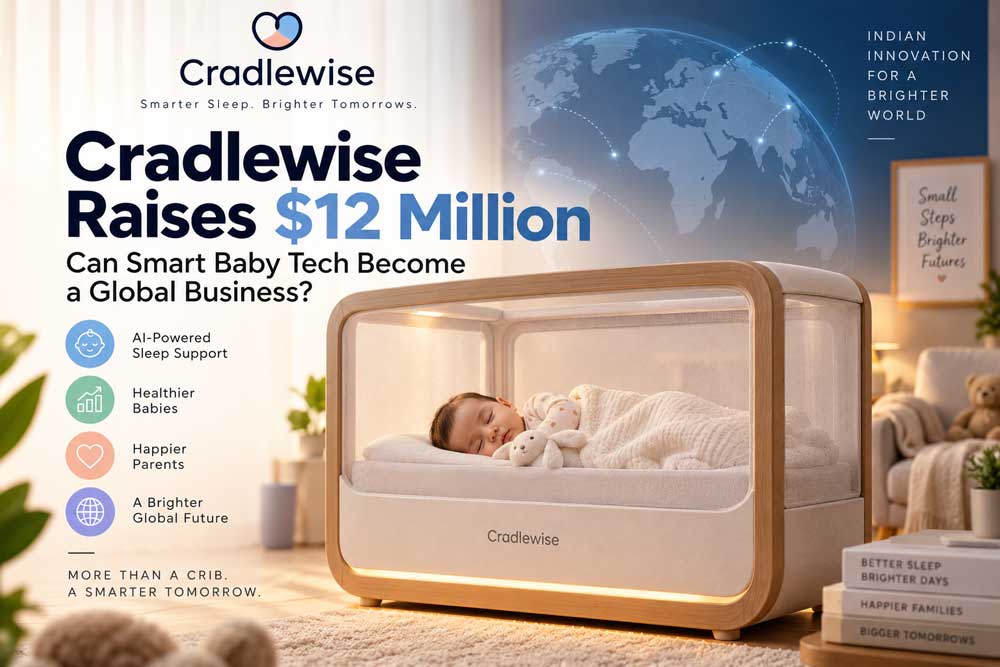
Cradlewise’s $12 Million Bet: Can Smart Baby Tech Become a Global Business?
Share this article
A smart crib sounds like a niche product. Cradlewise is betting it can become something much bigger: a technology platform for parents that combines hardware, artificial intelligence and recurring digital services.
The San Francisco- and Pune-based startup has raised $12 million in Series A funding, led by 3one4 Capital and Prudent Investment Management. The new capital will support product development, distribution and international expansion. Cradlewise says its total funding has reached $26 million.
The bigger question is whether a premium connected baby product can become a global business rather than remain a high-end consumer gadget.
A Product Built Around a Painful Problem
Founded by Radhika Patil and Bharath Patil, Cradlewise developed an AI-enabled crib that monitors movement, sound and sleep patterns and automatically responds when a baby begins stirring.
The company says its technology has processed more than 75 million hours of sleep data, while its Pune facility can manufacture, test and pack thousands of cribs each month.
That combination is important.
Cradlewise is not simply importing electronics and attaching an app. It is building proprietary hardware, sensing technology and manufacturing capabilities around a specific parenting problem.
The Business Model Is Becoming More Interesting
The company's product can create a relationship with customers that extends beyond the initial hardware purchase.
Its connected software can support sleep tracking and personalised routines, while the company plans to introduce additional sleep-related products and lower-priced entry points.
That creates the possibility of a broader smart parenting ecosystem rather than a one-time crib sale.
Parents can explore the company's product ecosystem through Cradlewise, but the commercial challenge remains significant: premium hardware requires customers to accept a much higher upfront cost than conventional baby furniture.
Why the Global Market Matters
Cradlewise is already focused heavily on international customers, particularly the United States, and the new funding will support geographic expansion.
This may actually be one of the company's biggest advantages.
India can provide engineering and manufacturing capabilities, while affluent international markets can provide customers willing to pay for technology that saves time and reduces parental stress.
The company is effectively trying to build a global consumer brand from an India-linked manufacturing base.
The Hard Part Comes Next
The funding creates room for growth, but important numbers remain unclear.
Public reporting does not provide a complete picture of current revenue, gross margins, customer-acquisition costs, subscription conversion or cash burn.
Those metrics will determine whether Cradlewise is building a scalable business or simply an impressive product.
There is also a broader challenge: baby products involve safety, trust and short customer lifecycles. A crib may serve a family for roughly the first two years, so the company must continually expand its relationship with customers.
The Business Lesson
Cradlewise's opportunity is not really about selling smarter cribs.
It is about proving that hardware can become the entry point to a long-term consumer technology platform.
If it succeeds, the $12 million round could finance the transition from a niche smart-baby product into a global child-sleep company.
If it fails, the lesson will be equally important: great technology does not automatically create great consumer economics.
Tags