
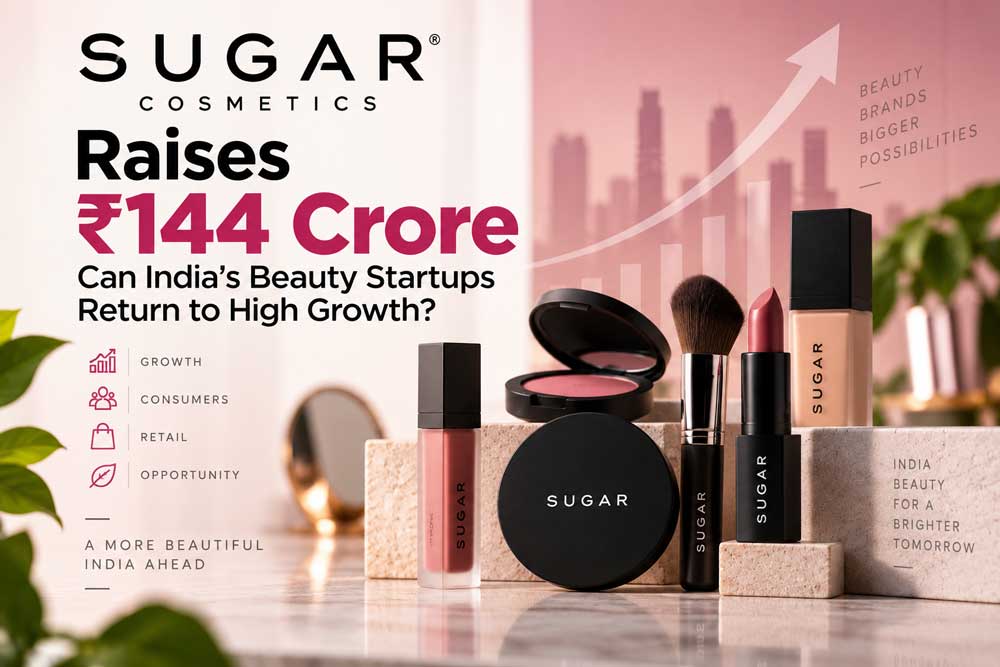
SUGAR Cosmetics Raises ₹144 Crore: Can India's Beauty Startups Return to High Growth?
Share this article
For years, SUGAR Cosmetics represented the promise of India’s D2C beauty boom: a young brand, a strong digital identity and a consumer category large enough to support rapid expansion.
Its latest funding round tells a more complicated story.
SUGAR has raised ₹144.47 crore from A91 Partners, but the bigger development is the sharp reset in its valuation. Recent reporting based on regulatory filings puts the company's latest valuation at roughly ₹550–600 crore, compared with ₹2,600–2,700 crore in November 2024 and a peak of around ₹3,000 crore in 2022.
The funding is therefore not simply a growth round. It is also a test of whether SUGAR can rebuild its economics.
From D2C Growth to a Difficult Reality
Founded in 2015 by Vineeta Singh and Kaushik Mukherjee, SUGAR built its position around cosmetics designed for Indian consumers and expanded through its website, e-commerce platforms and physical retail.
The strategy worked during the rapid expansion of India's D2C market.
But scale brought new problems.
In FY25, SUGAR's operating revenue fell approximately 20% to ₹404.4 crore, from ₹505.1 crore the previous year. Its net loss almost doubled to ₹135 crore, while EBITDA loss widened to ₹116 crore.
That combination is more concerning than a simple slowdown.
Revenue declined while losses increased.
Where Did the Model Go Wrong?
One important factor appears to have been aggressive offline expansion.
According to reporting by Inc42, SUGAR had to shut 30–40% of the physical stores it opened because of losses at the store level.
This highlights a common D2C problem.
Online distribution can scale relatively quickly because the company does not need to operate hundreds of individual locations. Physical retail provides visibility and customer experience, but every store introduces rent, employees, inventory and local operating costs.
For a beauty brand, the question is therefore not simply how many stores can be opened, but how much profitable demand each store can generate.
Can Beauty Return to High Growth?
India's beauty market remains attractive, and SUGAR is not starting from zero. The company has built brand recognition, a sizeable customer base and multiple product categories. It has also raised roughly $90 million from investors over its life. (Inc42 Media)
Its A91 Partners investment provides additional capital to attempt a turnaround.
But capital alone will not restore the old growth trajectory.
SUGAR now needs to answer three questions:
Can revenue return to growth?
Can retail become profitable?
Can new products generate repeat purchases without excessive marketing spending?
The Bigger Consumer Startup Lesson
The SUGAR story reflects a broader transition in Indian beauty.
The first D2C phase rewarded speed, customer acquisition and brand visibility.
The next phase will reward repeat purchases, product differentiation, efficient distribution and profitability.
SUGAR still has a path back to growth. But it is unlikely to look like its earlier hypergrowth phase.
The real turnaround will begin when SUGAR can demonstrate that every additional rupee of revenue creates more—not less—economic value.
Tags