
Quibi: Why Millions in Funding Couldn't Save the Streaming Startup
Share this article
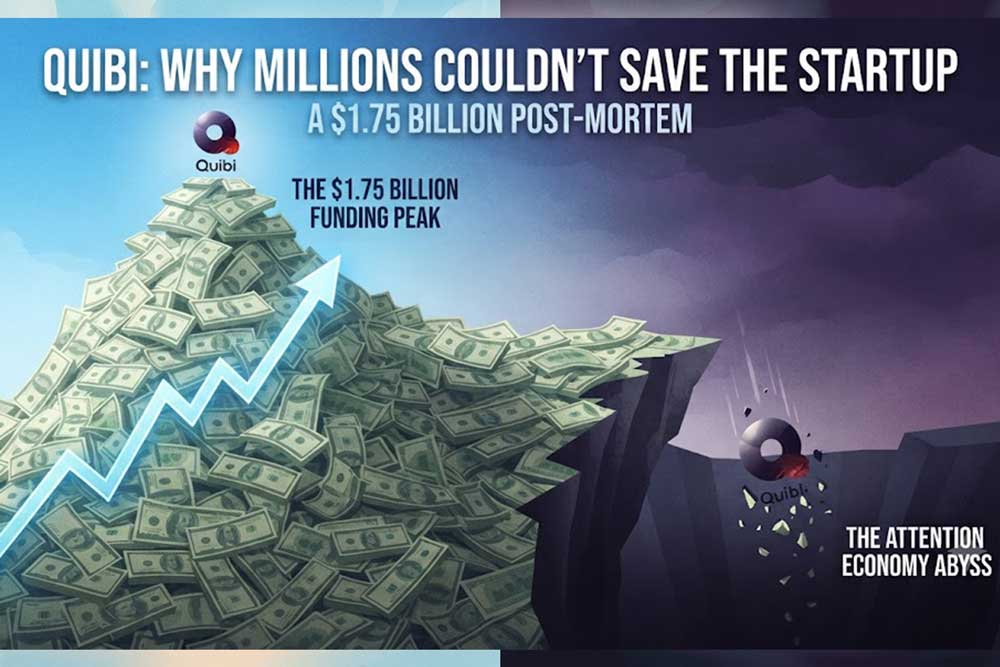
Launched with an eye-popping $1.75 billion in pre-launch capital, Quibi entered the market in April 2020 aiming to pioneer a brand-new digital category: "quick bites" of premium, Hollywood-produced video designed exclusively for smartphones. Founded by media mogul Jeffrey Katzenberg and led by tech veteran Meg Whitman, the startup boasted elite backing from major film studios and massive media fanfare. Yet, despite its heavy financial artillery, the company shut down its operations a mere six months later. Quibi’s rapid collapse provides a stark textbook study in how elite pedigree and abundant capital cannot override a fundamental misalignment with consumer behavior.
The Problem and the Capital Influx
Quibi’s premise was built on a specific behavioral observation: people spent hours staring at mobile devices while commuting, waiting in lines, or taking short breaks. Katzenberg theorized that there was a massive untapped market for high-production-value scripted entertainment broken down into chapters under 10 minutes.
To turn this vision into reality, the company raised a staggering $1.75 billion from major Hollywood studios, telecommunications giants, and venture investors. However, this massive capital accumulation created a false sense of security. Rather than testing a minimum viable product (MVP) or validating demand on a smaller scale, management burned through hundreds of millions on elite Hollywood talent and expensive original content before the platform ever saw its first day in the open market. For a broader look at how capital deployment impacts early enterprise milestones, explore our guide on startup funding strategies.
Business Model Flaws and Strategic Rigidities
Quibi’s foundational business model suffered from severe structural and economic miscalculations:
The Subscription Mismatch: Quibi chose a paid subscription model—charging $4.99 with ads and $7.99 ad-free—placing it in direct financial comparison with mature, broad-library streaming giants like Netflix and Disney+. Consumers struggled to justify paying a monthly fee for short-form video when platforms like YouTube, TikTok, and Instagram offered vast libraries of short-form content entirely for free.
Mobile-Only Confinement: The platform enforced a rigid mobile-only design. Users could not cast content to living room televisions or share clips easily on social media. This technological restriction isolated the platform from broader viewing habits.
The Pandemic Timing Shock: Debuting right as global COVID-19 lockdowns took effect, Quibi's core premise evaporated overnight. With populations confined to their homes, the demand for on-the-go, commute-friendly bite-sized entertainment plummeted as consumers pivoted toward large-screen televisions and long-form streaming services.
The Competitive Landscape
Quibi found itself caught in a devastating crossfire between two distinct media categories. On one side, it competed for user attention against free, user-generated short-form platforms like TikTok and YouTube, which relied on network effects and authentic content creation. On the other side, it competed against deep-pocketed subscription streaming services offering hundreds of hours of immersive television and cinema. Because Quibi lacked social sharing functionality and interactive community loops, it failed to build the viral retention loops necessary to sustain user habits.
Risks, Investor Perspective, and What’s Next
From an investor perspective, Quibi serves as a cautionary tale about capital allocation and "escalation of commitment." When user acquisition metrics severely missed internal projections—tracking toward roughly 2 million first-year subscribers against a target of 7.4 million—leadership recognized that spending more money would not alter the trajectory.
In a rare display of swift damage control, management pulled the plug in October 2020 and returned remaining capital to investors while selling its content library to Roku for a fraction of its cost. The core lesson for modern founders is absolute: capital can accelerate distribution and production, but it cannot manufacture demand for a solution to a problem consumers do not have.
Sources & References
Company Investor Relations & Corporate Actions: Official Corporate Announcements and Wind-Down Notices by Quibi Holdings, LLC.
Secondary Financial & Market Media: The Wall Street Journal – Quibi Shutting Down Just Six Months After Launch.
Industry & Startup Analysis: Babson College Entrepreneurship Research – The Lessons Learned from a $1.7 Billion Failure.
Market Research & Historical Data: Wikipedia – Quibi Corporate History, Funding, and Asset Sale to Roku.
Tags