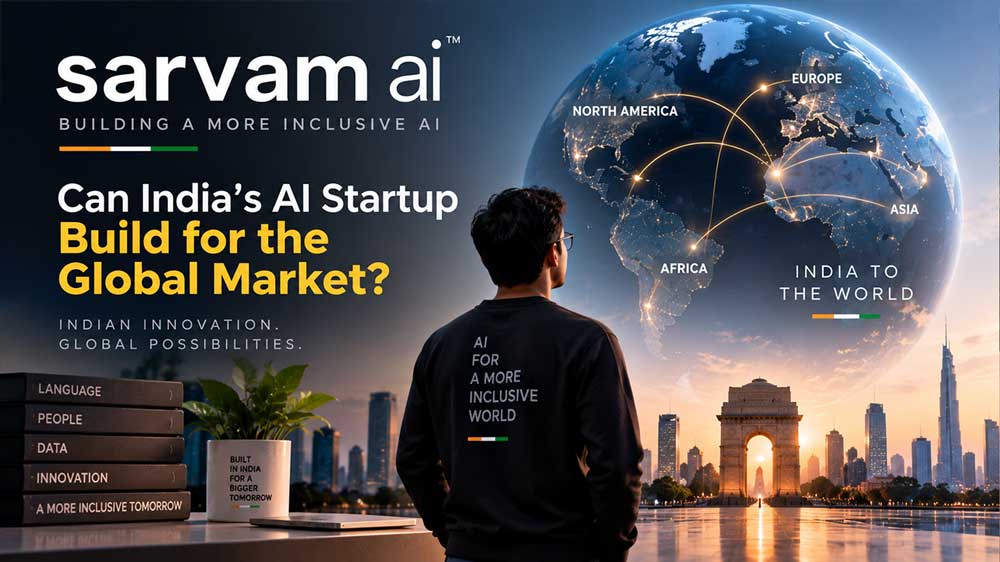
Sarvam AI: Can India's AI Startup Go Global?
Share this article
India's artificial intelligence ambitions are increasingly moving beyond adopting models built elsewhere. Sarvam AI is trying to build foundational models, infrastructure and enterprise applications in India—and then take that technology beyond the Indian market.
Founded in 2023 by Vivek Raghavan and Pratyush Kumar, Sarvam describes itself as a full-stack sovereign AI company focused on models, infrastructure and applications designed around Indian languages and institutional requirements.
The bigger business question is no longer whether Sarvam can build AI for India. It is whether an India-first AI strategy can become a globally competitive business.
From Indian-Language AI to a Full-Stack Platform
Sarvam initially differentiated itself around India's linguistic diversity and the need for AI that could work across Indian languages, accents and local contexts.
Its current platform extends considerably further. Sarvam offers large language models, speech recognition, text-to-speech, translation, document intelligence, vision capabilities and AI agents. Its model portfolio includes Sarvam 30B, Sarvam 105B, Saaras V3, Bulbul V3 and Sarvam Vision.
That expansion matters strategically.
A company focused only on Indian-language models could remain a specialized regional provider. A company that owns models, inference infrastructure, APIs and enterprise applications has a larger opportunity to capture value across the AI stack.
Sarvam's own positioning reflects this broader ambition through its full-stack sovereign AI platform.
The Funding Gives Sarvam Room to Play a Bigger Game
In June 2026, Sarvam announced the first close of a $300 million Series B, raising $234 million at a post-money valuation of $1.5 billion.
HCLTech committed $150 million as the lead strategic investor, while existing investors including Khosla Ventures and Peak XV Partners continued their support. Sarvam said the capital would fund frontier-model research, compute, infrastructure and expansion of its enterprise and developer business. (Sarvam AI)
The company subsequently attracted an additional Nvidia investment, taking the reported financing for the round to roughly $309 million and the valuation to about $1.51 billion, according to The New Indian Express.
For an AI company, this capital is particularly important because frontier-model development requires expensive computing infrastructure, researchers and engineering talent.
Sarvam's founders have said the new funding will help the company recruit experienced AI researchers and expand its computing capacity. The company also planned a San Francisco office to access the global AI talent pool.
Why the Global Market Is a Different Challenge
Building an AI company for India and building one for the world are two different problems.
Global AI markets already include companies with enormous computing budgets, established developer ecosystems, cloud infrastructure and millions of users.
Sarvam therefore cannot compete simply by building another general-purpose chatbot.
Its more distinctive proposition is localisation plus control.
The company is developing models specifically around Indian languages, while also offering private-cloud, on-premise, hybrid and air-gapped deployment options for organizations that require greater control over their data and infrastructure.
That could become relevant outside India as well.
Banks, governments, healthcare organizations and other regulated enterprises in different countries increasingly need AI that can operate within their own security and governance environments.
The question is whether Sarvam's India-specific advantage can translate into a broader sovereign and enterprise AI proposition.
Enterprise Adoption Could Be More Important Than Consumer Popularity
Sarvam does not currently need to defeat ChatGPT or Gemini in consumer usage to build a substantial business.
Its enterprise strategy is potentially more important.
The company says its technology is already being used for voice conversations, document digitisation and enterprise workflows. In July 2026, Sarvam said its stack was handling more than 2 million voice conversations per day, had digitised 35 million pages, and was generating roughly 1 crore API calls per day on its own models across public- and private-sector deployments.
Recent partnerships also show the direction of the strategy. Sarvam lists collaborations with IBM, IDFC FIRST Bank, C-DAC, HP, Maharashtra's government and other organizations, alongside earlier partnerships with companies such as Swiggy and Razorpay.
This is a different route to scale from consumer AI.
Instead of asking:
How many people use Sarvam's chatbot?
the more important business questions become:
How many enterprises pay for Sarvam's models?
How deeply are those models integrated into workflows?
How much revenue does each deployment generate?
Can customers continue using Sarvam as their AI requirements become more sophisticated?
India's Language Advantage Could Become a Global Product Advantage
Sarvam's biggest differentiator is its focus on multilingual AI.
Its current models support numerous Indian languages, while its speech and translation systems are designed for multilingual and code-mixed usage.
This creates an interesting possibility.
India is not the only market where AI companies need to handle multiple languages, regional accents and code-switching. Southeast Asia, Africa, the Middle East and other emerging markets have similar challenges.
If Sarvam can develop technology that works reliably across India's linguistic complexity, some of that engineering could potentially transfer to other multilingual markets.
But that is an opportunity, not yet proof of global success.
The Economics Will Ultimately Decide the Story
AI companies face an unusual challenge: better technology can require more capital.
Training increasingly capable models requires compute. Running those models requires inference infrastructure. Enterprise deployments require engineering, security, support and integration.
Sarvam therefore needs to balance model performance with cost.
Its current strategy appears to recognize this. The company describes its infrastructure as a system designed to serve models efficiently, while its enterprise offering emphasizes private deployment, governance and production support.
This could be important in markets where enterprises are less interested in owning the largest possible model and more interested in achieving a specific business outcome at an acceptable cost.
The Competitive Pressure Is Enormous
Sarvam's challenge is not limited to other Indian startups.
It operates in a market where OpenAI, Google, Anthropic, Meta and other global AI companies have enormous research budgets, computing resources and distribution networks.
Global consumer AI platforms also already have substantial adoption in India, giving international companies a significant distribution advantage. The New Indian Express reported large Indian user bases for ChatGPT, Gemini and Claude in 2026.
Sarvam therefore needs a different competitive position.
Its potential advantages are:
Indian-language specialization
Sovereign infrastructure
Enterprise deployment flexibility
Government and institutional relationships
Local engineering and research
Potentially lower-cost inference
Understanding of Indian workflows and data environments
The challenge is turning those advantages into a repeatable international product.
From “Made for India” to “Built in India, Used Globally”
This is perhaps the most important strategic question for Sarvam.
India gives the company a large and unusually complex test market. It can develop technology around dozens of languages, massive population-scale systems and highly varied enterprise requirements.
If those capabilities can be packaged into products that solve similar problems elsewhere, Sarvam's addressable market becomes much larger.
But global expansion will require more than translating Indian-language models.
It will require:
international distribution → local partnerships → regulatory compliance → enterprise sales → competitive pricing → strong model performance → reliable infrastructure.
The company's planned San Francisco presence and partnership strategy suggest that it is already building some of those capabilities.
What Happens Next?
Sarvam's next phase will be less about proving that India can build AI and more about proving that an Indian AI company can build a sustainable global business.
The funding gives Sarvam significant resources to invest in compute, research and talent. Its enterprise traction provides a potential route to monetisation. Its sovereign-AI positioning gives it a differentiated story at a time when governments and regulated businesses are increasingly interested in data control.
But the global AI market is brutally competitive.
Sarvam does not necessarily need to become India's version of OpenAI. Its opportunity could be different: becoming a leading enterprise AI infrastructure and application company for markets where language, sovereignty, cost and deployment control matter.
That is a much narrower proposition—but potentially a more defensible one.
The Business Lesson
Sarvam's story illustrates a broader lesson for Indian AI startups:
Global companies do not always need to win by copying Silicon Valley's biggest companies. They can begin with a problem where local expertise creates an advantage, build technology around that problem, and then determine whether the same capability travels to other markets.
For Sarvam, the next test is whether India's linguistic and infrastructure complexity can become a global competitive advantage rather than simply a domestic specialization.
Tags