
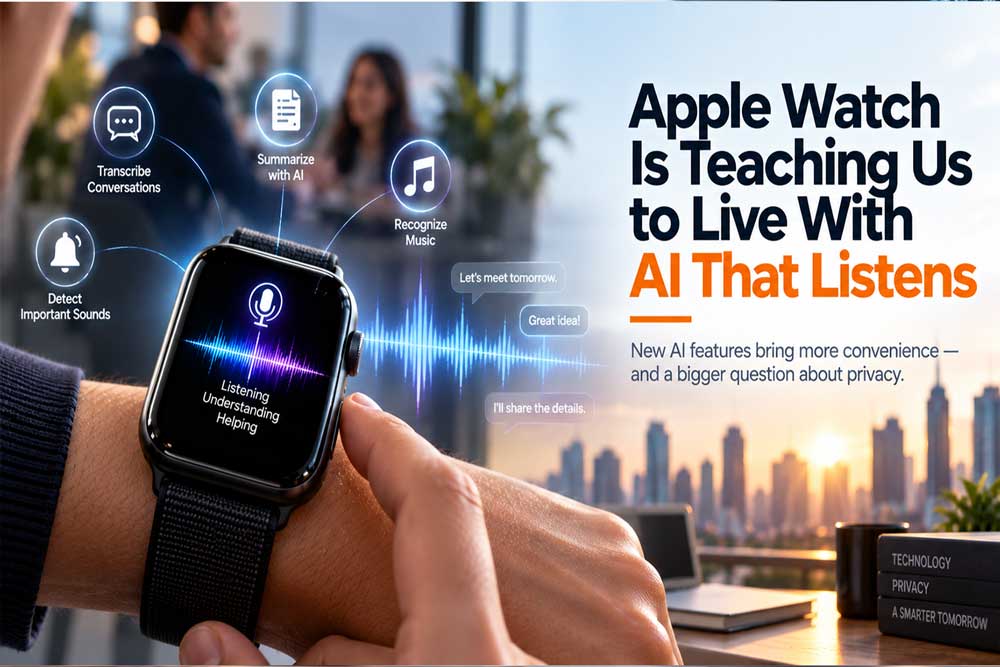
Apple Watch Is Teaching Us to Live With AI That Listens
Share this article
Apple has spent years positioning the Apple Watch as a device that helps people see more, move more and stay healthier. Its latest generation introduces a more uncomfortable possibility: a watch that can understand what is being said around you.
The new Apple Watch Series 12 and Ultra 4 introduce Audio Intelligence, including Sound Recognition, Music Recognition, Live Rewind and Siri Recap. Apple says the features are designed to help users remember conversations, identify important sounds and stay aware of their surroundings.
The technology itself is not entirely new.
AI transcription tools, meeting assistants and dedicated recording devices have already made ambient listening increasingly common.
What makes Apple's move different is scale and familiarity.
Millions of people already wear Apple Watches throughout the day.
The Convenience Is Easy to Understand
Consider Live Rewind.
If someone quickly gives you a restaurant recommendation, book title or important detail that you missed, a double press of the Digital Crown can display a transcript of the previous 15 seconds. Siri Recap goes further, creating high-level summaries of conversations when enabled.
These are genuinely useful applications.
For people who struggle to hear conversations, Sound Recognition could be even more valuable. It can detect sounds such as alarms, sirens, doorbells and a crying baby.
The bigger question is therefore not “Is this useful?”
It clearly can be.
The question is “What happens when listening becomes invisible?”
Apple Is Trying to Make Listening Feel Safe
Apple has put considerable emphasis on privacy.
According to Apple's Audio Intelligence privacy architecture, raw audio is processed inside the Secure Exclave of the S11 chip and is not stored as an audio recording. Apple says the raw audio is inaccessible to the operating system, apps and even Apple itself.
Live Rewind also provides an audible and visual signal when activated, while Siri Recap can be switched on or off and scheduled for particular situations.
So this isn't simply a story about Apple secretly recording everyone.
It is more subtle.
The Cultural Shift Matters More
The real change may be psychological.
When a person wears a device capable of understanding nearby speech, everyone around that person becomes part of a new technological environment—even if the device isn't permanently storing conversations.
That changes social expectations.
Should you ask someone to disable a feature before discussing something private?
Should workplaces create rules around AI-enabled wearables?
Will people eventually stop noticing the microphone altogether?
These questions may become increasingly relevant as AI moves from phones and computers into watches, glasses, earbuds and other devices that remain with us all day.
The Bigger Business Opportunity—and Risk
Apple is effectively testing whether consumers will accept ambient AI as a normal part of everyday life.
If people embrace it, the implications extend far beyond Apple Watch.
The next generation of devices may not wait for users to type, search or even speak a command.
They may simply listen, understand and anticipate.
That could make technology dramatically more useful.
It could also make privacy increasingly dependent on trust, transparency and social norms.
The biggest Apple experiment may therefore not be whether Siri can remember what was said.
It may be whether society becomes comfortable with technology that is always ready to listen.
Tags