
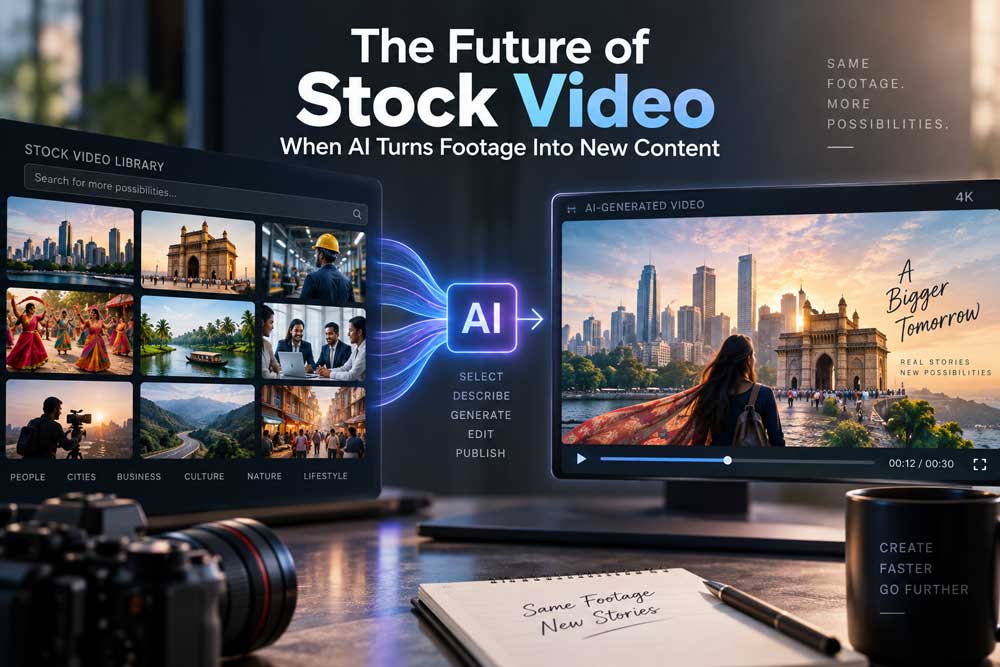
The Future of Stock Video: When AI Turns Footage Into New Content
Share this article
For decades, stock video has followed a straightforward model: search, license, download and edit. A creator needed footage of a city, office, festival or factory, found a suitable clip and built a production around it.
Artificial intelligence could change that workflow completely.
Instead of simply downloading footage, creators could eventually select licensed videos as visual references and use AI to generate new scenes, variations and complete sequences. The stock-video library would no longer be just a collection of finished clips. It could become the raw material for creating content that never existed before.
From Library to Creation Platform
The traditional workflow is:
Search → Select → License → Download → Edit
AI introduces another possibility:
Describe → Select References → Generate → Edit → Publish
A creator working on a campaign about India's startup ecosystem, for example, could select footage showing offices, entrepreneurs, technology and city environments. AI could potentially use those clips as visual references to create a new sequence.
Adobe Firefly is already moving toward reference-based video generation, making the idea technically possible.
This could fundamentally change what customers expect from stock platforms.
The Real Value May Be the Footage Behind the AI
Historically, stock companies competed on library size, quality, price and search.
AI introduces another competitive advantage: the quality of the visual data available for creation.
Imagine a library containing Indian cities, manufacturing facilities, farmers, festivals, transportation, healthcare, education and everyday life.
Today, each clip is a product.
Tomorrow, those clips could become building blocks for AI-assisted production.
This creates an interesting opportunity for specialised platforms.
A company focused on Indian footage could potentially build a rights-managed visual reference library covering locations, culture, businesses and lifestyles that generic AI models may struggle to reproduce authentically.
The Contributor Model Could Change
The transformation could also affect videographers.
Today, contributors primarily earn when customers license their footage. In an AI-driven model, platforms could potentially introduce additional licensing categories, including AI reference licences and broader enterprise AI usage.
That could create new revenue opportunities from existing footage.
But there is an important distinction.
AI training and AI reference are not necessarily the same right.
A conventional licence may permit editing a video into a commercial production without giving permission to train an AI model, create datasets or generate derivative AI content.
This makes rights management one of the most important future competitive advantages for stock-media businesses.
Search Could Become More Intelligent
AI may first transform stock video without generating anything.
Instead of typing:
"Indian businessman office"
a creator could describe an entire creative concept.
An intelligent search system could understand the intent, find relevant footage and potentially create a storyboard containing an opening city shot, office scene, team discussion and technology close-up.
The next step could be automated editing—creating different versions for 16:9, 9:16 and 1:1 formats from the same collection of assets.
AI Could Destroy Some Stock Video—and Increase the Value of Other Footage
There is an uncomfortable possibility for the industry.
Generic stock footage could become increasingly replaceable.
Why license a generic office, city street or business meeting if AI can create something similar instantly?
But distinctive footage could become more valuable.
Authentic locations, cultural events, rare environments and difficult-to-recreate scenes provide something synthetic content cannot easily replicate: real-world visual authenticity.
That could divide the market into two categories:
Commodity footage → increasingly replaceable
Unique authentic footage → potentially more valuable
A New Business Model
The future stock-video platform could combine:
Traditional licensing
Subscriptions
AI generation credits
Enterprise plans
AI reference licensing
Contributor revenue sharing
In other words, the business could evolve from selling video files to selling access to visual content and creation capabilities.
For a specialised platform such as Shutter Stock, Pixel, Pond5 and IndianStockVideo, this could create an interesting position: Indian footage + rights management + metadata + AI search + AI editing + licensed references.
The Bigger Business Lesson
The future of stock video may not be about having the largest number of clips.
It may be about having the right footage, clear rights and the technology to transform that footage into something new.
The industry could move from:
“What existing video can I use?”
to:
“What video can I create?”
And the stock library could become the starting point.
For creators, that means faster production. For contributors, potentially new revenue models. For platforms, an opportunity to evolve from digital libraries into AI-powered content marketplaces.
The future of stock video may not be finding the perfect clip. It may be using the perfect clip to create something that has never existed before.
Tags