
Unacademy: How a $3.4 Billion EdTech Giant Was Sold for $206 Million
Share this article
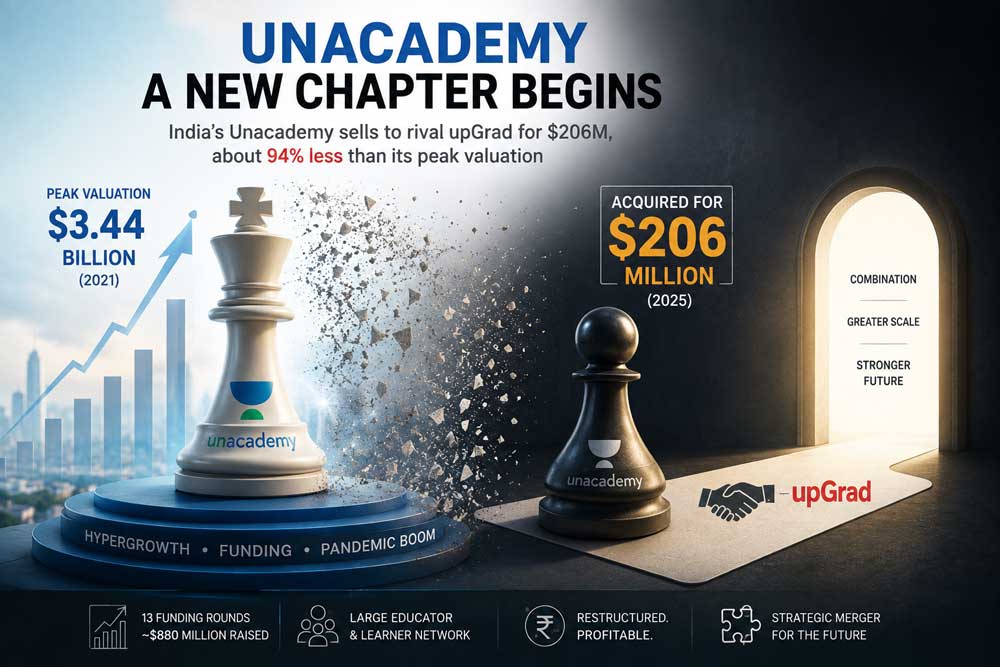
India’s edtech boom created some of the country’s most valuable startups. Unacademy was among the biggest winners, reaching a $3.44 billion valuation in 2021 after raising hundreds of millions of dollars from investors including SoftBank, Tiger Global and General Atlantic. Five years later, the company has been acquired by rival upGrad for approximately $206 million—a roughly 94% decline from its peak valuation.
The deal is more than a valuation correction. It marks the end of Unacademy’s journey as an independent company and illustrates how dramatically India's edtech economics changed after the pandemic.
Funding → Rapid Growth
Founded in 2015, Unacademy used venture funding to rapidly expand its educator network, content library and competitive-exam offerings.
During the pandemic, online learning demand surged. Unacademy became one of India's most recognisable edtech platforms, raising approximately $880 million across 13 funding rounds.
But the same growth strategy created a problem: expectations became tied to continuously expanding users, revenue and valuation.
When students returned to physical classrooms, that growth rate became difficult to maintain.
Business Model → Profitability
Unacademy responded by cutting costs, restructuring operations and moving some offline centres toward franchise models.
The company eventually brought most of its businesses to profitability or close to profitability, according to co-founder and CEO Gaurav Munjal. It also reportedly had around ₹900 crore in cash and annual revenue of approximately ₹400 crore when the acquisition closed.
That makes the $206 million deal particularly interesting.
Unacademy was not simply a cash-starved startup being forced into a sale.
It was making a strategic decision about what kind of company it could become independently.
Competition → Scale-Up Challenge
The biggest challenge was scale.
India's edtech market became much more competitive after the pandemic. Physics Wallah strengthened its position, while traditional coaching businesses remained powerful in test preparation.
Unacademy could continue independently, but management increasingly saw a larger opportunity through combination with upGrad.
The Unacademy-upGrad acquisition is therefore less about rescuing a failing company and more about combining complementary businesses.
Acquisition → A Different Growth Strategy
The transaction is a 100% share-swap deal, meaning Unacademy investors receive upGrad shares rather than a traditional cash payout. Unacademy, PrepLadder, Graphy and Airlearn are included in the transaction, while Munjal continues as Unacademy CEO.
For upGrad, the strategic logic is clear.
upGrad has strength in higher education, professional learning and career development, while Unacademy adds competitive-exam preparation and a large consumer education platform.
Together, they can cover a much broader learner journey.
What Went Wrong?
Unacademy's lifecycle can be summarised as:
Funding → Hypergrowth → Pandemic Boom → Post-Covid Slowdown → Cost Restructuring → Profitability → Strategic Consolidation → Acquisition
The uncomfortable lesson is that becoming profitable does not automatically restore a startup's peak valuation.
Valuations reflect expectations about future scale, not simply whether the company is currently making money.
Unacademy eventually improved its economics, but the market opportunity was no longer valued in the same way as it was during the pandemic.
What's Next?
The acquisition gives upGrad a larger consumer-facing education business while allowing Unacademy to continue operating under its existing brand.
The bigger question is whether the combined company can turn two different education models into one scalable ecosystem.
For Unacademy, the $206 million exit may look like a dramatic failure compared with its $3.4 billion peak.
But another interpretation is possible.
The company survived the edtech correction, improved its economics and found a strategic buyer before destroying its remaining value.
The real startup lesson is not that Unacademy failed.
It is that the valuation you achieve during extraordinary growth can become a dangerous benchmark once the market returns to normal.
Tags