
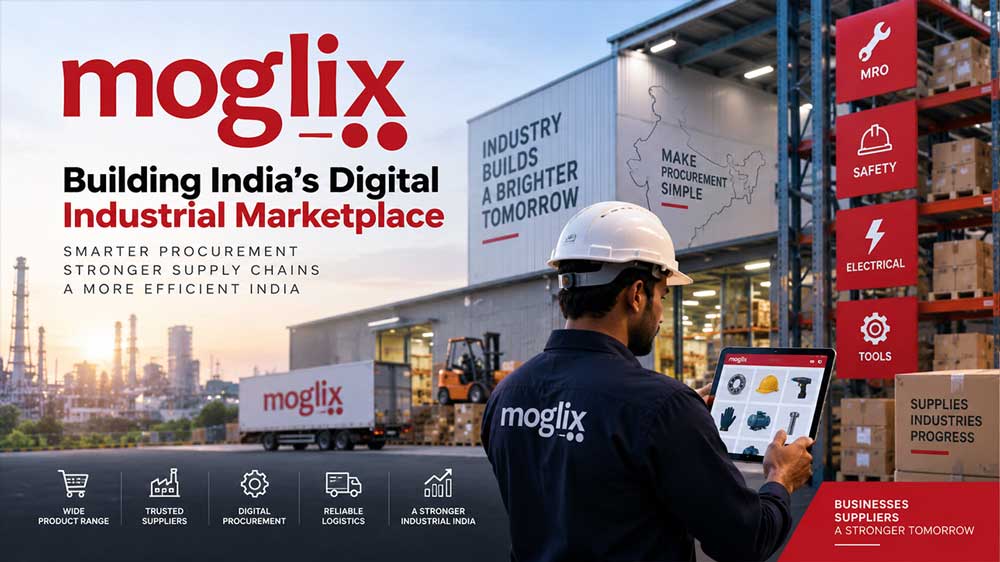
Moglix: Building India’s Digital Industrial Marketplace
Share this article
India’s industrial procurement market has traditionally depended on manufacturers, distributors, dealers and regional suppliers. While consumer commerce moved rapidly online, industrial purchasing remained more fragmented, with businesses often relying on offline networks, manual quotations and multiple supplier relationships.
Moglix was founded in 2015 with an attempt to bring the convenience and technology of e-commerce into this complex B2B environment. Founded by Rahul Garg, the company initially focused on industrial tools and Maintenance, Repair and Operations (MRO) products before expanding into a broader procurement and supply-chain platform. The World Bank notes that Moglix evolved from a marketplace serving SMEs into a wider digital solution for industrial firms.
From Industrial Products to Digital Procurement
Moglix's marketplace covers industrial categories including MRO, safety equipment, electrical products, lighting, cleaning supplies, office supplies and power tools. Its current website lists more than 800,000 SKUs across more than 1,500 categories.
The size of the catalogue is important, but the larger opportunity is how those products are purchased.
Industrial procurement is fundamentally different from consumer shopping. A manufacturing company may need bulk quantities, technical specifications, negotiated pricing, GST-compliant documentation and delivery to multiple locations.
Moglix has therefore built features around business procurement rather than treating industrial products as ordinary e-commerce inventory.
Its platform supports bulk-order enquiries, quotations and procurement solutions designed for business customers.
Building a B2B Marketplace
The marketplace model connects industrial buyers with suppliers while providing technology and logistics capabilities around the transaction.
Moglix says its supplier ecosystem includes thousands of suppliers, while its business platform serves enterprises and manufacturing organizations across multiple sectors. Its current business offering focuses on procurement optimization, sales optimization, supply-chain financing and digital transformation.
This creates value on both sides of the marketplace.
For buyers, the platform can provide product discovery, supplier access and procurement visibility. For suppliers, it creates a digital sales channel through which they can reach business customers beyond their traditional geographic markets.
Moglix's supplier platform also provides catalogue management, dashboards, logistics support and payment-related services.
Why Procurement Technology Matters
The industrial procurement opportunity goes beyond putting products on a website.
Companies need to know what they are buying, from whom, at what price and when it will arrive. Procurement systems can bring these activities into a more structured digital workflow.
Moglix's enterprise solutions include integration with systems such as SAP, Oracle, Coupa and JDE, while its digital storefront capabilities cover pricing, payment processing, order management and supply-chain tracking.
This is where B2B commerce begins to resemble enterprise infrastructure.
The growing importance of digital transformation in manufacturing is closely connected to this shift, as businesses increasingly use technology to improve procurement, productivity and supply-chain operations.
Funding Helped Moglix Scale
Moglix's expansion has been supported by significant venture investment.
In May 2021, the company raised $120 million in Series E funding at a valuation of $1 billion, becoming a unicorn. In January 2022, it announced another $250 million Series F round at a $2.6 billion valuation, led by Tiger Global and Alpha Wave Global.
The funding reflected investor interest in the digitization of India's industrial and manufacturing supply chains.
But capital alone does not solve the fundamental challenge of B2B commerce. The platform still needs sufficient suppliers, reliable fulfilment, competitive pricing and recurring enterprise demand.
The Supply Chain Is Part of the Business
Industrial e-commerce cannot rely solely on a digital storefront.
If a factory needs a critical product, availability and delivery can be just as important as the online purchasing experience. Moglix has consequently built logistics and supply-chain capabilities alongside its marketplace.
The company describes its business as transforming the supply chain from procurement through distribution. Its current business platform also focuses on improving visibility, predictability, cost efficiency and agility for enterprise supply chains.
This creates a more integrated model.
Instead of simply matching a buyer with a seller, the platform can participate in product discovery, procurement, order management, logistics and related financial services.
Moving Beyond the Marketplace
Moglix's evolution shows why B2B commerce can become more complicated—and potentially more valuable—than a conventional online marketplace.
The company has described its ambition as building an operating system for manufacturing, combining procurement, packaging, supply-chain financing and software.
That strategy expands the potential relationship with customers.
A business might begin by purchasing industrial products through Moglix. Over time, it could use additional procurement technology, supply-chain services or financing capabilities.
This creates opportunities to generate value from multiple stages of the industrial purchasing process rather than depending entirely on product transactions.
The SME Opportunity
Small and medium-sized businesses represent another important part of the market.
Many SMEs have historically depended on local distributors and fragmented supplier relationships. A digital marketplace can give them access to a larger selection of products and suppliers while making price discovery and ordering more convenient.
Moglix has said that it has enrolled hundreds of thousands of SMEs into its digital ecosystem. The World Bank reported that the company was serving about 500,000 SME customers and more than 20,000 suppliers in 2023.
For SMEs, however, digital adoption ultimately depends on practical benefits: product availability, price, delivery reliability, payment options and ease of purchasing.
Technology becomes valuable when it improves those outcomes.
The Challenges of Industrial E-Commerce
The opportunity also comes with significant operational complexity.
Industrial products can have detailed technical specifications, different grades and configurations. Bulk orders may require negotiations, quotations and customized delivery arrangements.
There is also a deeply established offline distribution ecosystem in India.
Moglix therefore needs to make digital procurement sufficiently useful for businesses to change established purchasing behaviour. Its early experience highlighted the complexity of B2B buying, where quality, cost and delivery are critical and purchasing decisions often involve multiple stakeholders.
Building trust with these customers can take considerably longer than acquiring a typical consumer e-commerce user.
What Moglix Is Building
The bigger story behind Moglix is therefore not simply online sales of industrial products.
It is an attempt to connect several traditionally separate parts of industrial commerce:
Products → Suppliers → Procurement → Payments → Logistics → Supply Chain
The more of this workflow a company can manage digitally, the more deeply the platform can become integrated into its customers' operations.
That is also why Moglix's enterprise strategy matters. Its current business platform describes its mission as reimagining B2B commerce and supply chains for enterprises, rather than limiting its role to marketplace transactions.
The Road Ahead
Moglix has already moved considerably beyond its original marketplace model. Its expansion into procurement technology, enterprise solutions, supplier services and supply-chain finance reflects the changing nature of B2B commerce.
The next phase will depend on how efficiently the company can scale this ecosystem.
Key areas to watch include:
Enterprise adoption of digital procurement
SME customer growth
Supplier network expansion
Logistics and fulfilment efficiency
Procurement software adoption
Supply-chain financing
Customer retention and recurring purchases
Economics across different industrial categories
India's manufacturing and infrastructure ecosystem provides a large potential market for digital procurement. But winning that market requires more than product listings. It requires technology, supplier relationships, logistics and an understanding of how businesses actually purchase.
Moglix's journey illustrates this transition. What started as an online marketplace for industrial goods has developed into a broader attempt to digitize the way businesses procure, manage and move industrial supplies.
The company's long-term story may therefore be less about becoming another e-commerce website and more about building a digital infrastructure layer for India's industrial economy.
Tags