
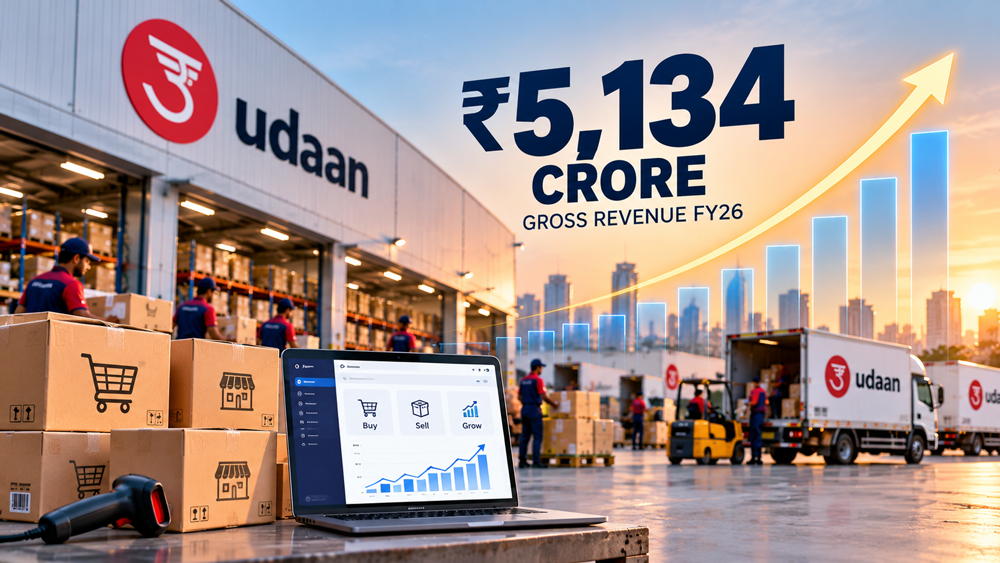
Udaan Revenue Rises 13% to ₹5,134 Crore in FY26
Share this article
Bengaluru-based B2B e-commerce startup Udaan returned to annual revenue growth in FY26, reporting operating revenue of ₹5,134 crore while continuing to reduce its losses. The performance marks an important step in the company's turnaround after several years of declining or subdued revenue.
Udaan's operating revenue increased approximately 12.6% from ₹4,561 crore in FY25. Its net loss narrowed to around ₹852 crore from approximately ₹1,055 crore a year earlier, according to financial statements reported by the media.
The results highlight a shift in strategy for the company: moving away from aggressive expansion towards stronger operating efficiency, more focused markets and a clearer path to profitability.
Revenue Growth Returns After Four Difficult Years
Udaan connects manufacturers, brands, wholesalers and distributors with retailers through its business-to-business marketplace. The platform focuses on helping small businesses source goods, manage procurement and access services that support their daily operations.
The company's recent financial trajectory has been uneven. Revenue declined sharply in FY23, grew only marginally in FY24 and fell by around 20% in FY25. The return to growth in FY26 therefore represents a meaningful change, although one year of recovery does not establish a sustained turnaround.
According to Udaan's FY26 financial performance, the company also reduced its net loss by approximately 19% year-on-year.
A Shift From Expansion to Operating Efficiency
Udaan has been changing how it operates. Rather than prioritising expansion across a large number of cities and categories, the company has focused on building stronger business density within selected markets.
This cluster-led model gives local teams greater accountability for performance across cities and product categories. Concentrating demand in established markets can help improve procurement, warehouse utilisation, delivery efficiency and customer relationships.
The approach reflects a broader lesson for B2B commerce: serving more locations does not necessarily create a stronger business if the cost of fulfilling orders remains high.
Udaan's earlier expansion created scale, but it also required substantial investment in logistics, working capital and operations. Its current strategy places greater emphasis on improving the economics of existing markets before expanding further.
Why Private Labels and Essential Goods Matter
Udaan has increasingly concentrated on essential products, including groceries, staples and goods used by businesses in the hospitality sector.
Private-label products can also support margins by giving the platform greater control over sourcing, pricing and product availability. The company has indicated that private labels account for a meaningful share of its staples sales in operating markets.
For retailers, a dependable supply of essential products can be more valuable than access to an extremely broad catalogue. For Udaan, repeat orders and more efficient distribution can help strengthen customer relationships while improving operating economics.
The challenge is to maintain competitive pricing while generating enough margin to cover fulfilment, technology, financing and administrative costs.
Losses Are Narrowing, but Profitability Remains the Test
Udaan's lower net loss is encouraging, but the company remains loss-making. Its FY26 results should therefore be viewed as evidence of progress rather than proof that its business model has reached sustainable profitability.
The company's broader strategy is similar to the shift explored in Udaan's effort to find a winning formula in B2B e-commerce, where local market density, private labels and tighter control over unit economics are central to the turnaround.
The next stage will depend on whether operating improvements translate into stronger cash generation. Revenue growth alone will not be sufficient if working-capital requirements, delivery costs or financing expenses continue to absorb the benefits.
Funding and IPO Ambitions
Udaan announced a $160 million financing transaction in July 2026 involving fresh equity, new debt and debt-to-equity conversion to strengthen its balance sheet.
The company has also been linked to potential IPO plans, with reports indicating that it is targeting a possible listing by early 2028. However, an IPO timeline remains subject to business performance, market conditions, regulatory requirements and other preparations.
For public-market investors, the key questions will include revenue consistency, operating margins, cash flow, debt obligations and the ability to grow without returning to unsustainable spending.
What Udaan's FY26 Results Mean
Udaan's return to revenue growth suggests that its more focused operating strategy is beginning to show results. Lower losses indicate progress, while concentrated markets and essential product categories may help the company improve efficiency further.
However, the turnaround is not complete. Udaan must demonstrate that the latest improvement can continue across multiple financial periods and eventually translate into sustainable profitability.
For India's B2B e-commerce sector, the company's experience reinforces an important lesson: building a large marketplace is only the beginning. Long-term success depends on creating a model in which retailers receive reliable service and the platform earns enough from each transaction to support its operations.
Tags