
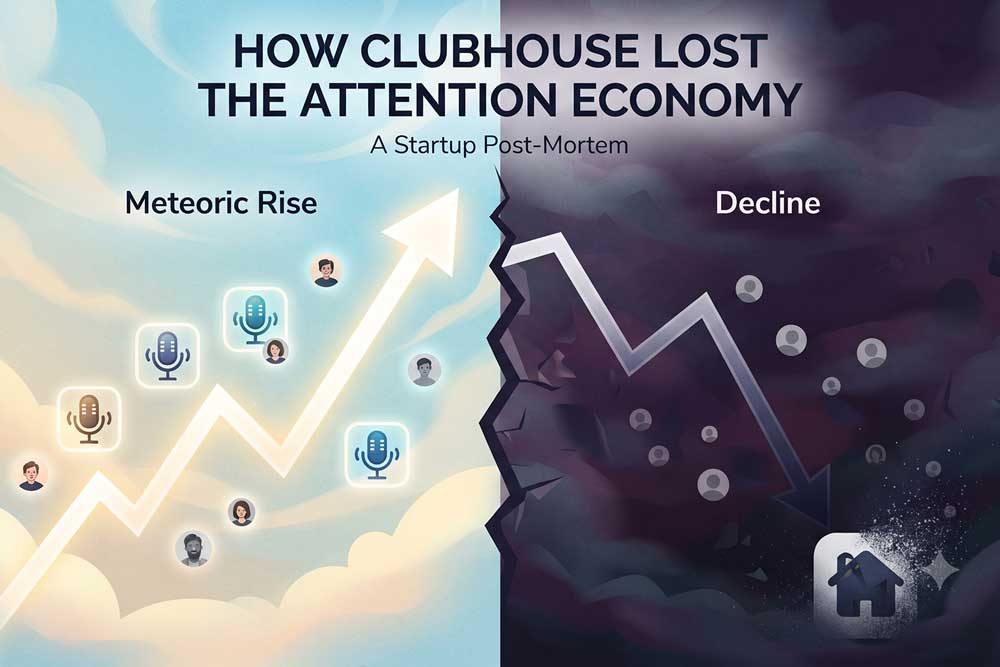
How Clubhouse Lost the Attention Economy: A Startup Post-Mortem
Share this article
Clubhouse entered the market in April 2020 right as pandemic-induced lockdowns forced the world indoors. By turning the human voice into an exclusive, drop-in digital commodity, the app captured the global technology landscape’s imagination. Backed by marquee venture capital firm Andreessen Horowitz, the startup achieved a staggering $4 billion valuation by April 2021.
Yet, beneath the massive user acquisition figures and high-profile celebrity rooms featuring Elon Musk and Oprah Winfrey lay a volatile foundation. Clubhouse’s trajectory stands as one of the most prominent case studies of a viral startup mistaking temporary novelty for a structural competitive moat.
The Numbers and the Hype Cycle
At its peak in early 2021, Clubhouse scaled from a few thousand invite-only users to over 10 million active weekly users. Cumulative downloads surged past 40 million as international expansion took hold.
However, growth metrics quickly decoupled from underlying platform economics:
The Retention Cliff: While top-of-funnel acquisition metrics soared, weekly active users plummeted sharply as pandemic restrictions eased and global populations returned to physical interaction.
Monetization Lag: The company lacked a stable, built-in revenue engine during its hyper-growth phase, relying purely on venture funding while experimenting late with creator tipping models that failed to scale.
Capital Burn vs. Workforce Correction: Faced with declining engagement, Clubhouse executed sweeping workforce reductions, laying off 50 percent of its staff to curb operational burn.
Strategy and Product Execution Failures
Clubhouse's core strategic vulnerability stemmed from being a single-feature application in a multi-modal digital ecosystem.
The Copycat Threat: Because live audio required minimal proprietary technology to replicate, tech conglomerates easily integrated the feature into existing distribution channels. Twitter launched Spaces, Spotify introduced Greenroom, and Meta rolled out Live Audio Rooms. Users preferred accessing audio features inside apps they already frequented rather than opening a standalone destination.
Friction of Exclusivity: The initial invite-only framework engineered intense FOMO (fear of missing out), but lifting restrictions diluted the product experience. Without structural incentives or sticky text/visual elements to bridge asynchronous communication, rooms emptied out once the novelty faded.
Governance and Moderation Deficits: Early scaling outpaced the company’s trust and safety infrastructure. Unmoderated rooms frequently amplified misinformation and toxic commentary, alienating mainstream users and high-profile creators alike.
Broader Startup Lessons
The rise and fall of Clubhouse offers critical takeaways for early-stage founders navigating hyper-growth and the modern attention economy. For a deeper examination of how early product execution dictates long-term market survival, review our analysis on startup growth strategies.
Ultimately, viral marketing and celebrity endorsements can manufacture a temporary market, but long-term enterprise value requires robust product retention, defensible technical moats, and a clear path to monetization.
Tags