
L'Oréal: How Creators Are Becoming Growth Engines
Share this article
Beauty marketing has changed dramatically. Consumers no longer discover products only through television commercials, magazines or store counters. Increasingly, they discover skincare, makeup and haircare through creators demonstrating products, explaining ingredients and sharing personal experiences.
L'Oréal has recognised this shift early.
Rather than treating creators simply as advertising channels, the beauty giant is building a broader creator ecosystem.
The strategic opportunity is to turn creators from paid media partners into long-term growth engines.
From Influencers to a Creator Network
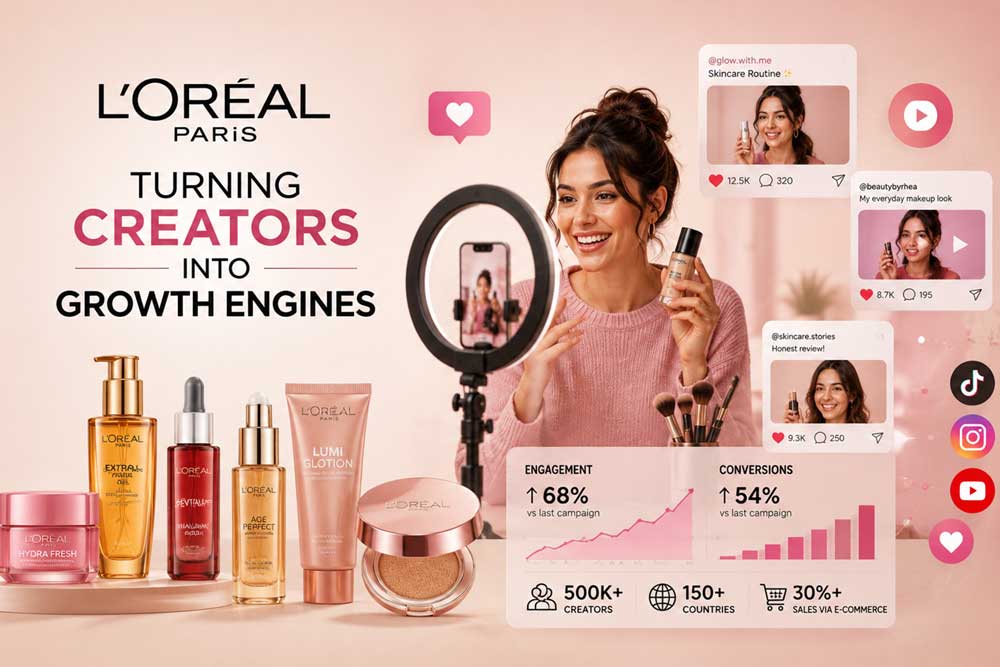
L'Oréal says it works with around 500,000 creators globally through its L'Oréalista Creator Club. The platform offers creators training, rewards, exclusive experiences and direct interaction with L'Oréal's brands.
This is fundamentally different from a traditional influencer campaign.
A conventional campaign might pay a creator to publish several sponsored posts. L'Oréal's approach is closer to building an extended marketing network.
Creators can discover products, learn about formulations, produce content and develop relationships with audiences. L'Oréal can then capture insights from these interactions to understand what consumers are discussing and which products are gaining momentum.
That creates a potentially valuable loop:
Creator → Content → Discovery → Purchase → Data → Better Marketing.
Beauty Is Perfect for Creator Marketing
Few industries benefit from creators as naturally as beauty.
A consumer buying a financial product may want statistics. A consumer buying lipstick, skincare or haircare often wants to see the product being used.
Creators can demonstrate application, explain routines and provide visual proof.
L'Oréal has previously described this approach as "edu-tainment," "info-tainment" and "proof-tainment." The company has also said it works with more than 60,000 influencers and thousands of advocates and prescribers across beauty categories. Its Creator Economy strategy shows how it is attempting to make creators part of the wider consumer journey.
The strategic value is clear: creators can reduce the distance between product awareness and purchase consideration.
Creators Are Becoming Part of Distribution
The more interesting development is that creators can influence what consumers search for and eventually buy.
A viral skincare routine can create demand before a consumer even visits an e-commerce platform.
This makes creator marketing increasingly connected to commerce.
L'Oréal's 2025 Annual Results show that e-commerce surpassed 30% of group sales, with the channel growing at double-digit rates.
That combination is powerful.
Creators generate discovery.
E-commerce captures the transaction.
L'Oréal's brands and distribution infrastructure fulfil the demand.
The creator is therefore no longer simply producing awareness. They can become part of the company's commercial funnel.
AI Could Make Creator Marketing Bigger
Artificial intelligence is adding another layer.
L'Oréal has developed CreAItech, its GenAI Beauty Content Lab, which allows thousands of users to generate unique, on-brand content for different platforms and audiences.
The company's 2025 reporting indicates that CreAItech was producing more than 495,000 assets per month, illustrating how quickly AI can increase the scale of marketing production.
This matters because creator marketing has a scale problem.
A company cannot manually produce personalised content for every audience.
AI can help creators and marketing teams produce more variations while maintaining brand guidelines.
The potential model becomes:
Human creator authenticity + AI production efficiency.
But there is a risk.
If AI makes content extremely easy to produce, consumers may become overwhelmed by sponsored material.
That could make authenticity even more valuable.
Scale Shows the Strategy Is Part of a Bigger Growth Engine
Creator marketing should not be viewed in isolation.
L'Oréal generated €44.05 billion in sales in 2025, with like-for-like growth of 4%. Its operating margin reached 20.2%, while e-commerce passed the 30% threshold.
The company also has more than 95,000 employees, 22 research centres and over 4,000 scientists, giving creators access to something independent influencers cannot easily replicate: a massive product-development and scientific infrastructure.
This creates an important distinction.
Creators generate attention. L'Oréal provides the products, science, brands and distribution needed to monetise that attention.
Investor Perspective
For investors, the important question is not simply how many creators L'Oréal works with.
The more useful metrics are:
Creator-driven sales
Engagement-to-purchase conversion
Customer acquisition cost
E-commerce growth
Repeat purchases
Organic social reach
Marketing return on investment
The company's growing e-commerce contribution is particularly important because it provides a clearer bridge between digital discovery and actual transactions.
If creator activity can consistently lower customer acquisition costs or improve conversion, it could change how beauty companies allocate marketing budgets.
The Bigger Industry Implication
L'Oréal's creator strategy points toward a broader transformation in consumer marketing.
The traditional model was:
Brand → Advertisement → Consumer
The emerging model is:
Brand → Creator → Community → Consumer → Commerce
The creator becomes a trusted intermediary.
L'Oréal's advantage is that it can combine this new distribution layer with a portfolio of global beauty brands, research capabilities and physical and digital distribution.
That makes its creator strategy more than influencer marketing.
It is potentially becoming a new growth infrastructure for the beauty industry.
Original Analysis
L'Oréal's creator strategy is strategically important because it connects influence, discovery, content, e-commerce and data into one system. The company's advantage is not simply the size of its creator network; it is the ability to connect creators with global brands, scientific expertise and an increasingly digital sales infrastructure.
Tags