
How Coca Cola Keeps Winning the Attention Economy
Share this article
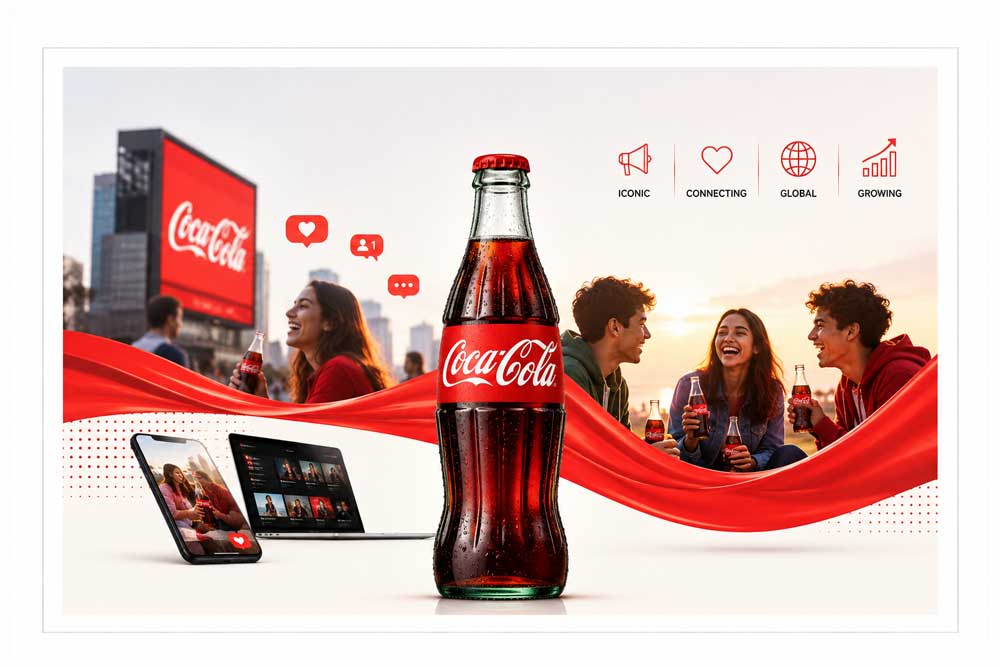
Coca-Cola: How It Keeps Winning the Attention Economy
In an economy where consumers are surrounded by advertisements, notifications, influencers and endless digital content, attention has become one of the world's most valuable assets.
For Coca-Cola, winning that attention has never been only about selling a soft drink. Its advantage comes from making the brand part of culture, memory and everyday moments—and then continually finding new ways to make those associations relevant.
The bigger question is whether a brand created in the 19th century can continue capturing attention from consumers who live in an increasingly digital world.
Brand Recognition Is Only the Beginning
Coca-Cola's greatest marketing asset is familiarity.
The red colour, distinctive bottle, typography and decades of advertising have created instant recognition. Consumers do not need to be introduced to the brand every time they encounter it.
But recognition can become a weakness if a legacy brand stops evolving.
Coca-Cola has therefore expanded from a single-product identity into a much broader portfolio. The company now has more than 200 brands across more than 200 countries and territories, while its products generate approximately 2.2 billion drink servings every day.
Its global brand portfolio allows Coca-Cola to participate in different consumer occasions rather than depending entirely on traditional cola consumption.
Winning Attention Through Culture
The attention economy rewards brands that become part of conversations rather than simply interrupting them.
Coca-Cola's 2025 "Share a Coke" revival is a good example. The campaign brought back personalised names on bottles and cans, combining nostalgia with digital sharing and Gen Z's interest in more personal forms of connection. Share a Coke's 2025 campaign shows how an old idea can be redesigned for a new generation.
The strategy is clever because Coca-Cola is not trying to abandon its history.
It is repackaging its history for contemporary consumers.
That is a significant distinction.
The Brand Is Selling Moments
Coca-Cola's latest marketing also demonstrates how the company tries to associate the product with experiences rather than simply taste.
Its 2025 global campaign encouraged Gen Z to step away from digital distractions and "enjoy the moment with a Coca-Cola." The campaign used music, sport and real-life social situations to connect the product with friendship and shared experiences. Coca-Cola's Gen Z campaign
This is important because Coca-Cola cannot realistically win every individual piece of online content.
Instead, it tries to own certain emotional territories.
Celebration. Friendship. Optimism. Refreshment.
Those associations can remain valuable even as individual advertising formats change.
AI Makes Attention Cheaper—and More Difficult
Artificial intelligence is creating another major shift.
AI can make advertising content faster and cheaper to produce. But that creates a paradox.
If every company can generate thousands of personalised advertisements, then content becomes abundant and attention becomes scarcer.
For Coca-Cola, that makes brand equity even more important.
The company has been experimenting with AI-powered marketing and creative technologies designed to accelerate content production while maintaining brand consistency.
Its broader Coca-Cola innovation and marketing strategy shows how the company is attempting to combine global brand consistency with local relevance and new technology.
The goal should not be to create more content simply because AI makes it possible.
The real advantage comes from creating more relevant content without weakening the identity of the brand.
Distribution Makes Attention Valuable
Marketing alone does not explain Coca-Cola's success.
Attention becomes commercially valuable only when consumers can easily buy the product.
Coca-Cola's global bottling system connects the company's brands with local bottlers, distributors, retailers and consumers across more than 200 countries. The company says this system helps deliver approximately 2.2 billion drinks every day.
This creates a powerful feedback loop:
Brand awareness → Consumer demand → Distribution → Sales → More brand investment.
A digital-first brand may generate enormous online attention, but Coca-Cola combines attention with one of the world's most extensive beverage distribution systems.
That is much harder to replicate.
The Financial Evidence
Coca-Cola's marketing strength ultimately has to translate into financial performance.
In 2025, the company reported $47.9 billion in net revenues, up 2%, while organic revenue grew 5%. Full-year free cash flow was $5.3 billion, excluding a fairlife contingent consideration payment.
The company also reported gaining value share in total non-alcoholic ready-to-drink beverages during the year.
For a mature consumer company, maintaining pricing power and market relevance is arguably more important than producing spectacular unit-volume growth.
Investor Perspective
Investors should therefore look beyond social-media impressions and advertising campaigns.
The more meaningful indicators are:
Organic revenue growth
Unit-case volume
Price/mix
Market share
Brand investment efficiency
Consumer engagement
Growth in emerging beverage categories
Free cash flow
The key question is whether Coca-Cola can continue converting brand attention into pricing power, distribution strength and recurring cash flow.
The Bigger Industry Lesson
Coca-Cola's marketing strategy offers a broader lesson for consumer companies.
Attention is not the same as visibility.
A brand can generate millions of impressions and still be forgotten.
Coca-Cola's advantage is that its marketing is connected to decades of memory and emotional associations.
AI may change how advertisements are produced. Social media may change how campaigns spread. Consumer preferences may change dramatically.
But the fundamental objective remains the same:
Be remembered when the consumer is ready to buy.
Coca-Cola's biggest advantage in the attention economy may therefore not be its advertising budget.
It is the fact that consumers already know what Coca-Cola means.
The company's challenge is to keep that meaning relevant for the next generation.
Original Analysis
Coca-Cola's attention advantage comes from combining brand memory, cultural relevance and distribution scale. AI can make content production faster, but it cannot instantly create the decades of consumer associations that Coca-Cola already owns. The company's long-term advantage is therefore likely to come from using new technology to refresh an existing brand rather than trying to reinvent it completely.
Tags