
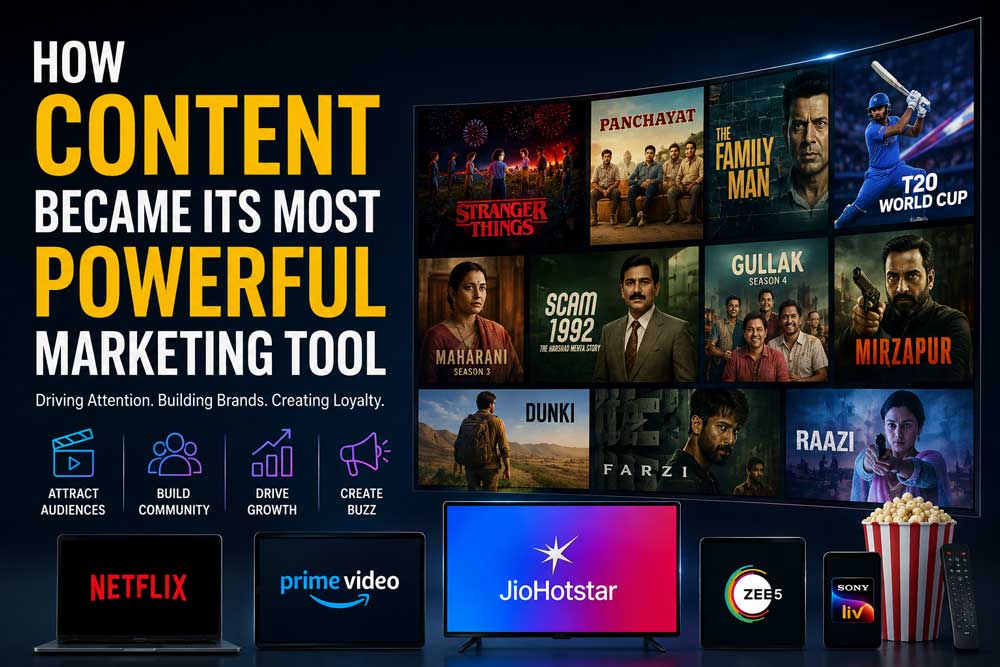
How Content Became OTT Platforms' Most Powerful Marketing Tool
Share this article
For OTT platforms, content was once the product.
Today, it is increasingly becoming the marketing engine.
Netflix, Prime Video, JioHotstar, ZEE5 and SonyLIV are competing in a market where consumers can switch between platforms within seconds. Discounts and subscriptions can attract users temporarily, but compelling content is what can make them return.
That changes the economics of streaming.
Content Is Now the Customer Acquisition Strategy
Traditional media companies spent heavily on advertising to promote their shows.
OTT platforms increasingly turn the shows themselves into advertising assets.
A successful series creates social-media conversations, memes, reviews, search traffic and word-of-mouth promotion. A major sports event can generate millions of simultaneous viewers while increasing awareness of the platform.
JioHotstar demonstrates this at enormous scale. Its platform averaged 451 million monthly active users in FY26, while major sports events generated record engagement. Its 2026 T20 World Cup coverage reached 72.5 million peak concurrent viewers.
The content does not simply generate viewing.
It creates attention that the platform can monetise.
Netflix: Content Builds Brand
Netflix has taken the strongest global approach to content-led differentiation.
Its strategy is built around original series, films and increasingly local-language productions that can become global hits.
The company's annual reports and financial strategy show how important content remains to its business model.
A show such as Stranger Things or Wednesday can do more than generate subscriptions. It can become part of popular culture, giving Netflix brand visibility that conventional advertising would struggle to replicate.
Prime Video: Content Meets an Ecosystem
Amazon takes a different approach.
Prime Video is connected to the broader Prime membership, meaning content can help strengthen an ecosystem that also includes shopping, delivery and other services.
Amazon has expanded Prime Video's role in India by integrating Amazon MX Player, bringing free and premium content together in a larger streaming destination.
That creates an interesting marketing model:
Content attracts attention → Prime strengthens engagement → the wider Amazon ecosystem benefits.
JioHotstar: Content at Massive Scale
JioHotstar demonstrates another model: combine entertainment, sports, regional programming and advertising.
The platform launched with more than 500 million users, close to 300,000 hours of entertainment and content across 19 languages.
Its Connected TV strategy also shows how content can become a marketing environment. JioStar reported an 85% increase in CTV watch time, while co-viewing was 3.1 times higher than individual viewing.
For advertisers, that makes premium content valuable because the audience is not merely present—it is paying attention.
Regional Content Is Becoming a Competitive Weapon
India's OTT market is too diverse for one universal content strategy.
Hindi remains important, but Tamil, Telugu, Malayalam, Bengali, Marathi and other languages can create highly loyal audiences.
ZEE5's original-content catalogue, for example, spans multiple genres and includes regional programming alongside Hindi originals.
SonyLIV similarly uses originals such as Scam 1992, Gullak and Maharani to create distinctive content identities.
The lesson is clear:
Local relevance can become a stronger retention tool than simply having the largest content library.
The Bigger Marketing Opportunity
OTT platforms are moving from buying attention to creating attention.
A successful show can generate its own marketing cycle:
Content → Conversation → Social Sharing → New Users → Higher Engagement → Advertising/Subscription Revenue.
But there is a major risk.
Content is expensive, and not every expensive production becomes a hit.
The next competitive advantage may therefore come from platforms that combine strong storytelling with better recommendation systems, data and AI.
JioHotstar is already investing in AI-driven personalisation and conversational content discovery, showing how technology can help users find the right content faster.
The Final Takeaway
The OTT industry is no longer simply fighting for subscribers.
It is fighting for time, attention and habit.
Netflix uses original content to build global cultural relevance. Prime Video connects entertainment with a broader ecosystem. JioHotstar combines entertainment, sports and advertising at enormous scale. ZEE5 and SonyLIV use local stories and distinctive originals to build loyal audiences.
The common thread is content.
The most valuable OTT platforms may ultimately be those that do not just distribute entertainment—but create stories powerful enough to market the platform themselves.
Original Analysis
Content has become an OTT platform's customer-acquisition, retention and brand-building engine at the same time. The strategic advantage increasingly comes from turning successful content into a repeatable attention cycle rather than treating every show as a standalone investment.
Tags