
Lyft Enters the Robotaxi Market: Why It Matters
Share this article
Lyft spent years trying to develop autonomous-driving technology. Then it walked away.
In 2021, the company sold its Level 5 autonomous-vehicle business to Toyota’s Woven Planet for $550 million. For a while, Lyft appeared to be choosing a simpler strategy: focus on ride-hailing while other companies spent billions trying to solve self-driving.
Now the strategy looks very different.
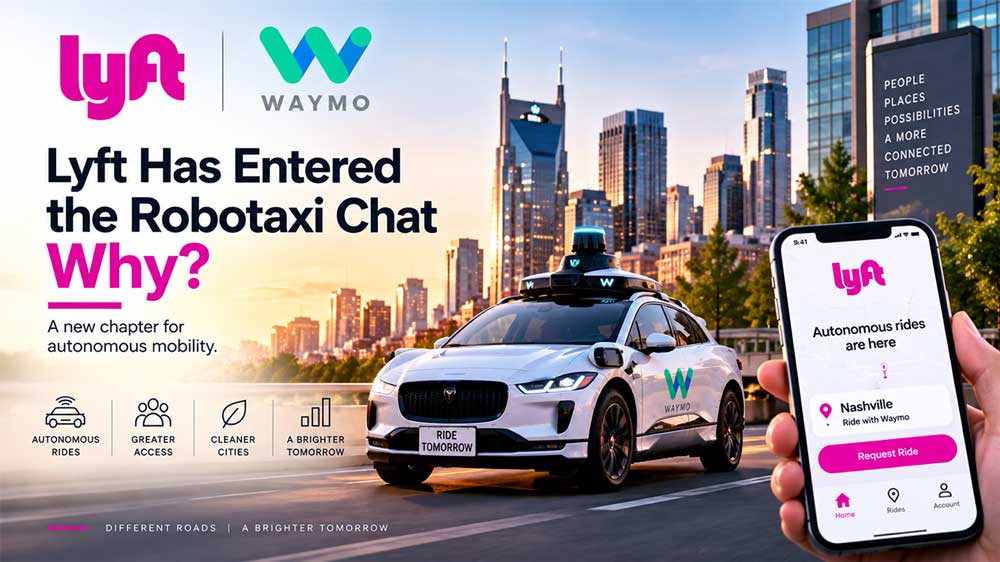
In September 2026, Waymo robotaxis became available through the Lyft app in Nashville. Riders can request a fully autonomous Waymo vehicle through Waymo's own app or potentially be matched with one through Lyft. For Lyft, this is its first major commercial deployment involving vehicles operating without a human driver behind the wheel.
The bigger story isn't simply that Lyft is adding robotaxis.
It is changing its role in the autonomous mobility economy.
Lyft Doesn't Need to Build the Robotaxi
The most important strategic decision Lyft has made is not to compete directly with Waymo on autonomous-driving technology.
Waymo develops the autonomous-driving system and operates the robotaxi technology. Lyft brings its ride-hailing marketplace and, increasingly, fleet-management capabilities.
That division of responsibilities could become extremely valuable.
Through its Flexdrive subsidiary, Lyft is responsible for fleet services in Nashville, including vehicle readiness, maintenance, infrastructure and depot operations. The company is also building an 80,000-square-foot facility designed to service, charge and maintain Waymo vehicles at scale.
This means Lyft can participate in the robotaxi economy without having to own the most expensive and technically difficult part of the stack: autonomous driving.
The Business Model Is Bigger Than the App
Traditional ride-hailing is relatively straightforward.
A passenger requests a ride. A driver supplies the vehicle. Lyft connects the two and takes a share of the transaction.
Robotaxis change the economics.
Once there is no driver, the value shifts toward vehicle utilization, fleet management, charging, maintenance, software, infrastructure and customer demand.
That creates several layers of opportunity.
Lyft can potentially make money by connecting passengers with autonomous fleets, while Flexdrive can generate value by keeping those fleets operational.
In other words, Lyft could become both a mobility marketplace and an operating layer for autonomous fleets.
That is a much more interesting position than simply being another ride-hailing app.
Why Waymo Needs Lyft
Waymo already has its own consumer application, so why work with Lyft?
The answer is demand.
A robotaxi is an expensive asset when it is sitting unused. Lyft can potentially increase utilization by providing another source of passengers.
At the same time, Lyft isn't trying to replace Waymo's consumer brand or autonomous-driving technology.
That makes the relationship different from partnerships where the ride-hailing company and autonomous-vehicle provider increasingly compete for the same customer relationship.
As robotaxi adoption expands, the ability to combine autonomous fleets with an existing mobility marketplace could become strategically important.
Nashville Is a Test of a Larger Strategy
Lyft has described Nashville as an important proving ground for the model.
The company is also pursuing autonomous mobility internationally.
In London, Lyft's Freenow business and Baidu's Apollo Go began testing autonomous vehicles in July 2026. The companies expect public riders to access the service in 2027, subject to regulatory approval. The planned model will combine autonomous vehicles with existing taxis and private-hire vehicles.
This suggests Lyft isn't betting on a world where human drivers suddenly disappear.
Instead, it is preparing for a hybrid mobility network.
Some trips could use human drivers. Others could use autonomous vehicles. Customers may not necessarily care which technology provides the ride as long as the service is available, safe, reliable and competitively priced.
The Competitive Battle Is Changing
Lyft is not entering an empty market.
Uber is developing its own autonomous mobility ecosystem through partnerships with multiple autonomous-driving companies. Waymo is expanding its direct consumer service. Tesla is pursuing its own robotaxi strategy. Baidu and other Chinese autonomous-driving companies are expanding internationally.
The competitive question therefore isn't only:
Who has the best autonomous-driving technology?
It is increasingly:
Who can build the most efficient autonomous mobility network?
That includes technology, vehicles, charging, maintenance, regulation, insurance, fleet operations, customer acquisition and utilization.
Lyft's advantage could be that it doesn't need to win every layer.
It can partner.
The Driver Question
There is also an uncomfortable side to this strategy.
Autonomous vehicles could reduce demand for traditional driving work over time. But the Nashville rollout also shows that automation doesn't eliminate every human role.
Lyft's Flexdrive operation is creating jobs around charging, cleaning, inspection, maintenance and fleet management. Some former Lyft drivers are already moving into these roles supporting autonomous vehicles.
That doesn't mean the employment impact will be neutral.
A robotaxi can potentially replace many driving hours while creating fewer specialized operational jobs. The transition could therefore reshape the labor market rather than simply eliminate or preserve jobs.
What Happens Next?
The Nashville experiment will reveal whether this model can work economically at larger scale.
The important metrics won't just be the number of robotaxis on the road.
Lyft and its partners will need to demonstrate:
Higher vehicle utilization
Reliable autonomous operations
Competitive ride prices
Efficient charging and maintenance
Strong customer adoption
Regulatory scalability
Sustainable fleet economics
If those pieces come together, Lyft could have made an important strategic move by not trying to build the robotaxi itself.
It may instead become the company that connects autonomous vehicles, customers and the operational infrastructure required to keep those vehicles moving.
The Bigger Business Lesson
The robotaxi race may ultimately produce several winners rather than one.
Waymo can specialize in autonomous driving. Automakers can build the vehicles. Infrastructure companies can provide charging and depots. And mobility platforms such as Lyft can connect supply with demand.
That is why Lyft's entry matters.
The future of autonomous mobility may not belong only to the company that builds the smartest car. It may belong to the companies that figure out how to operate the entire ecosystem around it.
Tags