
Lenskart: How Technology Is Reshaping India's Eyewear Market
Share this article
India's eyewear market has traditionally been fragmented, with local optical stores dominating distribution and consumers often choosing frames through physical trial and personal recommendations.
Lenskart is changing that model by putting technology, manufacturing and omnichannel retail at the centre of eyewear.
The company's opportunity is bigger than selling more glasses. It is attempting to make eye testing, product discovery, manufacturing and distribution more accessible—and in the process, expand India's organised eyewear market.
Technology Is Becoming the Core Advantage
Lenskart's technology strategy covers almost the entire customer journey.
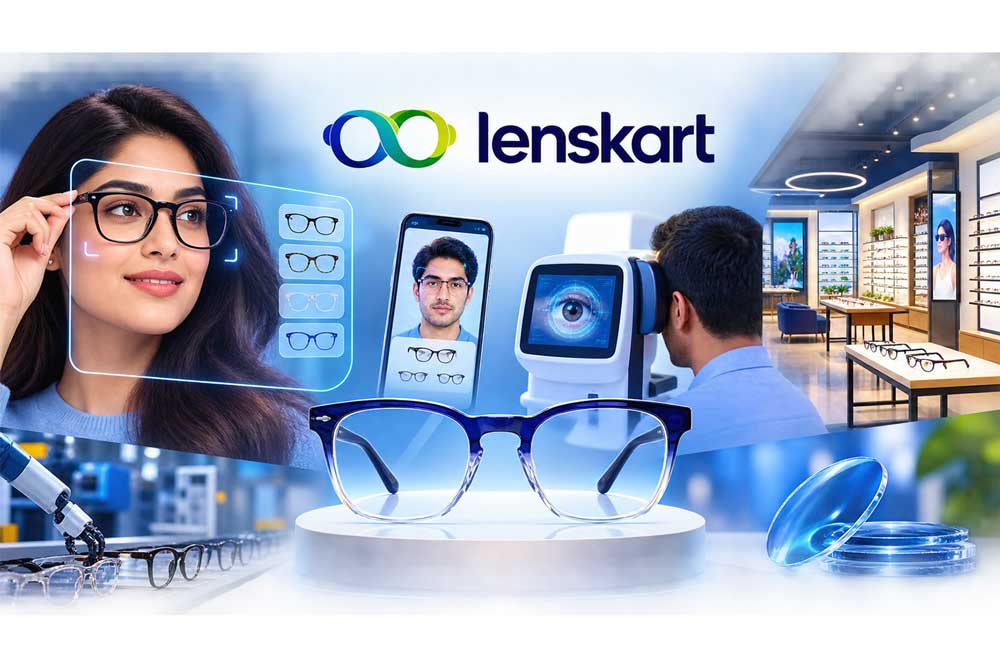
Its technology platform includes virtual try-on, remote optometry, self-eye testing, store-inventory integration and geo-analytics.
Virtual try-on reduces one of the biggest disadvantages of buying eyewear online: consumers cannot physically test frames before purchasing.
Meanwhile, integrated online and offline inventory allows customers to move between the website, app and physical stores without treating them as completely separate channels.
That creates a powerful model:
Digital discovery → Physical testing → Technology-enabled purchase → Integrated fulfilment.
Data Can Improve Store Expansion
Lenskart is also using technology to decide where new stores should be located.
This is important because physical retail can be expensive, particularly when companies expand too aggressively.
According to Lenskart's FY26 shareholder report, India delivered 20.8% full-year same-store sales growth, while same-pincode growth was stronger than overall store growth. The company also entered 157 new cities, primarily in Tier 2 and smaller markets.
This suggests technology is helping Lenskart identify underserved demand rather than simply adding stores everywhere.
Manufacturing Creates Another Advantage
Lenskart has also invested heavily in its supply chain and manufacturing capabilities.
That matters because eyewear is not simply a retail category. Lens quality, prescription accuracy, frame availability and delivery speed directly affect customer experience.
Controlling more of the supply chain can allow Lenskart to respond faster to demand and potentially improve margins.
The company describes itself as a technology-driven eyewear business with manufacturing and distribution capabilities integrated into its model.
The Numbers Suggest Operating Leverage
Lenskart's FY26 performance provides evidence that the technology-led model is scaling.
Revenue increased 32.3% to ₹90,023 million, while EBITDA increased 55.3% to ₹17,895 million. Adjusted PAT rose 147.7% to ₹5,300 million.
The company also conducted 23.8 million eye tests during FY26, up 48.5% year over year, with approximately half representing first-time eye examinations in India.
That last number is particularly important.
Lenskart is not simply taking market share from existing optical retailers.
It may also be creating new demand by making vision testing and eyewear more accessible.
AI Could Be the Next Layer
Artificial intelligence could further change the economics.
Lenskart has discussed AI-enabled eye testing, computer vision, location intelligence and personalised frame recommendations.
It has also launched B by Lenskart, an AI-powered smart-glasses product capable of supporting prescription lenses. More than 30,000 customers had joined the waitlist by the end of FY26's fourth quarter.
This expands Lenskart's opportunity beyond traditional spectacles.
The Investor Question
The biggest question is whether technology can continue producing better economics as the company gets larger.
Lenskart has already demonstrated strong growth and improving profitability. Reuters reported that quarterly profit surged sharply in August 2026, supported by strong prescription-eyewear demand.
But the company now faces the challenge of maintaining growth while expanding internationally, investing in technology and competing with both traditional opticians and emerging online brands.
Can Technology Reshape Eyewear?
Lenskart's real competitive advantage may not be its website or mobile app.
It is the integration of technology, manufacturing, data, stores and optometry into one system.
That makes the business harder to replicate than a conventional online eyewear marketplace.
The bigger opportunity is therefore not simply selling more frames.
Lenskart is trying to build a technology-led vision-care platform where data improves testing, technology improves discovery, manufacturing improves availability and physical stores build trust.
If that model continues to produce stronger customer engagement and operating margins, Lenskart could demonstrate how technology can transform an entire offline consumer category—not just move it online.
Tags