
How to Identify B2B Market Opportunities in India in 2026
Share this article
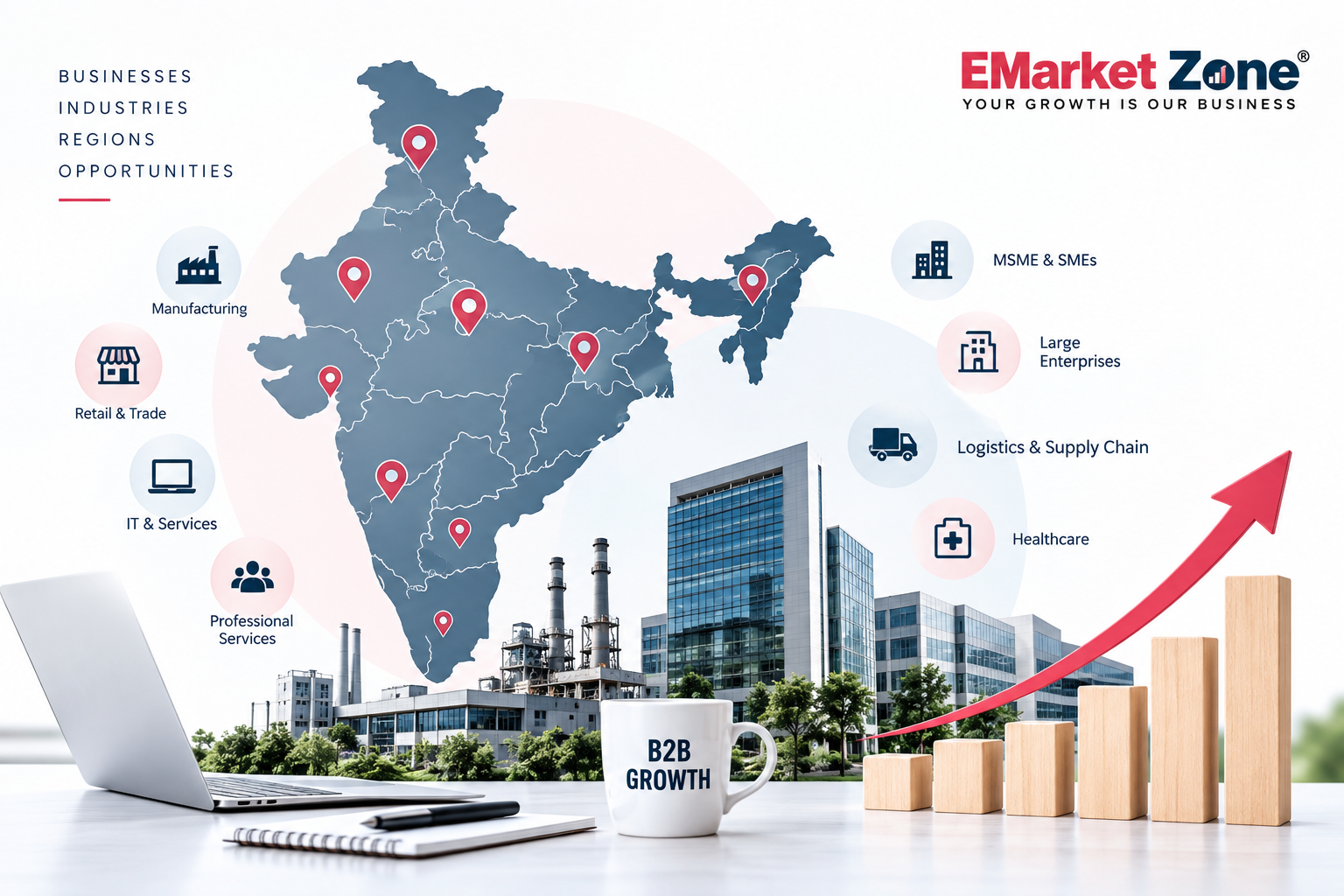
India’s B2B market is not one single market. It is made up of businesses across different industries, states, company sizes, and operating models.
That makes one question particularly important for companies planning their next stage of growth:
Where exactly is the opportunity?
A broad approach such as “target Indian businesses” is usually too vague to build an efficient B2B marketing strategy. A better approach is to break the market into measurable segments and identify where the strongest concentration of potential customers exists.
This is also the approach we used while studying the Indian B2B business landscape for our India B2B Market Opportunity Report 2026.
Start With the Overall B2B Market
The first step is understanding the size and structure of the market.
Before selecting a particular industry or state, businesses should establish a broad market baseline. This helps answer questions such as:
How large is the addressable business market?
Which types of businesses make up the market?
How widely are businesses distributed geographically?
Which industries contain the largest number of potential customers?
Where are smaller and mid-sized businesses concentrated?
The purpose is not simply to collect a large number of companies.
The real objective is to understand how the market is distributed.
Geography Can Change the Opportunity
A national market can look very different when examined state by state.
For example, a company selling a business service may have thousands of potential customers nationally but only a small concentration in some regions. Another state may contain a much larger pool of businesses within the company's ideal customer profile.
This is why geographic segmentation matters.
Instead of treating India as one market, businesses can examine:
State
City
Business concentration
Industry concentration
Regional commercial activity
Company size
The important point is that market size and market accessibility are not always the same thing.
A large market may not necessarily be the easiest market to enter.
Look at Industries, Not Just Company Counts
Company volume alone does not tell the entire story.
Suppose two industries each contain a significant number of businesses. One may have a strong need for your product, while the other may have very limited relevance.
Industry-level analysis helps narrow the market.
Businesses can examine sectors such as:
Manufacturing
Retail
Wholesale
Professional services
Construction
Logistics
Technology
Healthcare
Financial services
Export-oriented businesses
The right industry depends on what you sell.
Industry concentration becomes much more useful when it is considered alongside geographic distribution and the characteristics of the businesses operating in each market.
Define Your Ideal Customer Profile
One of the biggest mistakes in B2B marketing is trying to reach everyone.
A useful Ideal Customer Profile (ICP) should describe the type of company most likely to benefit from your product or service.
Depending on the business model, this could include:
Industry
Company size
Location
Revenue range
Employee count
Business age
Technology adoption
Purchasing requirements
Business model
For example, a SaaS company targeting small businesses should not necessarily use the same audience definition as a manufacturer selling industrial equipment.
The more clearly an ICP is defined, the easier it becomes to decide which businesses should actually be included in a campaign.
Segment Companies Before Building Campaigns
Once the ICP is defined, the next step is segmentation.
Instead of creating one large audience, businesses can divide prospects into smaller groups.
For example:
Segment 1: Manufacturing companies with 10–50 employees in selected states
Segment 2: Larger manufacturing companies in industrial hubs
Segment 3: Retail businesses operating in selected cities
Each segment can then receive a different message.
This makes the marketing process more precise because the campaign is built around the characteristics of the potential customer rather than simply the size of the database.
Combine Multiple Data Points
The most useful market opportunities often appear when several variables are combined.
For example:
Industry + State + Company Size
is much more actionable than:
India + All Businesses
A company selling accounting software might identify a particular combination of industries, locations, and company sizes where its product has the strongest relevance.
This can then influence:
Lead generation
Outbound sales
Advertising
Content marketing
Email campaigns
Sales territory planning
Partnership development
The same principle applies whether a company is targeting hundreds of prospects or building a much larger B2B acquisition program.
Market Opportunity Is More Than Market Size
A large number of businesses does not automatically mean a large commercial opportunity.
Businesses should consider at least four factors:
1. Market Size
How many potential businesses exist?
2. Relevance
How closely do those businesses match the product's ICP?
3. Accessibility
Can the business realistically reach and engage those companies?
4. Commercial Potential
Is there a reasonable possibility that those businesses will purchase the product or service?
This distinction is important because the largest segment is not necessarily the most relevant segment.
Use Data to Build a More Focused Strategy
Once market segments have been identified, the next step is turning the information into an actionable plan.
A simple framework is:
Market → Industry → Geography → Company Profile → ICP → Campaign
For example:
India → Manufacturing → Gujarat → Small & Mid-sized Companies → Defined ICP → Targeted Outreach
This is considerably more specific than simply targeting “Indian businesses.”
It also gives sales and marketing teams a framework for measuring results.
Track What Happens After Segmentation
Segmentation should not end when the campaign begins.
Businesses should measure performance across different segments.
Useful metrics include:
Response rate
Lead-to-opportunity rate
Cost per lead
Meeting rate
Conversion rate
Customer acquisition cost
Revenue per segment
Over time, this creates a feedback loop.
The original market analysis identifies potential opportunities. Campaign results then show which segments actually respond.
That information can be used to refine the ICP and improve future campaigns.
The Indian B2B Market Requires a More Granular Approach
India's business ecosystem is large and diverse. A single nationwide targeting strategy can therefore hide important differences between industries, regions, and company types.
A more practical approach is to start broad, identify relevant segments, and then progressively narrow the audience.
For businesses planning B2B growth in 2026, the objective should not simply be to find more companies.
It should be to identify the right companies, in the right markets, with a clear reason to engage them.
For a broader analysis of India's B2B landscape, see the India B2B Market Opportunity Report 2026.
Tags