
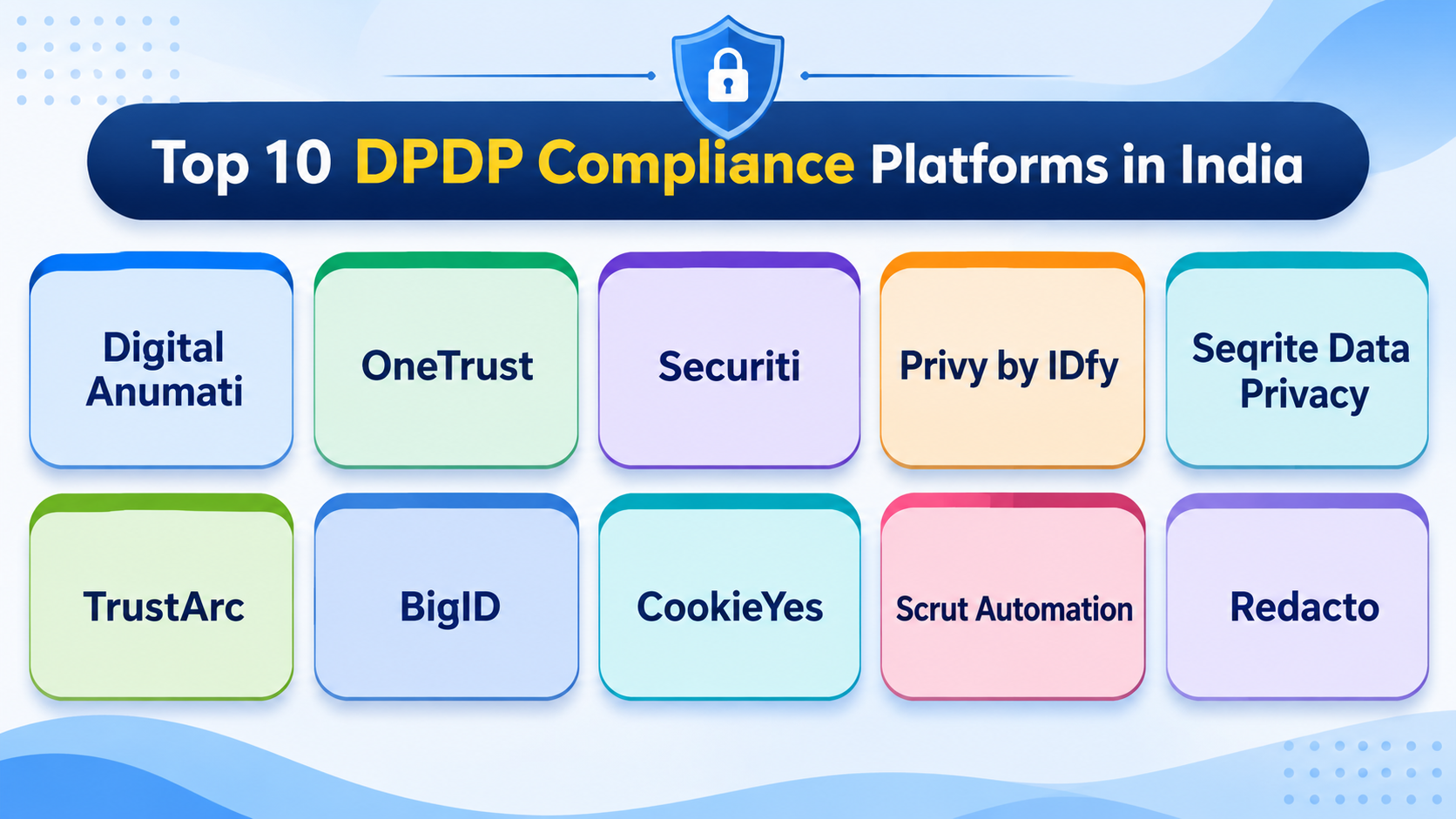
Top 10 DPDP Compliance Platforms in India
Share this article
India's Digital Personal Data Protection (DPDP) Act, 2023, is changing how organisations collect, process, store, and manage personal information. Businesses need to understand what personal data they hold, why they process it, and how they protect it.
With information spread across websites, mobile applications, CRM systems, databases, HR platforms, and third-party services, managing privacy responsibilities manually can become difficult.
This is where a DPDP compliance platform can help. These solutions offer tools for consent management, personal data discovery, Data Principal rights management, privacy assessments, and compliance documentation.
However, not all platforms provide the same capabilities. Some are designed specifically for privacy management, while others focus on data discovery, website cookie consent, or governance, risk, and compliance (GRC).
To help businesses explore their options, here are 10 DPDP compliance and related privacy platforms available for evaluation in India.
1. Digital Anumati
Digital Anumati is an India-focused DPDP compliance and privacy management platform designed to help organisations manage consent and personal data throughout its lifecycle.
Its documented capabilities include consent collection, purpose-based consent management, preference updates, consent withdrawal, and consent record maintenance.
The platform also offers Data Principal rights management, personal data discovery, data mapping, grievance workflows, cookie and tracker management, and audit trails.
One of its notable features is support for 22 Indian languages, helping organisations create multilingual privacy notices and consent experiences.
Digital Anumati also provides REST APIs, Web SDKs, Mobile SDKs, and iFrame integrations. These options allow businesses to connect consent and privacy workflows with their websites, mobile applications, databases, and enterprise systems.
The platform also advertises offline consent collection, Data Principal portals, and SaaS and on-premises deployment options.
It is worth evaluating for organisations in BFSI, NBFC, healthcare, education, manufacturing, insurance, and other sectors that process personal information.
Businesses looking for an India-focused platform combining consent management with broader privacy operations can consider Digital Anumati.
2. OneTrust
OneTrust is a global privacy, security, and governance platform used by organisations to manage data protection and regulatory requirements.
Its product capabilities include consent and preference management, cookie consent, privacy automation, data discovery, data mapping, and third-party risk management.
OneTrust supports consent management across websites and mobile applications. It also provides tools for managing privacy requests, conducting assessments, and maintaining privacy-related records.
For multinational organisations, its broad privacy management capabilities can help coordinate different regulatory requirements across markets.
Businesses evaluating enterprise-level privacy software can consider OneTrust, particularly when they need a centralised approach to privacy management.
3. Securiti
Securiti provides a platform combining data privacy, security, governance, and data intelligence.
Its PrivacyOps capabilities include consent management, data mapping, Data Subject Request automation, privacy assessments, third-party risk management, and breach management.
The platform also supports personal data discovery across structured and unstructured data environments, helping organisations understand where sensitive information is stored.
Securiti's data governance capabilities provide additional visibility into data classification, access, and management across enterprise environments.
It can be worth evaluating for larger organisations with complex data infrastructure and privacy requirements spanning multiple systems.
4. Privy by IDfy
Privy by IDfy is an India-focused DPDP compliance and data privacy platform designed to help enterprises organise their privacy operations.
Its capabilities cover three major areas: consent lifecycle management, continuous compliance and risk management, and personal data discovery and governance.
The platform includes consent management, Data Principal rights management, cookie governance, privacy impact assessments, incident management, and third-party risk management.
Its data discovery capabilities help organisations identify, classify, and map personal information across business systems and applications.
Privy also provides workflows for handling individual privacy requests and maintaining supporting compliance evidence.
For Indian enterprises looking for a broader DPDP management solution, Privy is worth evaluating.
5. Seqrite Data Privacy
Seqrite Data Privacy provides data privacy management capabilities alongside Seqrite's wider cybersecurity portfolio.
The platform supports personal data discovery, data classification, consent and preference management, cookie consent, and Data Principal rights management.
It also offers privacy assessment and breach notification capabilities, depending on the selected edition and available add-ons.
According to Seqrite's product documentation, its solution supports connections to more than 500 data sources, including databases, SaaS applications, cloud storage, and file servers.
The platform also provides workflows for locating personal information and handling requests related to access, correction, and deletion.
Seqrite is worth considering for businesses looking to bring data discovery, privacy management, and information security activities into a more connected environment.
6. TrustArc
TrustArc is an established global privacy management platform that helps organisations manage privacy programmes and regulatory compliance activities.
Its capabilities include privacy assessments, data mapping, risk management, compliance workflows, and consent management.
TrustArc also provides India-specific DPDP compliance solutions designed to help organisations manage consent, privacy controls, data inventories, and regulatory reporting.
Its Data Mapping and Risk Manager helps businesses understand what personal information they collect, where it is stored, and how it is processed.
The platform can be relevant for enterprises operating across multiple countries that need to coordinate privacy requirements through a centralised system.
Businesses evaluating international privacy management solutions can explore TrustArc's India DPDP offering.
7. BigID
BigID specialises in data discovery, classification, privacy, security, and data intelligence.
Its platform helps organisations identify personal, sensitive, and regulated information across databases, cloud environments, SaaS applications, and on-premises infrastructure.
BigID's discovery and classification capabilities provide visibility into where sensitive information resides and how it is distributed across enterprise systems.
The platform also supports privacy automation, data governance, data rights workflows, and data risk management.
These capabilities can help businesses strengthen their data management practices and improve visibility into personal information.
BigID is particularly worth evaluating for organisations that need advanced data discovery and classification as part of their wider privacy and security strategy.
8. CookieYes
CookieYes primarily focuses on website cookie consent and tracking preference management.
Its solutions help website owners identify cookies, configure consent banners, communicate cookie usage, and provide visitors with options to manage their tracking preferences.
For businesses whose main requirement is website cookie consent management, CookieYes can be a useful option.
Under India's DPDP framework, businesses should assess whether cookies and tracking technologies process personal data and identify the appropriate legal basis for that processing.
However, CookieYes should not be treated as a complete DPDP compliance platform simply because it supports cookie consent.
Organisations that also need Data Principal rights management, personal data discovery, privacy assessments, and broader governance capabilities may require additional software.
9. Scrut Automation
Scrut Automation provides governance, risk, and compliance (GRC) automation capabilities designed to help businesses manage security and compliance programmes.
Its platform supports compliance control management, evidence collection, risk assessments, audit preparation, and integrations with business applications.
These capabilities can help organisations maintain compliance documentation, coordinate internal controls, and manage security-related risks.
However, Scrut's general GRC capabilities should not be confused with a dedicated DPDP privacy management solution.
Businesses considering Scrut for DPDP-related initiatives should confirm whether its available controls cover their specific requirements. Additional software may be needed for consent management, Data Principal rights, and personal data discovery.
10. Redacto
Redacto is an India-focused privacy and data protection platform that offers capabilities for managing DPDP-related privacy operations.
Its documented features include consent management, data discovery and mapping, vendor risk management, Privacy Impact Assessments, Data Subject Access Request management, and breach notification workflows.
The platform also advertises AI-assisted privacy assessments and integrations designed to connect consent workflows with existing business systems.
Redacto provides deployment options including SaaS, private cloud, and on-premises environments, according to its product information.
It is worth exploring for organisations looking to organise consent, data governance, vendor assessments, and privacy management through a unified platform.
Why Do Businesses Need a DPDP Compliance Platform?
Businesses collect personal information through different channels, including websites, mobile applications, customer portals, physical branches, payment systems, HR applications, and third-party service providers.
As the number of applications and data processing activities grows, maintaining accurate records and managing privacy responsibilities becomes more challenging.
A DPDP compliance platform can help bring these activities together and provide organisations with a more structured way to manage privacy operations.
Depending on the solution, common capabilities include:
Consent Management: Collecting, recording, updating, and managing consent.
Consent Withdrawal: Managing withdrawal requests and maintaining related records.
Data Principal Rights: Handling applicable access, correction, erasure, and grievance workflows.
Personal Data Discovery: Identifying personal information across different systems.
Data Mapping: Understanding how personal information moves between applications and departments.
Privacy Governance: Maintaining processing records, policies, and retention requirements.
Cookie Management: Managing website trackers, cookie preferences, and consent records.
Third-Party Management: Maintaining visibility into external data processors and vendors.
Audit Trails: Recording privacy-related activities and changes.
Compliance Reporting: Organising evidence, assessments, and privacy documentation.
The objective is to make privacy operations easier to manage, improve accountability, and reduce dependence on fragmented manual processes.
Key Features to Look for in DPDP Compliance Software
Choosing privacy management software requires more than comparing feature lists. Organisations should understand whether a platform can support their actual data processing activities and operational requirements.
Here are some important capabilities to evaluate.
1. Consent Management
Consent management is an important consideration under the DPDP framework.
The software should support consent collection, purpose-based consent records, preference management, and withdrawal mechanisms.
It should also maintain records that help organisations establish when and how consent was obtained or modified.
2. Data Principal Rights Management
Organisations need processes to manage applicable requests from Data Principals.
Look for solutions that allow teams to receive, assign, track, resolve, and document requests through centralised workflows.
Clear ownership and status tracking can help improve request handling.
3. Personal Data Discovery and Mapping
Personal information is often distributed across databases, applications, cloud environments, and business systems.
Data discovery helps identify where personal information exists, while data mapping provides visibility into how it is collected, processed, stored, and shared.
These capabilities can support better privacy assessments and data governance.
4. Audit Trails and Compliance Records
Maintaining reliable records is important for privacy accountability.
A suitable platform should record relevant consent activities, workflow updates, administrative changes, and other privacy-related actions.
These records can help privacy, legal, security, and audit teams review organisational processes and maintain supporting evidence.
5. Integration Capabilities
A privacy platform should fit into the organisation's existing technology environment.
Check whether the solution provides APIs, SDKs, plugins, webhooks, or connectors for integration with:
Websites and mobile applications
CRM and ERP platforms
Databases and data warehouses
HR and employee management systems
Customer portals
Enterprise applications
Third-party service providers
Integration flexibility helps organisations avoid disconnected privacy workflows and unnecessary manual intervention.
6. Multilingual Support
India's linguistic diversity makes multilingual communication an important consideration.
Businesses serving customers across different states may need privacy notices, consent interfaces, and preference experiences in multiple Indian languages.
A platform with multilingual capabilities can help organisations communicate privacy information more effectively.
7. Scalability and Deployment Flexibility
Privacy requirements can change as businesses grow, introduce new applications, and expand their operations.
Evaluate whether the platform can support increasing data volumes, consent records, users, applications, integrations, and privacy requests.
It is also important to consider SaaS and on-premises deployment options, customisation, access controls, and compatibility with existing infrastructure.
How to Choose the Right DPDP Compliance Platform
The selection process should start with understanding how your organisation collects and processes personal information.
Before comparing vendors, consider the following questions:
What categories of personal data does the organisation collect?
Through which channels is the information obtained?
Where is personal information stored?
Which applications and departments process it?
Who has access to the information?
Is personal data shared with third-party processors?
How are consent and withdrawal requests currently handled?
What processes exist for managing Data Principal requests?
Once these areas are understood, businesses can evaluate platforms based on their actual requirements.
For example, a small digital business may initially need consent and cookie management. A bank, healthcare provider, insurance company, or large manufacturer may require a wider set of capabilities, including data discovery, data mapping, privacy governance, third-party assessments, and enterprise integrations.
Other important evaluation factors include:
Ease of implementation and onboarding
API and integration availability
SaaS and on-premises deployment
Data security and access management
Customisation options
Multilingual support
Reporting and audit capabilities
Scalability and performance
Vendor expertise and ongoing support
The best platform is not necessarily the one with the most features. It is the solution that aligns with the organisation's data environment, business processes, technology infrastructure, and long-term privacy objectives.
Conclusion
The DPDP Act, 2023, is making personal data protection an important part of business operations in India.
As organisations manage information across increasingly complex digital environments, relying solely on spreadsheets, emails, and manual processes can create operational challenges.
DPDP compliance platform help businesses organise consent management, Data Principal rights, personal data discovery, privacy governance, and compliance documentation within a more structured environment.
However, implementing software alone does not establish compliance. Organisations must also maintain appropriate policies, contractual safeguards, security measures, internal accountability, and employee awareness.
Before choosing a platform, businesses should assess their data processing activities, identify operational gaps, and compare solutions based on their actual capabilities.
The right technology, supported by appropriate organisational processes, can help businesses build more transparent, accountable, and responsible personal data management practices.
FAQs:
1. What is a DPDP compliance platform?
A DPDP compliance platform is software designed to help organisations manage activities related to India's Digital Personal Data Protection Act, 2023. Depending on the solution, it may include consent management, Data Principal rights workflows, personal data discovery, data mapping, privacy governance, and compliance documentation.
2. Why do businesses need a DPDP compliance platform?
Businesses process personal information across multiple applications, departments, and third-party systems. A DPDP platform can help centralise privacy activities, maintain records, manage consent, and organise applicable Data Principal requests.
3. What features should DPDP compliance software include?
Important capabilities include consent management, withdrawal management, Data Principal rights workflows, personal data discovery, data mapping, audit trails, privacy governance, reporting, and integration with existing business applications.
4. Is Digital Anumati a DPDP compliance platform?
Yes. Digital Anumati is an India-focused DPDP consent management and privacy compliance platform. Its advertised capabilities include consent lifecycle management, Data Principal rights, personal data discovery, privacy workflows, cookie management, and enterprise integrations.
5. Can DPDP platforms manage consent withdrawal?
Yes. Platforms with consent lifecycle management capabilities can help individuals withdraw consent and enable organisations to record, track, and manage withdrawal requests through structured workflows.
6. Can DPDP compliance platforms handle Data Principal requests?
Many privacy platforms provide workflows for receiving, assigning, tracking, and managing applicable Data Principal requests. These capabilities help organisations establish more consistent and traceable request-handling processes.
7. Do DPDP platforms support Indian regional languages?
Some platforms provide multilingual consent interfaces and privacy notices. However, the number of supported languages differs between providers. Businesses should verify language coverage based on their customer requirements.
8. Can DPDP compliance software integrate with existing business systems?
Yes. Depending on the provider, integration options may include APIs, SDKs, plugins, webhooks, and pre-built connectors for websites, mobile applications, CRM, ERP, HR systems, databases, and enterprise applications.
9. Does using DPDP compliance software guarantee compliance?
No. Software can help automate and organise privacy-related activities, but compliance also depends on appropriate policies, lawful data processing, contractual arrangements, security safeguards, governance, employee awareness, and effective implementation.
10. How should businesses select a DPDP compliance platform?
Businesses should begin by understanding their data environment and privacy requirements. They should compare solutions based on consent management, Data Principal rights, data discovery, integrations, deployment flexibility, scalability, multilingual support, audit capabilities, and implementation expertise.
Disclaimer
This article is intended for general informational purposes only. The inclusion of a platform does not constitute an endorsement, certification, or guarantee of compliance with India's Digital Personal Data Protection Act, 2023, or the DPDP Rules, 2025.
Product features, availability, integrations, and deployment options may change. Organisations should verify current capabilities directly with vendors and obtain appropriate legal or professional advice before selecting or implementing a solution.
The platforms listed are not ranked by performance, effectiveness, or regulatory approval.
Tags