
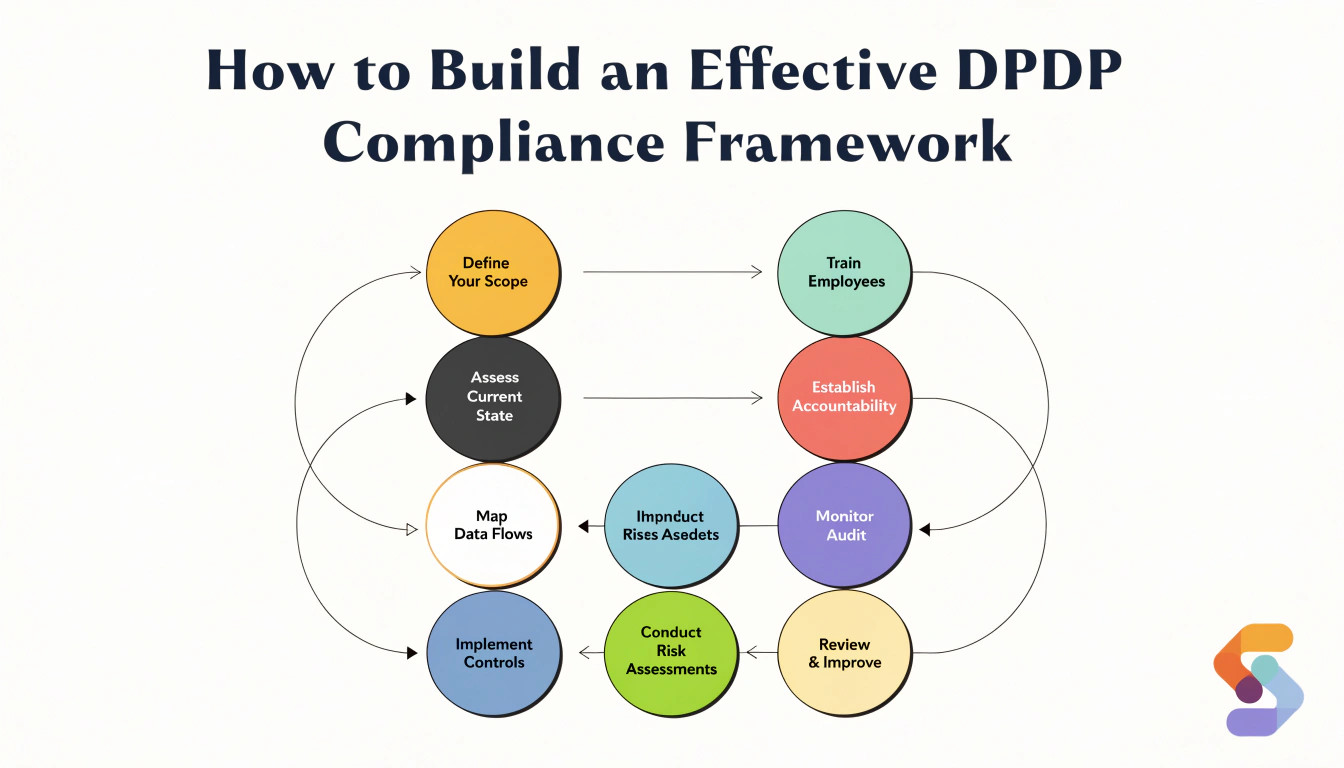
How to Build an Effective DPDP Compliance Framework
Share this article
India's Digital Personal Data Protection Act, 2023 (DPDP Act) establishes a legal framework for processing digital personal data while recognising individuals' rights to protect their personal information. For businesses, this means paying closer attention to how they collect, use, store, share and erase personal data.
The Digital Personal Data Protection Rules, 2025 provide further details about implementing the framework. Together, the Act and Rules establish responsibilities for organisations that determine why and how personal data is processed.
However, understanding the law is only the first step. Organisations also need practical processes, appropriate security measures, clear privacy notices and accountability across their operations.
Building an effective DPDP compliance framework can help businesses identify gaps in existing data practices, prepare for statutory obligations and establish responsible personal data management processes.
This guide explains the key steps involved in developing a DPDP compliance framework under India's data protection legislation.
What Is a DPDP Compliance Framework?
A DPDP compliance framework is a structured approach that helps an organisation manage digital personal data in accordance with the Digital Personal Data Protection Act, 2023 and the applicable DPDP Rules.
It brings together the policies, processes, responsibilities and technical measures used to manage personal data throughout its lifecycle.
A practical framework generally covers:
Identifying the personal data an organisation collects and processes.
Understanding the purpose and legal basis of processing.
Providing appropriate privacy notices.
Managing consent where consent is the applicable basis.
Establishing processes for handling individual rights requests.
Protecting personal data through appropriate security safeguards.
Managing third-party service providers and Data Processors.
Preparing for personal data breaches.
Reviewing data retention and erasure practices.
The Act defines a Data Fiduciary as a person who, alone or together with others, determines the purpose and means of processing personal data. A Data Processor processes personal data on behalf of a Data Fiduciary.
The Data Fiduciary remains responsible for complying with the Act in respect of processing undertaken by it or on its behalf, including processing by a Data Processor.
Who Needs a DPDP Compliance Framework?
The DPDP Act applies to the processing of digital personal data within India when the data is collected in digital form or collected in non-digital form and subsequently digitised.
It also applies to processing outside India when that processing is connected with an activity related to offering goods or services to Data Principals within India.
For example, the framework may be relevant to:
E-commerce businesses collect customer names, addresses and contact details.
SaaS companies processing customer account information.
Educational platforms managing student information.
Healthcare service providers processing digital patient information.
Employers maintaining digital employee records.
Marketing companies managing customer databases.
Online platforms collecting information through registration forms.
The Act also contains exclusions under Section 3 and exemptions under Section 17. These include processing by an individual for personal or domestic purposes and certain publicly available personal data, subject to the statutory conditions.
Businesses should assess the Act's actual scope rather than assume that every organisation or every category of information is covered in the same way.
1. Identify and Map Personal Data
The first step in developing a DPDP compliance framework is understanding what personal data the organisation processes.
Businesses often collect personal information through multiple channels, including websites, mobile applications, customer support systems, payment platforms, employee management software and marketing tools.
Without a clear understanding of these activities, it becomes difficult to identify privacy risks or establish appropriate controls.
Start by preparing a personal data inventory.
Record the following information:
Categories of personal data collected.
The individuals to whom the data relates.
The source through which the data is obtained.
The purpose of processing.
The systems and applications where the data is stored.
Internal teams that can access the information.
Third parties or processors receiving the data.
Applicable retention requirements.
For example, an e-commerce company may collect a customer's name, phone number, delivery address and order details during checkout.
The company should identify which systems receive this information, why each category is required and which service providers process it.
A data inventory is a useful compliance-management practice. Although the Act does not prescribe a universal data-inventory template, understanding processing activities helps organisations identify their responsibilities and manage personal data more effectively.
2. Identify the Applicable Legal Basis for Processing
Under Section 4 of the DPDP Act, a person may process personal data only for a lawful purpose and on the basis of either:
Consent given by the Data Principal; or
Certain legitimate uses specified under Section 7.
Businesses should not assume that consent is the only permitted basis for processing personal data.
Section 7 recognises certain situations involving voluntarily provided personal data for a specified purpose, employment-related processing and other listed circumstances.
Organisations should examine each processing activity and determine which provision applies.
A practical assessment should answer three questions:
Why is the personal data being processed?
Which provision of the Act permits that processing?
Is the processing limited to the relevant purpose?
Documenting this assessment helps organisations avoid collecting or using personal data without identifying an applicable legal basis.
3. Create Clear Privacy Notices
Transparency is an important part of the DPDP framework.
Section 5 of the Act requires a notice to accompany or precede a request for consent. The notice must explain the personal data being processed and the purpose of processing, along with information about exercising applicable rights and making complaints to the Board.
Rule 3 of the DPDP Rules, 2025 provides further requirements for these notices.
The notice must be understandable independently of other information and presented in clear and plain language. It must include an itemised description of the personal data and the specified purpose or purposes of processing.
It must also provide the relevant communication links and information about how individuals can withdraw consent, exercise their rights and make complaints to the Board.
Businesses should review their:
Website privacy notices.
Mobile application privacy notices.
Customer registration forms.
Checkout forms.
Employee data collection notices.
Newsletter and marketing subscription forms.
Avoid vague statements that do not explain why personal data is required.
For example, instead of simply stating that information is collected to improve services, explain the specific purpose for which the information is needed.
4. Establish a Proper Consent Management Process
Where consent is the basis for processing, Section 6 of the DPDP Act establishes specific requirements.
Consent must be free, specific, informed, unconditional and unambiguous, with a clear affirmative action. It must relate to the specified purpose and be limited to personal data necessary for that purpose.
Organisations should therefore review how consent is requested and recorded.
An effective consent management process should include:
Clear consent requests.
Identification of specific processing purposes.
Records of consent provided.
A process for withdrawing consent.
A mechanism for responding to consent-related requests.
Processes to stop processing where consent is withdrawn, unless another legal basis permits or requires continued processing.
The Act also requires that withdrawing consent should be as easy as giving it.
For example, if a customer subscribes to promotional emails through a website, the organisation should provide an accessible way to withdraw that consent.
Businesses should also remember that Section 7 provides for certain legitimate uses. A consent mechanism should not incorrectly treat every processing activity as consent-based.
The Role of Consent Managers
Section 6(9) recognises the role of registered Consent Managers, who provide a single point of contact through which Data Principals can give, manage, review and withdraw consent.
Rule 4 of the DPDP Rules, 2025 establishes their registration and obligations.
Under the commencement notification, Section 6(9) and Rule 4 take effect on 13 November 2026.
Businesses should understand the Consent Manager framework and assess whether it is relevant to their consent-management arrangements.
5. Implement Appropriate Data Security Safeguards
Protecting personal data is another important part of the framework.
Section 8 of the DPDP Act requires Data Fiduciaries to implement appropriate technical and organisational measures and take reasonable security safeguards to prevent personal data breaches.
Rule 6 of the DPDP Rules, 2025 specifies minimum security safeguards.
These include:
Appropriate security measures such as encryption, obfuscation, masking or virtual tokens.
Appropriate access controls for computer resources.
Logs, monitoring and review to detect unauthorised access.
Reasonable measures to maintain continued processing, including data backups.
Retention of relevant logs and personal data for one year for the security purposes specified in the Rule, subject to applicable legal requirements.
Appropriate contractual provisions with Data Processors concerning reasonable security safeguards.
Technical and organisational measures to ensure effective implementation.
Businesses should review their existing security arrangements against these requirements.
Practical measures may include role-based access, secure authentication, regular security reviews, backup testing, vulnerability management and documented incident-response procedures.
The appropriate measures will depend on the organisation's systems, the nature of the personal data and the risks involved.
6. Review Third-Party Vendors and Data Processors
Businesses rarely process all personal data using their own systems.
They may rely on cloud hosting providers, payment gateways, customer relationship management platforms, payroll software, marketing platforms and external support providers.
When these organisations process personal data on behalf of a Data Fiduciary, they may act as Data Processors under the Act.
Section 8 requires a Data Fiduciary to engage a Data Processor for activities related to offering goods or services to Data Principals only under a valid contract.
The Data Fiduciary also remains responsible for compliance with the Act in respect of processing carried out on its behalf.
Businesses should therefore:
Identify third parties that process personal data.
Understand what information is shared with each provider.
Review the purpose and scope of processing.
Include appropriate data protection and security provisions in contracts.
Establish procedures for handling security incidents.
Review data access, retention and deletion arrangements.
A vendor assessment process can help organisations understand where personal data is being processed and whether suitable safeguards are in place.
7. Establish a Data Principal Rights Management Process
The DPDP Act recognises specific rights of individuals, referred to as Data Principals.
These include:
The right to access information about personal data.
The right to correction and erasure of personal data.
The right to grievance redressal.
The right to nominate another individual in the circumstances provided by the Act.
Sections 11 to 14 explain these rights.
Rule 14 of the DPDP Rules, 2025 further addresses the process for enabling Data Principals to exercise their rights.
Businesses should establish a clear process for receiving, verifying, assigning, tracking and responding to such requests.
For example, an organisation may receive a request from a customer asking for correction of an incorrect phone number or erasure of personal data.
The organisation should have a documented procedure to verify the request, identify the relevant records, assess applicable legal requirements and take appropriate action.
Rule 14 also requires a grievance redressal system and provides that the period for responding to grievances must not exceed 90 days.
A dedicated email address, online request form or customer support channel can help businesses manage these requests.
8. Develop a Personal Data Breach Response Plan
A personal data breach may involve unauthorised access, acquisition, sharing, use, alteration, destruction or loss of access to personal data that compromises its confidentiality, integrity or availability.
Section 8 of the Act addresses breach notification obligations.
Rule 7 of the DPDP Rules, 2025 provides further details about the notification process.
When a Data Fiduciary becomes aware of a personal data breach, the prescribed framework requires it to:
Intimate each affected Data Principal without delay, using the prescribed communication approach.
Inform the Data Protection Board without delay about the breach.
Provide updated and detailed information to the Board within 72 hours of becoming aware of the breach, unless a longer period is allowed by the Board following a written request.
The notification to affected individuals must explain the nature and extent of the breach, its likely consequences, mitigation measures, recommended protective steps and relevant contact information.
Organisations should prepare an incident-response plan covering:
Identification and reporting of incidents.
Containment of the incident.
Assessment of affected personal data.
Investigation and documentation.
Required notifications.
Remediation and prevention of recurrence.
A documented response process can help organisations respond more effectively when an incident occurs.
9. Establish Data Retention and Erasure Procedures
Keeping personal data indefinitely without a continuing purpose can create unnecessary privacy and security risks.
Section 8 of the Act addresses erasure when the specified purpose is no longer being served or consent is withdrawn, unless retention is necessary for compliance with applicable law.
Rule 8 of the DPDP Rules, 2025 specifies certain time periods for particular classes of Data Fiduciaries and purposes.
It also requires retention of specified personal data, associated traffic data and processing logs for at least one year for the purposes identified in the Seventh Schedule, subject to the stated exceptions and applicable legal requirements.
This does not mean that every business must delete all personal data after one year or that every category of information must be retained for exactly one year.
Businesses should develop retention schedules that consider:
The original purpose of the collection.
Whether the purpose is still being served.
Applicable statutory retention requirements.
The specific requirements of Rule 8, where applicable.
The process for securely erasing personal data.
Deletion requirements applicable to Data Processors.
A documented retention policy can help organisations avoid unnecessary storage while meeting other legal obligations.
10. Assign Responsibilities and Review Compliance Regularly
An effective framework needs clear ownership.
Although the Act does not require every organisation to appoint a separate Data Protection Officer, it establishes additional requirements for Significant Data Fiduciaries.
Under Section 10, a Significant Data Fiduciary must appoint a Data Protection Officer based in India who represents it under the Act and is responsible to its governing body or similar governing structure.
It must also appoint an independent data auditor and undertake Data Protection Impact Assessments and data audits as prescribed.
Rule 13 provides further details about these requirements, including periodic assessments and audits.
The October 2026 Removal of Difficulties Order also clarified the wording of Section 10 concerning periodic data audits.
Businesses should assign responsibilities to relevant teams, such as:
Management: oversight and accountability.
Legal and compliance: regulatory interpretation and policy review.
IT and security: technical safeguards and incident response.
HR: employee personal data management.
Marketing: consent and customer communication.
Procurement: vendor and processor assessments.
Organisations should also review their framework periodically and update it when processing activities, systems, vendors or applicable legal requirements change.
DPDP Compliance Implementation Checklist
Businesses can use the following checklist to assess their preparation:
Area
Recommended action
Data inventory
Identify personal data and processing activities
Legal basis
Assess consent and applicable legitimate uses
Privacy notices
Review notices for clarity and required information
Consent
Establish consent recording and withdrawal processes
Security
Review safeguards, access controls and backups
Vendors
Review Data Processor contracts
Individual rights
Establish request and grievance procedures
Breach response
Prepare an incident-response and notification process
Data retention
Define retention and erasure procedures
Accountability
Assign responsibilities and conduct periodic reviews
This checklist is a practical preparation tool, not a separate statutory certification or an exhaustive statement of every legal requirement.
DPDP Act and Rules: Understanding the Implementation Timeline
The DPDP Act and DPDP Rules, 2025 use a phased commencement approach. This means that different provisions become effective on different dates.
The Central Government issued notification G.S.R. 843(E) on 13 November 2025, specifying the commencement schedule for the Act.
The DPDP Rules, 2025 were notified through G.S.R. 846(E), dated 13 November 2025, and contain a corresponding phased schedule.
The key milestones are:
Date
Implementation milestone
13 November 2025
Initial provisions of the Act and Rules commenced
13 November 2026
One-year milestone, including Section 6(9), Section 27(1)(d) and Rule 4 concerning Consent Managers
13 May 2027
Eighteen-month milestone covering most core operational provisions
The main operational requirements, including Sections 3 to 17 of the Act (subject to the specified exceptions), are scheduled to commence on 13 May 2027. This includes the main consent provisions, Data Fiduciary obligations, Data Principal rights and breach-related obligations.
Similarly, Rules 3 and 5 to 16, along with Rules 22 and 23, are scheduled to commence on 13 May 2027.
The Digital Personal Data Protection (Removal of Difficulties) Order, 2026, issued in October 2026, also made clarificatory changes to Sections 9 and 10 concerning verifiable consent for children and persons with disabilities who have lawful guardians, and periodic data audits by Significant Data Fiduciaries.
Businesses should use the phased timeline to plan their preparation while monitoring official notifications, amendments and clarifications.
Conclusion
Building an effective DPDP compliance framework requires more than updating a privacy policy or adding a consent checkbox to a website.
Organisations need to understand the personal data they process, identify the applicable legal basis, establish transparent notices, manage consent where required, protect information, oversee third-party processors and prepare for individual rights requests and personal data breaches.
The Digital Personal Data Protection Act, 2023 and DPDP Rules, 2025 provide the legal foundation for these responsibilities. Businesses that start reviewing their data practices early can identify operational gaps and prepare their systems before the relevant provisions become applicable.
A structured approach to DPDP compliance can also support better data governance, responsible information handling and customer trust.
Disclaimer
This article is intended for general informational and educational purposes only. It does not constitute legal advice, professional advice or a substitute for consultation with a qualified legal practitioner.
Reasonable care has been taken to present information based on the Digital Personal Data Protection Act, 2023, the Digital Personal Data Protection Rules, 2025, relevant Gazette notifications and subsequent legal clarifications available as of 13 November 2026.
However, laws, rules, regulatory interpretations and commencement requirements may change over time. The applicability of specific provisions depends on the nature of an organisation's activities, the personal data being processed, applicable exemptions and the commencement dates of the relevant provisions.
Readers should independently verify the latest official legal notifications and consult qualified legal professionals before making decisions or implementing compliance measures. The publisher accepts no responsibility for actions taken solely on the basis of this article.
Tags