
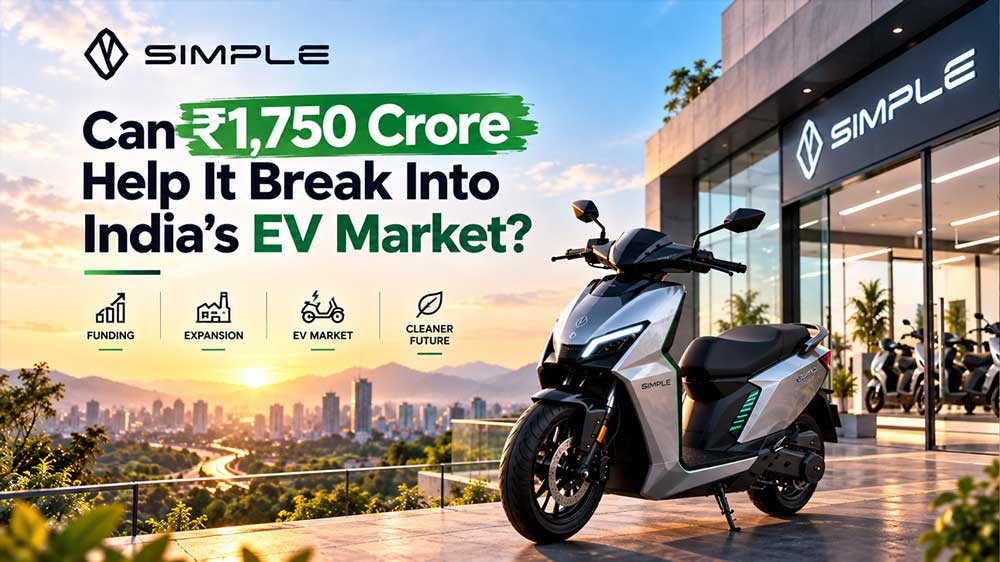
Simple Energy: Can ₹1,750 Crore Help It Break Into India's EV Market?
Share this article
Simple Energy has just raised ₹1,750 crore in its Series C funding round, giving the Bengaluru-based electric two-wheeler manufacturer substantially more capital to expand manufacturing, strengthen its supply chain and build a wider retail and service network.
The timing is important.
India's electric two-wheeler market is growing, but it is also becoming increasingly concentrated around established manufacturers such as TVS Motor, Bajaj Auto, Ather Energy and Hero MotoCorp. In September 2026, these larger players accounted for most electric two-wheeler registrations, while Simple Energy remained a much smaller participant.
That makes the ₹1,750 crore raise less about simply launching another scooter and more about whether Simple Energy can scale fast enough to become a meaningful player in India's electric two-wheeler market.
₹1,750 Crore Changes the Scale of the Ambition
The latest round is Simple Energy's largest funding round so far.
The company said the Series C round was led by the Velumani Family Office, with participation from the Haran Family Office, investor Amit Mishra and Simple Energy's founders. The funding takes the company's total capital raised to approximately ₹2,530 crore.
The fresh money is expected to be directed toward:
A new manufacturing facility
Increasing production at the existing plant
Supply-chain expansion
Retail and service network expansion
Research and development
Hiring
Marketing and other growth functions
This is significant because Simple Energy's immediate constraint has increasingly been industrial scale rather than simply product development.
Demand May Not Be the Biggest Problem
In September, Simple Energy executives said monthly demand was around 3,000–4,000 scooters, while deliveries were approximately 1,500–2,000 units. The company also reported a rolling backlog of around 2,000–2,200 vehicles.
Separately, the company said demand had increased sharply while production capacity and supplier capability were limiting how many vehicles it could deliver.
This creates an unusual situation for a young EV manufacturer.
Instead of first having to spend heavily to create demand, Simple Energy now needs to demonstrate that it can convert demand into consistent production and deliveries.
That distinction matters.
A backlog is useful only if a company can manufacture and deliver the vehicles within a reasonable timeframe. If production remains constrained, potential demand does not automatically translate into revenue.
Production Is the Immediate Test
Simple Energy had previously targeted monthly sales of 10,000 scooters by March 2027.
In June 2026, its reported manufacturing capacity was around 3,000 units per month, while monthly sales were approximately 1,500 units. The company had also been expanding its battery manufacturing line.
The latest funding now gives it substantially more financial capacity to move beyond those constraints.
Reports following the Series C round say the company currently has production capacity of approximately 10,000 units per month and operates more than 80 outlets across over 60 cities. Free
The important metric from here will therefore not simply be factory capacity.
It will be actual monthly production and retail registrations.
A factory capable of producing 10,000 scooters is very different from consistently selling 10,000 scooters.
India's EV Market Is Growing — But Competition Is Getting Harder
India's electric two-wheeler segment has expanded considerably.
Government data shows the share of electric vehicles among two-wheeler registrations increased from 0.3% in FY2020-21 to 6.1% in FY2024-25.
More recent Vahan-based data indicates that electric two-wheelers represented around 11.3% of all two-wheelers registered during September 2026 so far, although the month was still ongoing when the data was recorded. Flash Finance
The market is therefore becoming larger.
But growth is not evenly distributed.
TVS Motor, Bajaj Auto and Ather Energy were among the leading electric two-wheeler manufacturers in September, with established automobile companies capturing a substantial share of registrations.
Simple Energy therefore has to compete not only with other EV startups, but increasingly with companies that already possess:
manufacturing scale + dealer networks + financing relationships + brand recognition + service infrastructure.
The Simple Energy Product Strategy
Simple Energy has positioned itself around performance-oriented electric scooters and has been expanding its product portfolio.
Its current range includes the Simple One and Simple Wave, with the company describing its products around long-range and performance characteristics.
The Wave is particularly relevant because it takes the company into the family-scooter segment rather than focusing exclusively on performance-oriented customers.
That could potentially widen the addressable customer base.
But entering a larger segment also creates a different competitive challenge.
Family scooter buyers can place considerable importance on:
Price
Reliability
Service availability
Battery warranty
Running cost
Financing
Resale value
Charging convenience
Product specifications alone may therefore not determine purchasing decisions.
Retail Expansion Could Be as Important as Manufacturing
One of the less visible challenges for EV startups is the cost of building a reliable customer-support network.
A scooter is not purely a digital product.
Customers need somewhere to go when they have a software issue, battery problem, accident or mechanical fault.
Simple Energy has expanded its retail network to more than 80 outlets across over 60 cities, according to reports following the latest funding.
The ₹1,750 crore funding can allow the company to continue expanding this footprint.
However, the more important question is whether the network becomes economically productive.
Opening outlets is relatively easy compared with building a network that generates sufficient sales and provides sustainable after-sales support.
Battery and Supply Chain Will Matter
EV manufacturers remain exposed to the availability and cost of batteries, electronics and other components.
Simple Energy has been developing its own technology and manufacturing capabilities, including battery-related infrastructure.
Company backers have highlighted its control over areas including the chassis, battery, motor and software technology.
Greater control over critical components can potentially help with product development and supply-chain resilience.
But vertical integration also requires capital.
The ₹1,750 crore raise could therefore be viewed partly as funding for an industrial system rather than simply funding for marketing scooters.
Government Support Has Helped Build the Market
India's EV market has also benefited from government programmes.
FAME-II, which ran from 2019 to March 2024, had a total budgetary support of ₹11,500 crore and supported the sale of approximately 16.72 lakh electric vehicles across categories.
The government subsequently introduced the PM E-DRIVE scheme, which provides targeted demand incentives for multiple EV categories, including electric two-wheelers. As of January 27, 2026, the government reported 19.19 lakh electric two-wheelers sold under the scheme.
This policy support has helped reduce upfront costs for consumers and accelerate adoption.
However, manufacturers cannot assume that incentives alone will create sustainable demand.
The long-term market will depend increasingly on product economics, charging convenience, battery durability, financing and total cost of ownership.
Simple Energy's Position Is Still Small
This is perhaps the most important reality behind the funding story.
During the first eight months of 2026, Simple Energy recorded approximately 10,450 electric two-wheeler registrations, according to Vahan-based data, compared with more than 3.5 lakh for TVS Motor and more than 3 lakh for Bajaj Auto over the same period.
That illustrates the size of the gap.
The ₹1,750 crore investment gives Simple Energy resources to narrow it, but capital does not automatically create market share.
The company needs to translate investment into:
Higher production → higher deliveries → stronger dealer utilisation → better customer support → repeat demand → improving unit economics.
That execution cycle will matter more than the headline size of the funding round.
The IPO Adds Another Layer
Simple Energy has previously indicated plans for an IPO in the second half of FY28. In June, the company said it was targeting substantial production growth and had ambitions to increase monthly sales to 10,000 scooters by March 2027.
The new funding makes that roadmap more financially feasible.
But a future IPO would place greater emphasis on measurable business fundamentals.
Investors would likely examine:
Revenue growth
Monthly vehicle registrations
Gross margins
Contribution margins
Cash burn
Production utilisation
Warranty costs
Customer acquisition costs
Dealer economics
Battery and component costs
Working-capital requirements
The company's ability to demonstrate improving economics alongside volume growth will therefore be important.
Can ₹1,750 Crore Help Simple Energy Break Into the Market?
The funding gives Simple Energy a much larger financial base, but it does not remove the central challenge.
The company now has to prove that it can scale manufacturing, strengthen suppliers, expand distribution and convert its reported demand into sustained sales.
The opportunity exists because India's electric two-wheeler market is growing rapidly.
The difficulty is that the market is no longer waiting for competitors.
Established manufacturers are already expanding their electric portfolios, while other EV startups are also building their own manufacturing and distribution networks.
For Simple Energy, the next phase is therefore likely to be defined less by fundraising and more by execution.
If the company can turn its new capital into significantly higher production and registrations while maintaining product quality and financial discipline, the funding could materially change its position in the market.
If production grows faster than sustainable demand, however, additional factory capacity could become an expensive asset rather than a competitive advantage.
The next 12–18 months will therefore be less about how much money Simple Energy has raised and more about what that money produces.
Tags