
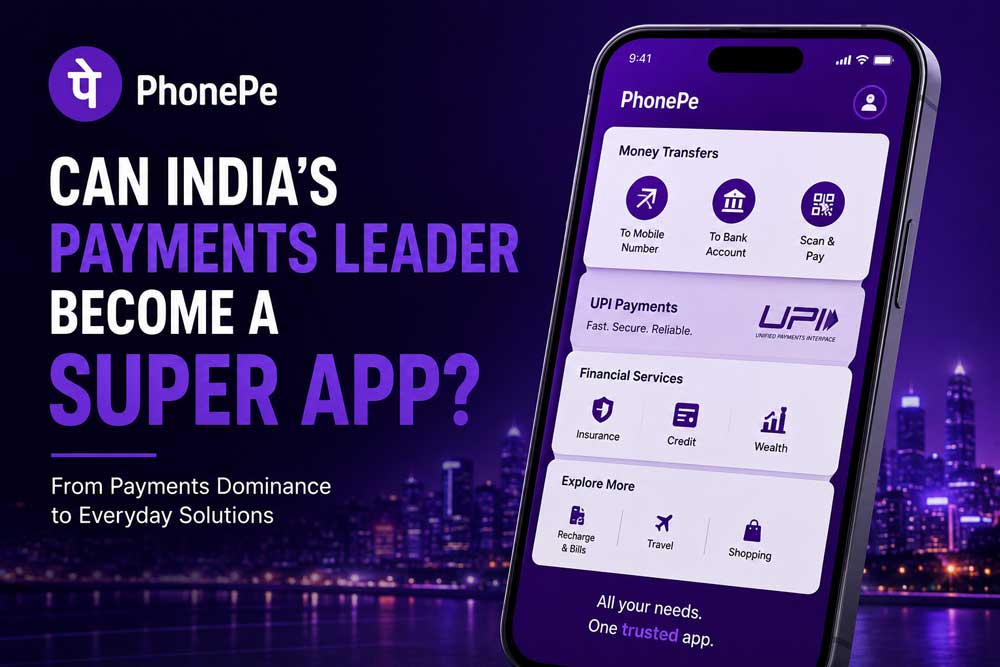
PhonePe: Can India's Payments Leader Become a Super App?
Share this article
PhonePe: Can India's Payments Leader Become a Super App?
PhonePe has already become one of India's most important digital-payment platforms. Its dominance in UPI gives the company something most fintech startups struggle to build: massive consumer reach and transaction frequency.
But payments alone can be a difficult business to monetise.
That raises a bigger strategic question: Can PhonePe turn its payments leadership into a super app spanning financial services, commerce and everyday consumer needs?
UPI Gave PhonePe the Distribution
PhonePe's biggest asset is its enormous UPI user base.
The platform has built strong consumer habits around sending money, paying bills and making merchant payments. That creates repeated engagement without requiring customers to consciously return to the app for a specific financial product.
This is important because a super app needs one thing above everything else: distribution.
PhonePe already has it.
The challenge is converting that distribution into multiple revenue streams.
Moving Beyond Payments
PhonePe has expanded into areas including insurance, lending, wealth management, travel and other financial services.
Its financial-services platform gives the company an opportunity to distribute products from multiple partners rather than depending entirely on payment-related economics.
The strategic logic is straightforward.
A user who already trusts PhonePe for payments may be more willing to explore insurance, mutual funds or credit through the same platform.
This creates a potential flywheel:
Payments → Engagement → Financial Products → Higher Revenue per User.
Commerce Could Be the Bigger Opportunity
A true super app usually goes beyond financial services.
PhonePe has also built businesses around travel, shopping and digital commerce, giving it the potential to capture more consumer spending inside its ecosystem.
Its acquisition of Indus Appstore is particularly interesting because it gives PhonePe a strategic position in India's mobile-app ecosystem.
The opportunity is not necessarily to copy China's super-app model.
India's market is different, with consumers already using multiple specialised platforms.
PhonePe therefore needs to prove that integrating more services actually creates incremental value, rather than simply adding features.
Scale Does Not Automatically Mean Profit
This is where the story becomes more complicated.
PhonePe's enormous UPI transaction volumes create scale, but UPI payments themselves have limited direct monetisation compared with traditional card networks.
The company therefore needs higher-margin businesses to monetise its customer relationships.
Insurance distribution, lending, wealth management, advertising and commerce could potentially provide those additional revenue streams.
But each comes with its own challenges, including regulation, customer acquisition costs and competition.
Walmart Provides Financial Strength
PhonePe also has an unusual advantage among Indian fintech companies: strong institutional backing.
Walmart has been a major investor in PhonePe, giving the company access to significant financial resources as it expands.
That reduces some of the pressure faced by startups that must rapidly achieve profitability to preserve cash.
However, financial backing cannot solve the fundamental question of unit economics.
PhonePe still needs to demonstrate that each additional service increases customer lifetime value faster than the cost of building and operating it.
Investor Perspective
For investors, the most important metrics are therefore likely to be:
Monthly active users
UPI transaction share
Revenue per customer
Financial-services adoption
Insurance and lending distribution
Commerce growth
Customer acquisition costs
Contribution margins
Path to sustainable profitability
The critical question is not whether PhonePe can add more services.
It clearly can.
The question is whether consumers will actually use those services regularly.
Can PhonePe Become India's Super App?
PhonePe has already solved the hardest part of the super-app equation: consumer distribution.
Its UPI leadership gives it an enormous starting advantage.
But a super app cannot be built simply by placing dozens of services inside one application.
The services must reinforce one another.
Payments should generate engagement. Engagement should create opportunities for financial products. Financial products should increase customer value. Commerce should add another layer of monetisation.
If PhonePe can create that ecosystem, its UPI leadership could become the foundation of a much larger business.
The next chapter for PhonePe is therefore not about becoming India's biggest payments app. It is about proving that payments can become the gateway to a much broader consumer-finance platform.
Original Analysis
PhonePe's super-app opportunity is fundamentally a monetisation challenge, not a distribution challenge. UPI has already given the company massive reach. The next test is whether financial services, commerce and other products can increase revenue per user without making the platform unnecessarily complex.
Tags