
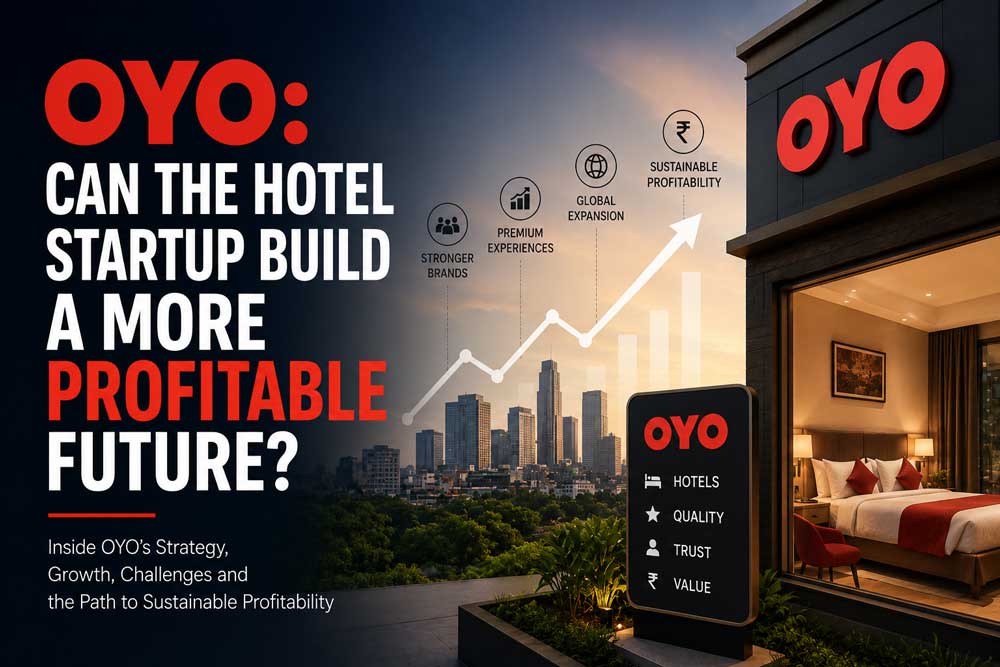
OYO: Can the Hotel Startup Build a More Profitable Future?
Share this article
OYO spent years proving that India's fragmented hotel market could be brought onto a technology platform. Its early strategy was built around affordable rooms, standardisation and a large network of partner properties.
But the company's next challenge is very different.
Can OYO turn scale into consistently profitable growth?
The question has become more important as the company moves toward a potential public listing and shifts its business toward premium hotels, company-serviced properties and international markets.
From Hotel Aggregator to Hospitality Platform
OYO's original model relied heavily on partnering with independent hotels and helping them improve occupancy, distribution and pricing.
That created scale, but scale alone does not guarantee attractive economics.
The company has increasingly moved toward a more controlled portfolio, including premium brands and company-serviced hotels. Its acquisition of G6 Hospitality in the United States also expanded its international footprint.
The strategy is essentially moving from "more rooms" to "better economics per room."
The Numbers Are Improving
OYO's parent company, PRISM, reported a significant improvement in FY26.
According to its latest annual results, PRISM's FY26 revenue increased 50% to ₹9,358 crore, while EBITDA more than doubled to ₹2,594 crore. Gross booking value jumped 88.5% to ₹30,683 crore.
Those numbers suggest the company is achieving stronger operating leverage as its network expands.
But there is an important caveat.
PRISM reported FY26 net profit of ₹994 crore, yet that figure included a ₹678 crore deferred-tax credit.
That means headline profit should not automatically be treated as proof that the underlying business is generating ₹994 crore of sustainable economic profit.
Premiumisation Could Be the Bigger Opportunity
One of OYO's most important strategic shifts is premiumisation.
Higher-quality hotels can potentially generate stronger room rates, better customer retention and higher revenue per property.
The company has expanded brands such as Townhouse and Sunday Hotels, targeting consumers who are willing to pay more for consistency and experience.
This could improve economics without requiring OYO to chase unlimited room-count growth.
The company's global hotel network also gives it the opportunity to spread technology, pricing and operating capabilities across multiple markets.
The G6 Acquisition Changes the Equation
The acquisition of G6 Hospitality, which includes Motel 6 in the United States, has materially increased OYO's international scale.
It also provides access to an established hospitality business rather than requiring OYO to build every market from scratch.
But acquisitions create another challenge: integration.
The long-term success of G6 will depend on whether OYO can improve operating efficiency without losing the strengths of the acquired brands.
The Profitability Test
For investors, the biggest question is no longer whether OYO can grow.
It clearly can.
The more important metrics are:
Revenue per hotel
Occupancy rates
Average room rates
EBITDA margins
Operating cash flow
Debt and finance costs
Organic growth
Return on invested capital
This distinction is particularly important because hospitality is a capital-intensive and cyclical business.
A company can report strong revenue growth while still struggling to generate attractive returns on capital.
Can OYO Build a More Profitable Future?
OYO's opportunity is to become less dependent on simply adding hotels and more focused on improving the economics of every property it operates or services.
Premiumisation, company-serviced hotels, international expansion and technology can all support that strategy.
But the real test will be whether reported earnings increasingly translate into sustainable operating cash flow rather than accounting benefits or acquisition-driven growth.
OYO's next chapter should therefore be measured not by how many hotels it can add, but by how much profitable value it can create from the hotels already inside its ecosystem.
Original Analysis
OYO's biggest opportunity is shifting from network expansion to network economics. The company has demonstrated that it can scale; its next challenge is proving that premiumisation, operating leverage and international expansion can produce durable, cash-backed profitability.
Tags