
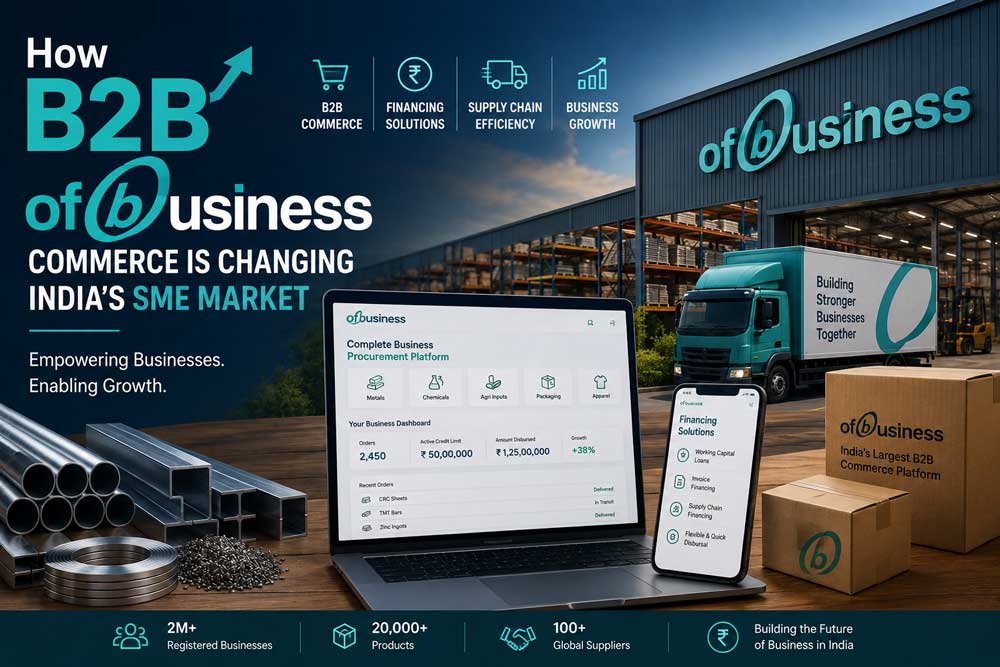
OfBusiness: How B2B Commerce Is Changing India's SME Market
Share this article
India's small and medium enterprises have traditionally operated through fragmented supply chains. A manufacturer needing steel, chemicals or other raw materials often has to negotiate with multiple suppliers, manage price fluctuations and arrange working capital separately.
OfBusiness is trying to change that model.
Founded in 2015, the company combines B2B commerce with financing, allowing SMEs to source materials while also accessing financial services. Its B2B commerce platform spans metals, chemicals, agri-products and apparel, while its wider ecosystem is designed around the financial and procurement needs of businesses.
The strategy is increasingly moving beyond simply selling products.
From Marketplace to Business Infrastructure
OfBusiness operates differently from a conventional e-commerce marketplace.
Instead of simply connecting buyers and sellers, it seeks to control more parts of the procurement process, including sourcing, pricing, financing and increasingly manufacturing.
That creates a powerful potential loop:
Procurement → Financing → Higher transaction volume → More data → Better pricing and credit decisions.
For SMEs, the benefit is convenience and potentially better working-capital access.
For OfBusiness, the benefit is a deeper relationship with each business customer.
Scale Is Becoming More Important
The company's FY26 numbers show how large the model has become.
OfBusiness reported consolidated revenue of ₹20,645 crore in FY26, while profit after tax increased 21% to ₹724 crore. Its commerce business generated ₹19,174 crore in revenue and EBITDA of ₹769 crore.
More importantly, commerce EBITDA margin increased from 2.6% to 4%, while operating cash flow rose to ₹1,302 crore.
The company also became free-cash-flow positive in its commerce business, generating ₹390 crore of FCFF during FY26.
That shift is strategically important.
For years, technology companies were often valued primarily on growth.
For B2B commerce, however, cash generation and working-capital discipline can be equally important.
Financing Makes the Model Different
OfBusiness' lending ecosystem adds another layer.
Its lending arm, Oxyzo, reported FY25 operating revenue of ₹1,207 crore and net profit of ₹339 crore.
This combination gives OfBusiness something many marketplaces lack: the ability to participate in both the transaction and financing relationship.
For an SME, buying raw materials and obtaining working capital are closely connected problems.
OfBusiness is attempting to solve both.
Why This Matters for India's SMEs
India's SME sector is becoming increasingly formal and digital.
As businesses adopt online procurement, digital payments, organised financing and technology-led supply chains, platforms that connect these functions could become increasingly valuable.
OfBusiness is also expanding internationally. Its exports more than doubled to over ₹2,500 crore in FY26, reaching more than 70 countries.
That creates another growth avenue: helping Indian manufacturers move from domestic supply chains into global markets.
The Bigger Risk
The model is attractive, but it is not risk-free.
B2B commerce operates on relatively thin margins, while financing introduces credit risk and capital requirements.
OfBusiness' FY26 revenue actually fell 7% after it exited lower-return businesses.
That may look negative at first glance, but it could represent a healthier strategy if lower revenue produces better margins and stronger cash generation.
For OfBusiness, the next phase is therefore not about becoming India's biggest B2B marketplace. It is about becoming the financial and procurement infrastructure behind India's SME economy.
Original Analysis
OfBusiness' real opportunity lies in combining commerce, financing and supply-chain intelligence. If these businesses reinforce one another, the company can potentially earn more from each SME relationship while making procurement easier and financing more accessible.
Tags