
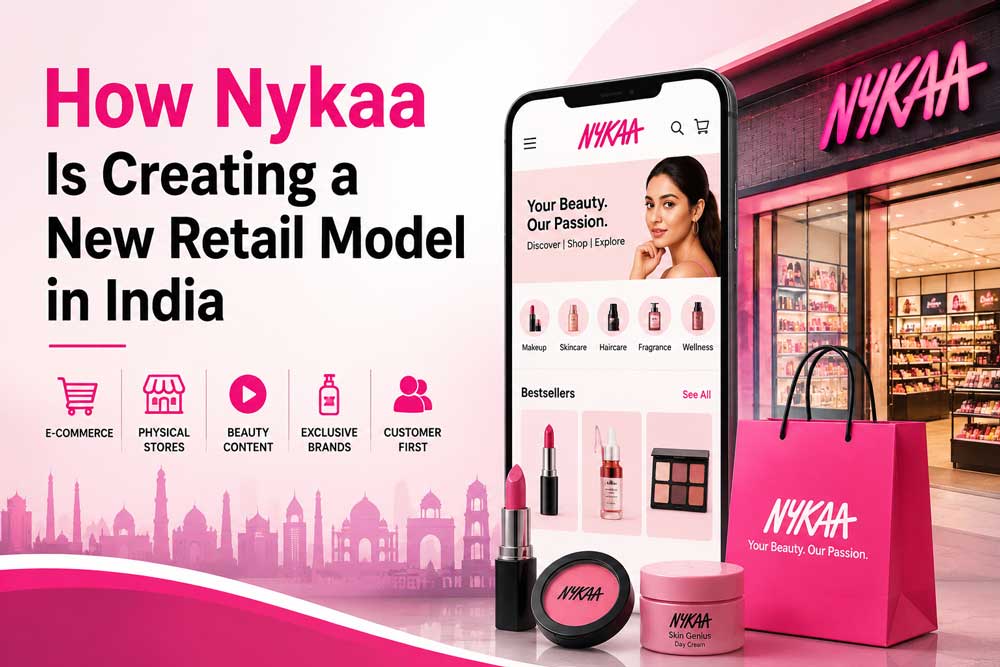
How Beauty E-Commerce Nykaa Is Creating a New Retail Model in India
Share this article
India's beauty market is changing from a largely store-driven business into a more connected combination of e-commerce, physical retail, content, brands and consumer communities. Among the companies driving this shift, Nykaa has built a particularly distinctive position.
Founded as an online beauty retailer, Nykaa is no longer simply competing with traditional stores on price or convenience. Its larger strategy is to connect digital discovery with physical shopping while building relationships with brands and consumers.
The important question is therefore not whether Nykaa is an e-commerce company.
It is whether Nykaa is becoming a new type of beauty retailer.
From Online Store to Beauty Ecosystem
The original advantage of beauty e-commerce was straightforward: customers could access a much wider selection of products than they might find in a local store.
But online retail eventually becomes competitive. Customers can compare prices, brands can sell directly to consumers, and large marketplaces can offer enormous product selections.
Nykaa's response has been to build more around the shopping experience.
Its platform combines product discovery, beauty content, brand information, recommendations and commerce. This is particularly relevant in beauty because customers often need information before purchasing a product.
Someone buying skincare, cosmetics or haircare products may want to understand ingredients, usage, suitability and trends before making a decision.
That makes content part of the retail experience.
Physical Stores Change the Equation
Nykaa has also expanded its physical retail presence.
This creates an omnichannel model where online and offline channels can support each other.
A customer may discover a product online, visit a store to experience it physically and later purchase through the app. Another customer might discover a product inside a store and subsequently reorder it online.
This reduces the traditional distinction between an e-commerce customer and a physical-store customer.
The bigger opportunity is the customer relationship across both channels.
For beauty brands, this model can also be attractive because physical stores provide visibility while the digital platform provides data, discovery and broader product distribution.
Private Brands Add Another Layer
Nykaa's retail strategy goes beyond selling products made by other companies.
Its portfolio of owned and exclusive brands gives the company another potential source of value.
A retailer that controls or participates in the economics of its own brands can potentially achieve greater control over:
Product positioning
Pricing
Packaging
Distribution
Customer feedback
Product development
Margins
This changes the relationship between retailer and supplier.
Instead of only asking, “How many products can we sell?”, the company can also ask:
“Which products should we build?”
That is a fundamentally different retail model.
The Power of Beauty Content
Beauty is unusually dependent on discovery.
Consumers constantly encounter new products through creators, tutorials, reviews and social media.
Nykaa has been able to operate at the intersection of content and commerce.
A consumer may first encounter an idea through beauty content and then move directly toward product discovery and purchase.
This creates a potential feedback loop:
Content → Discovery → Purchase → Customer Data → Better Recommendations → More Discovery
Traditional retailers have historically had less ability to connect these stages digitally.
For Nykaa, this connection can become a competitive advantage if it continues to produce useful content rather than simply promotional material.
The Competition Is Getting Tougher
Nykaa's opportunity does not come without significant challenges.
Beauty e-commerce is attracting competition from large marketplaces, quick-commerce companies, brand-owned websites, social commerce and offline retailers.
The customer also has more choices than ever.
Price comparison is increasingly easy, while popular products can quickly become available across multiple platforms.
This means Nykaa cannot depend only on having a large catalogue.
It needs to provide reasons for customers to return.
Those reasons could include:
Trust, product authenticity, selection, content, exclusive brands, personalised discovery and a strong physical retail experience.
Quick Commerce Could Change Beauty Shopping
Another development worth watching is the growth of quick commerce in India.
Companies built around rapid delivery can potentially capture urgent and convenience-driven purchases in beauty and personal care.
But speed may not be equally valuable for every beauty purchase.
Someone replacing toothpaste or shampoo may value immediate delivery.
A customer choosing a new skincare routine may care more about information, reviews, recommendations and product confidence.
This creates an interesting divide.
Quick commerce may win on convenience, while specialised platforms can compete on discovery and expertise.
Nykaa's challenge will be balancing both.
What Makes Nykaa's Model Different?
Nykaa's evolution illustrates a broader change taking place in Indian retail.
The strongest consumer platforms increasingly want to control several parts of the customer journey.
For Nykaa, that journey can look like:
Discover a trend → Learn about a product → Compare options → Purchase online or offline → Reorder → Discover something new
The more of that journey the company can own, the more valuable its relationship with the customer becomes.
This is also why the company's physical stores, digital platform, content strategy and owned brands should not be viewed as completely separate businesses.
They can reinforce one another.
The Bigger Retail Lesson
Nykaa's strategy points toward a broader shift in Indian consumer businesses.
The future of retail may not be about choosing between online and offline.
Instead, successful retailers may combine:
Digital commerce
Physical stores
Content
Consumer communities
Private brands
Data
Personalisation
The retailer increasingly becomes part marketplace, part media platform and part brand builder.
For beauty, where trust and discovery strongly influence purchasing decisions, this combination can be particularly powerful.
Conclusion
Nykaa started by bringing beauty shopping online, but its larger opportunity lies beyond e-commerce.
By combining digital commerce, physical stores, beauty content and owned brands, the company is attempting to create a more integrated retail model for India's rapidly evolving consumer market.
The strategy will face growing competition from marketplaces, quick-commerce platforms and direct-to-consumer brands.
But the underlying idea is significant.
The next generation of Indian retail may not be defined by where customers buy products. It may be defined by how effectively a company connects discovery, trust, experience and purchase.
For Nykaa, that could be the difference between remaining a successful beauty marketplace and becoming one of India's most influential consumer retail platforms.
Tags