
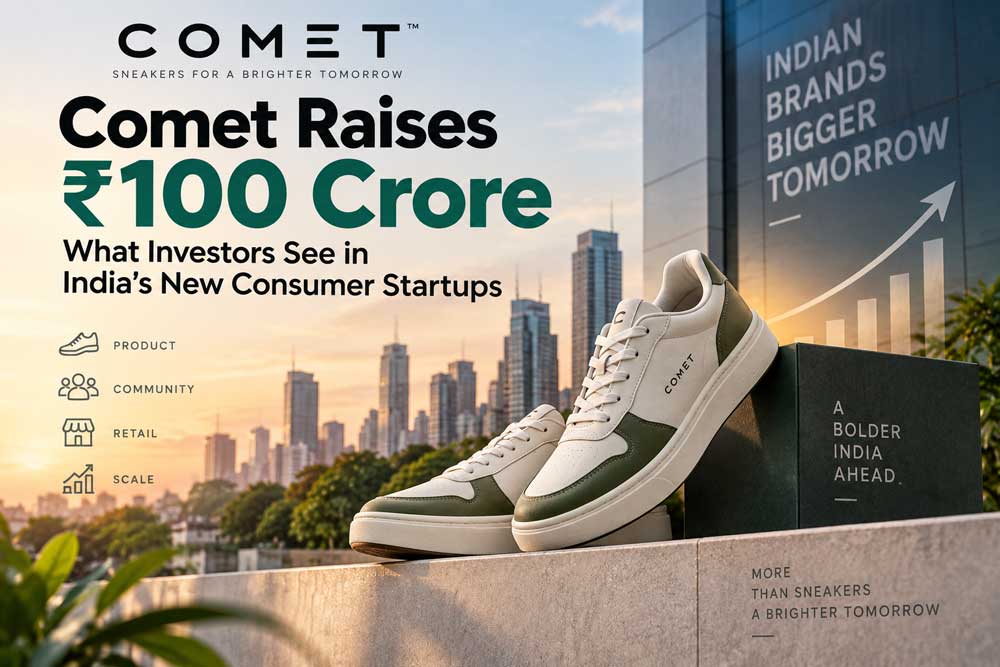
Comet Raises ₹100 Crore: What Investors See in India’s New Consumer Startups
Share this article
India’s consumer startup market is entering a different phase. The easy version of the D2C story was about building an audience online, spending aggressively on marketing and expanding quickly. The harder phase is about proving that a young brand can become a repeat-purchase business with products, distribution and economics strong enough to survive beyond its initial hype.
Comet’s latest fundraise offers a useful example.
From Sneaker Brand to Scaled Consumer Company
Founded in 2023 by Utkarsh Gupta and Dishant Daryani, Bengaluru-based Comet has raised ₹100 crore in Series B funding, led by Verlinvest. Existing investors Elevation Capital and Nexus Venture Partners also participated, alongside several angel investors.
The company says its revenue has grown ninefold since its previous institutional fundraise, a ₹42.3 crore Series A round in 2024.
That growth explains why investors are interested. But the more revealing part of the round is where the money is going.
Comet plans to use the capital for retail expansion, technology, product development and R&D, including its own sole moulds and tooling. It currently has four footwear models and plans to double that number to eight.
Why Physical Retail Matters
Comet expects to reach 10 stores in September 2026 and aims for 20 stores by the end of FY27. The company says its existing stores are outperforming the broader athleisure category in their markets. (ETRetail.com)
This is an important strategic shift.
A digital-first brand can acquire customers quickly, but footwear is highly experiential. Customers want to see the product, try different sizes and understand comfort and design before purchasing.
Retail can therefore become more than another sales channel. It can become part of the brand-building strategy.
The broader Indian consumer market is increasingly giving homegrown brands room to compete with established global names, but scale requires much more than social-media visibility.
Investors Are Betting on Product, Not Just Marketing
Comet's investment in proprietary tooling is particularly interesting.
Instead of depending entirely on generic manufacturing capabilities, greater control over product engineering could allow the company to develop distinctive designs and improve its ability to launch new products.
That creates a potentially stronger moat.
But it also increases complexity and capital requirements.
More stores mean higher fixed costs. More products mean greater inventory risk. More manufacturing control requires additional investment.
So the next test is not simply whether Comet can grow revenue.
It is whether growth can remain efficient while the business becomes more capital-intensive.
The Bigger Consumer Startup Lesson
The new generation of Indian consumer startups may be moving away from the pure D2C playbook.
The winning formula could increasingly look like:
Community → Product → Brand → Retail → Scale
Comet appears to have built the first three and is now aggressively investing in the fourth.
The ₹100 crore round gives it the capital to attempt that transition. The real question is whether the company can turn early momentum into a durable footwear brand without allowing expansion costs to outrun demand.
Investors are not simply funding Comet's next collection. They are betting that a young Indian sneaker brand can become a scaled consumer company.
Tags