
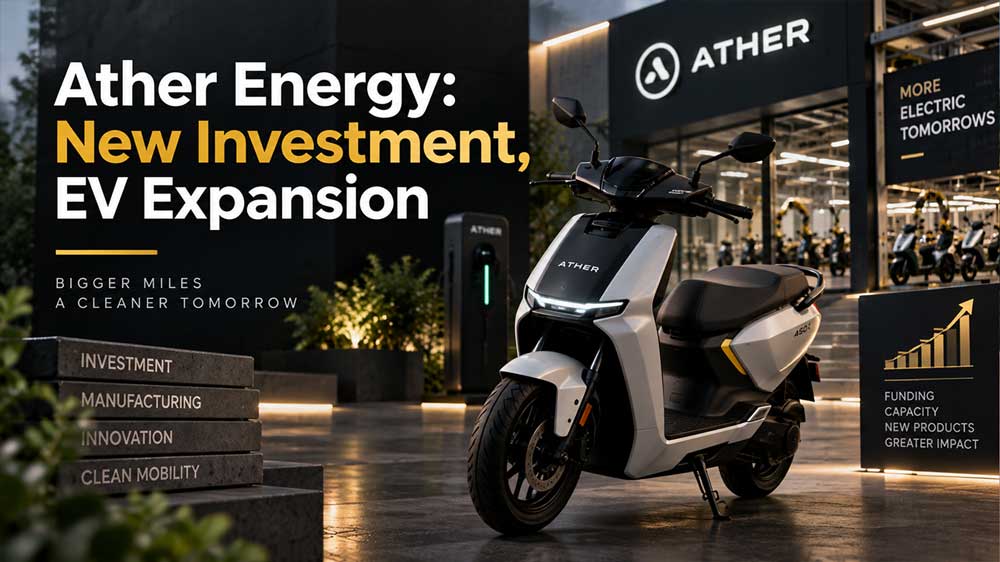
Ather Energy: Can New Investment Fuel EV Expansion?
Share this article
Ather Energy is entering a new phase of expansion with substantially more capital behind its electric two-wheeler business.
In July 2026, Ather completed a ₹1,300 crore qualified institutional placement (QIP), while existing investors committed another ₹1,200 crore, taking the broader fundraising programme to ₹2,500 crore. The company said the capital would support manufacturing expansion and new product development, including investment in its upcoming manufacturing capacity.
Then, in August, Hero MotoCorp agreed to invest up to ₹1,758 crore to increase its stake in Ather from 29.88% to approximately 32.8%. The transaction involves Hero acquiring additional shares from an existing shareholder.
Together, these developments put Ather in a stronger capital position as it attempts to expand volumes, manufacturing capacity and its presence in India's increasingly competitive electric two-wheeler market.
But the bigger question is whether additional capital can translate into sustainable scale and improving profitability.
Ather Has Already Demonstrated Strong Volume Growth
Ather's FY26 numbers show why investors are paying attention to the company.
The company sold 262,942 electric two-wheelers in FY26, a 69% year-on-year increase. Quarterly volumes reached a record 83,418 units in Q4 FY26, up 76% year-on-year.
Total income increased 66% to ₹3,823 crore, while adjusted gross margin rose 116% to ₹925 crore. Ather also reported a significant improvement in EBITDA margins, although the business remained EBITDA-negative for the full year.
The company also expanded its retail footprint substantially.
Ather ended FY26 with approximately 700 Experience Centres, compared with 351 at the end of FY25, while its service network reached about 548 centres. Its LECCS charging ecosystem also crossed 6,000 charging points.
This creates an important relationship between capital and growth.
More manufacturing capacity requires investment, but so does retail expansion, service infrastructure, charging infrastructure, product development and inventory.
Ather is therefore attempting to build an entire EV ecosystem rather than simply increase scooter production.
Why the ₹2,500 Crore Fundraise Matters
The QIP and additional investor commitments provide Ather with capital at a time when the company is trying to move from rapid expansion toward greater operating leverage.
The company has identified manufacturing expansion and new products as important uses of the capital. Its Factory 3.0 project at AURIC is intended to provide additional scale and efficiency, while its new EL platform is designed to address a larger portion of India's electric two-wheeler market.
The strategic logic is straightforward:
More capacity → more vehicles → greater factory utilisation → potential operating leverage.
But the sequence only works if demand grows alongside production.
Ather therefore needs its new capacity to be matched by strong product-market fit, distribution and competitive pricing.
Hero MotoCorp's Increasing Commitment
Hero MotoCorp's increasing investment adds another dimension to Ather's expansion.
Hero initially became a major Ather shareholder and has continued increasing its exposure. The latest proposed ₹1,758 crore transaction would take its stake to approximately 32.8%.
For Ather, having a major established two-wheeler manufacturer increase its financial exposure provides more than capital.
Hero brings experience in:
Large-scale manufacturing
Supply chains
Distribution
Two-wheeler markets
Vendor relationships
International markets
That does not automatically guarantee commercial success for Ather, but it gives the EV maker a strategic relationship with an established automotive company.
The Rizta Has Already Changed Ather's Market
One of the biggest changes in Ather's business has been its move beyond a predominantly premium customer base.
The Rizta helped the company address the family scooter segment and broaden its potential customer base.
Ather's own FY26 results say Rizta was a major driver of market-share gains and helped the company expand its retail network. The company ended FY26 with an 18.6% national electric two-wheeler market share according to its reported Vahan-based data.
This matters because Ather's next stage of growth depends partly on moving from a premium-focused EV brand toward a larger-volume player.
Its recently launched Konarc, starting at ₹99,999, is another step into the mass-market segment. Recent investor and analyst meetings have focused on volume growth and improving contribution margins as Ather attempts to scale this part of the business.
The Biggest Opportunity: Scale
The Indian electric two-wheeler market is becoming increasingly competitive.
Ather faces established manufacturers such as Hero MotoCorp, TVS Motor and Bajaj Auto, alongside EV-focused companies including Ola Electric and newer players entering different price segments.
In this environment, scale can become an important competitive advantage.
A larger production base can potentially reduce manufacturing costs. Higher volumes can spread fixed expenses across more vehicles. A wider retail network can improve accessibility. More vehicles on the road can increase opportunities for software, servicing, accessories, subscriptions and charging revenue.
Ather's FY26 results already show the beginnings of this broader ecosystem. Non-vehicle revenue—including software subscriptions, charging, accessories, spares and service—accounted for 13% of total income in FY26.
That gives Ather another potential source of higher-margin revenue beyond selling scooters.
But More Capital Also Raises the Execution Bar
Fresh capital solves one problem: funding growth.
It does not automatically solve another: earning an adequate return on that growth.
Ather now has to demonstrate that its investment in factories, products and distribution can translate into:
Higher volumes
Better factory utilisation
Improving gross margins
Lower losses
Stronger cash generation
Sustainable customer demand
The company has already been moving in that direction. Its FY26 EBITDA margin improved significantly year-on-year, while adjusted gross margin expanded sharply.
The next stage is converting those improvements into a more durable profitability profile.
Can New Investment Strengthen Ather's Expansion?
The answer depends on what Ather does with the capital.
If the additional funding primarily supports productive capacity, successful new products and distribution expansion, it can accelerate the company's transition toward scale.
The QIP gives Ather additional financial resources, while Hero MotoCorp's increased stake strengthens the strategic relationship. At the same time, the company's recent operating performance suggests that volume growth and unit economics are moving in a more favourable direction.
However, the competitive environment means Ather cannot rely on capital alone.
The company will need to prove that its new products can generate substantial incremental demand without sacrificing margins.
What to Watch Next
The next phase of Ather's story can be tracked through five indicators:
1. Production capacity
How quickly can new manufacturing capacity become operational and productive?
2. Konarc and EL platform volumes
Can Ather use its new products to reach a significantly larger customer base?
3. Gross and EBITDA margins
Can increasing volumes translate into sustained improvement in unit economics?
4. Retail productivity
Can the expanding Experience Centre network generate sufficient sales per location?
5. Non-vehicle revenue
Can software, charging, service and accessories become a larger and more profitable part of the business?
These indicators will reveal whether Ather's latest capital infusion is primarily financing expansion or helping create a more scalable business model.
The Bigger EV Business Lesson
Ather's latest funding cycle illustrates an important stage in India's EV industry.
The first phase of India's EV industry was largely about building the product and proving consumer demand. Ather's journey is closely connected to the evolution of India's electric two-wheeler market, where product innovation, charging infrastructure and customer adoption are shaping the next stage of mobility.
The next phase is about manufacturing at scale, reaching more customers and improving economics.
Ather now has substantially more capital to pursue that second phase. Its challenge is to convert money into manufacturing capacity, capacity into vehicles, vehicles into market share, and market share into sustainable profitability.
The company's recent numbers show meaningful progress in volume, revenue and gross margin.
The next question is whether that progress can continue as Ather moves deeper into India's mass-market electric two-wheeler segment.
Tags