
Apple's Next Growth Cycle: Services, AI and Beyond
Share this article
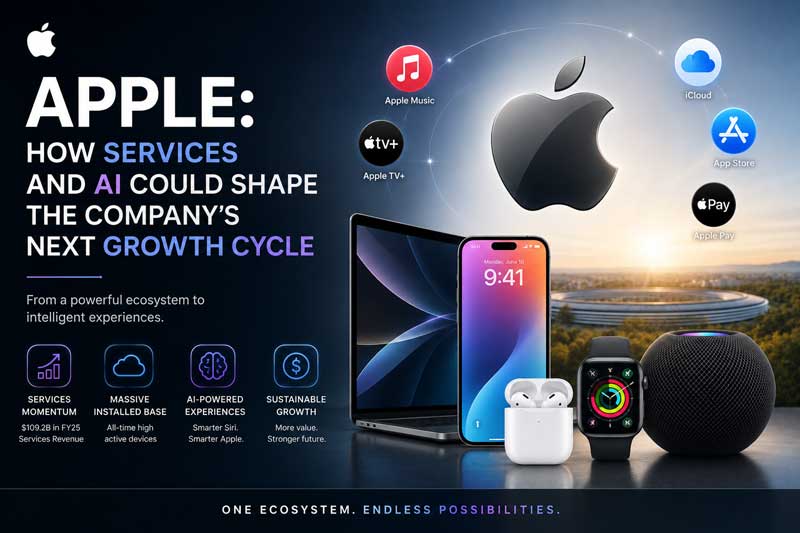
Apple has already built one of the world's most valuable technology ecosystems. The iPhone remains its economic engine, but the company's next major growth cycle may depend increasingly on two areas: Services and artificial intelligence.
The challenge is that Apple can no longer rely on simply selling more iPhones to generate the same level of growth. Its installed base is already enormous. The next opportunity is to extract more value from the customers and devices it already has.
Services Are Becoming More Important
Apple's Services business has transformed from a supporting segment into a major source of revenue.
In fiscal 2025, Apple generated $109.2 billion in Services revenue, compared with $96.2 billion a year earlier. Services represented more than a quarter of Apple's total annual revenue. (apple.com)
The momentum continued in fiscal 2026. In Apple's June 2026 quarter, Services revenue reached approximately $30.7 billion, up 12.1% year over year. (apple.com)
Apple's Services ecosystem includes the App Store, Apple Music, iCloud, Apple TV, Apple Pay, advertising and other subscription-based businesses.
The strategic advantage is obvious: unlike hardware, many Services revenues can recur after the initial device purchase.
Apple's enormous installed base makes this particularly powerful. The company reported an all-time high active-device installed base in its June 2026 results. (apple.com)
That means Apple does not necessarily need to find a completely new customer to create additional revenue.
AI Could Make the Ecosystem More Valuable
Artificial intelligence represents Apple's second major opportunity.
At WWDC26, Apple introduced the next generation of Apple Intelligence and a redesigned Siri AI, designed to understand personal context, interact across applications and perform system-level actions. (apple.com)
This could become strategically important because Apple has something many AI competitors do not: direct access to the user's device ecosystem.
An AI assistant integrated into the iPhone, Mac, Watch and other Apple products could potentially become the interface through which users search, communicate, organise information, make purchases and use applications.
If Apple succeeds, AI would not simply be another feature.
It could become a new layer connecting the entire Apple ecosystem.
The Bigger Opportunity: AI + Services
The most interesting possibility is the combination of AI and Services.
Imagine an AI assistant that can manage iCloud information, recommend Apple Music content, organise travel, interact with applications, assist with shopping and help users manage subscriptions.
Every additional interaction could potentially strengthen Apple's ecosystem.
Apple has already started integrating Apple Intelligence into Services. In its 2025 Services update, the company highlighted AI-powered capabilities in Apple Wallet, Maps, Podcasts and other products. (apple.com)
The long-term opportunity is therefore not necessarily to sell an "AI product."
It is to make every Apple service more useful through AI.
But Apple Faces a Difficult AI Test
The biggest risk is that Apple's AI ambitions may take longer to translate into financial results.
While Apple has introduced new AI capabilities, competitors such as Google, Microsoft and OpenAI have been moving rapidly in generative and agentic AI.
Apple's advantage is integration and privacy. Its weakness could be speed.
The company therefore has to prove that its AI experience is not merely safer or better integrated—it must also be good enough to change user behaviour.
That distinction matters.
Consumers may appreciate an AI feature without paying more for it.
Services Are Not Risk-Free
Apple's Services business also faces pressure.
Its App Store economics are being challenged by regulatory changes and alternative payment mechanisms in some markets. In the June 2026 quarter, Apple acknowledged headwinds in mobile gaming and changes to its App Store business model. (reuters.com)
That means investors should not assume Services will grow indefinitely at historical rates.
The business is becoming larger, but its growth rate and margins will increasingly matter.
Investor Perspective
For investors, Apple's next growth cycle should be judged on three questions.
First, can Services continue growing faster than hardware?
Second, can AI increase the value of Apple's installed base?
Third, can Apple monetise AI without damaging the simplicity and privacy that differentiate its ecosystem?
These questions are more important than simply asking how many AI features Apple launches.
Apple's June 2026 quarter showed the strength of its current model, with total revenue reaching $109.4 billion, up 16% year over year. (apple.com)
But the next phase will require more than strong quarterly numbers.
Apple's Next Chapter
Apple's greatest asset may no longer be any single product.
It is the relationship between its devices, software, Services and users.
If AI makes that relationship more valuable, Apple could create a new growth cycle without depending entirely on higher iPhone volumes.
But the opposite is also possible. If AI becomes a commodity feature available across every major platform, Apple's enormous installed base may not automatically translate into a new revenue stream.
The opportunity is therefore significant—but still unproven.
Apple's next growth story may not be about selling more devices. It may be about making every device, service and interaction worth more.
Original Analysis
The central argument is that Apple's next growth cycle could emerge from the intersection of its installed base, recurring Services revenue and AI-powered experiences. The key investor question is whether AI can increase customer engagement and monetisation enough to offset slowing hardware growth and increasing regulatory pressure on Services.
Tags