
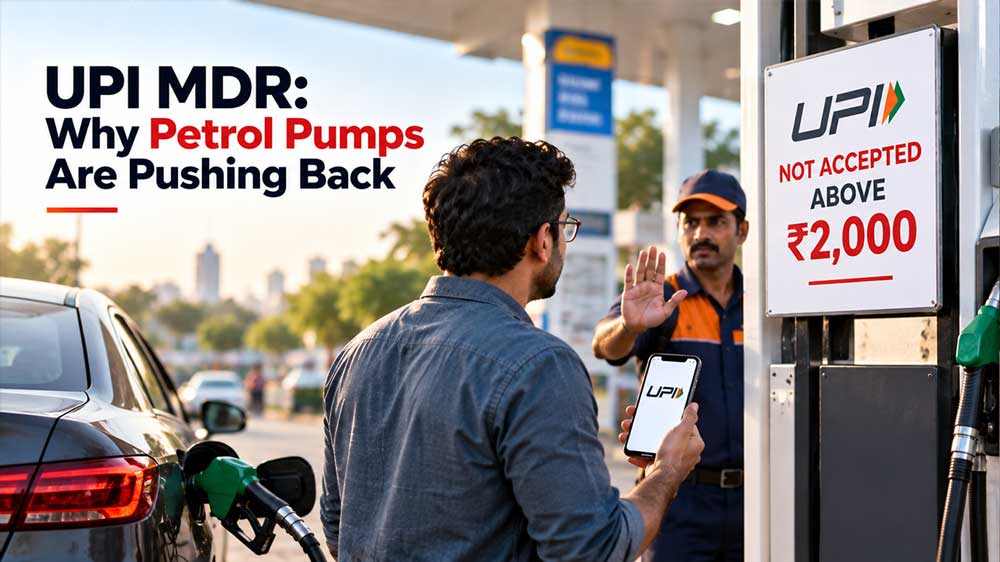
UPI MDR: Why Petrol Pumps Are Rejecting Payments Above ₹2,000
Share this article
India’s Unified Payments Interface (UPI) is entering a new phase. From October 15, 2026, specified merchant transactions above ₹2,000 will attract a Merchant Discount Rate (MDR), while consumers will continue to make UPI payments without a transaction fee.
But the debate is no longer only about whether merchants should pay for UPI. It is about whether businesses will continue accepting UPI for larger transactions when even a small payment-processing cost starts affecting already-thin margins.
The response from petrol-pump dealers offers an early example of what could happen.
In Punjab, petrol pumps have announced restrictions on UPI payments above ₹2,000 from September 21, 2026, while Madhya Pradesh dealers have announced a similar move from October 15/16. Dealers have cited the additional MDR burden and their limited margins.
What Is Changing With UPI MDR?
The new framework introduces a 0.4% MDR on eligible UPI merchant transactions above ₹2,000, with the charge capped at ₹300 for transactions of ₹75,000 or more.
However, an important distinction is frequently being missed.
Fuel is not charged the standard 0.4% MDR.
Fuel, railways, telecom, insurance and certain agricultural-input transactions above ₹2,000 fall into a special category with a flat ₹5 MDR per transaction.
For example:
Transaction Standard eligible merchant Fuel transaction
₹2,500 ₹10 ₹5
₹5,000 ₹20 ₹5
₹ 10,000 ₹40 ₹5
₹30,000 ₹120 ₹5
₹75,000 ₹300 ₹5
₹1,00,000 ₹300 ₹5
This distinction is critical when assessing the impact on petrol pumps.
Why Are Petrol Pump Dealers Objecting?
A ₹5 charge may look insignificant to a consumer.
For a petrol station processing thousands of transactions, however, the calculation changes.
Suppose a fuel station processes:
1,000 eligible UPI transactions × ₹5 = ₹5,000
At 5,000 transactions:
5,000 × ₹5 = ₹25,000
At 10,000 transactions:
10,000 × ₹5 = ₹50,000
The cost becomes a recurring operating expense.
Petrol dealers have argued that their margins are already narrow. Hindustan Times reported dealer estimates of roughly ₹2.40–₹3.40 per litre in margins, while dealers in several states have opposed the new MDR and threatened restrictions on UPI payments above ₹2,000.
That explains why a flat ₹5 charge can become commercially important even though it is small relative to the customer's total fuel bill.
The Petrol Pump Is a Warning Signal for Other Merchants
The fuel sector could become an early test case for the broader Indian merchant economy.
Consider a customer making a ₹20,000 payment.
Under the normal 0.4% MDR framework, the merchant's cost would be:
₹20,000 × 0.4% = ₹80
The customer still pays ₹20,000.
The issue is therefore not necessarily a higher price at the point of payment. It is the cost of accepting the payment for the merchant.
For a business with a high gross margin, ₹80 may be manageable.
For a low-margin business, it can become significant when multiplied across thousands of transactions.
That creates three possible merchant responses:
Absorb the MDR and accept lower margins.
Try to shift customers toward another payment method.
Restrict UPI for larger transactions.
The petrol-pump announcements suggest that the third response is already appearing in parts of the market.
UPI's Biggest Challenge May Be Merchant Acceptance
The government has emphasized that approximately 96% of P2M UPI transactions will remain unaffected, while all person-to-person UPI transactions remain free. MDR is distributed among participants in the payment ecosystem rather than collected as a government tax.
That means the policy does not fundamentally change everyday low-value UPI payments.
A ₹300 grocery purchase remains straightforward.
A ₹1,000 restaurant bill remains straightforward.
But the economics become different for high-value merchant transactions.
This matters because UPI has become more than a payment method. It has become part of the operating infrastructure of Indian businesses.
If a customer sees:
UPI accepted up to ₹2,000
the problem is not merely the MDR.
It introduces friction into a payment behaviour that consumers have become accustomed to.
Who Could Be Most Affected?
The impact will probably vary substantially by business model.
Petrol and fuel
Fuel is particularly sensitive because of the fixed ₹5 MDR and low dealer margins. Dealer associations in multiple states are already seeking exemptions.
Jewellery
Large jewellery purchases can involve tens or hundreds of thousands of rupees. Even a capped MDR can become a recurring cost for merchants handling large UPI volumes.
Electronics
Smartphones, televisions, computers and appliances frequently exceed the ₹2,000 threshold.
Healthcare
Hospitals, clinics and diagnostic centres can process high-value payments, although the commercial impact will depend on the applicable merchant category and transaction structure.
Travel and hospitality
Hotels, travel agencies and other businesses handling larger customer payments could see a direct impact on payment economics.
Automobile businesses
Vehicle purchases can involve very large digital transactions, making payment costs more visible even with the ₹300 cap.
The impact will therefore be determined less by the number of UPI transactions and more by the value and margin structure of the transactions being charged.
Small Merchants Are Being Protected
The new framework does not treat every merchant equally.
Payments up to ₹2,000 remain free, and the government has stated that eligible small merchants using QR-based UPI collections up to ₹1 lakh per month will continue under the zero-MDR framework.
This is important because India's UPI ecosystem contains millions of small merchants.
Without such exemptions, the economic burden could have been much broader.
Instead, the policy concentrates MDR largely on higher-value merchant transactions.
Could UPI Push Some Transactions Back Toward Cash?
This is one of the biggest questions for the Indian market.
The government and RBI have argued that the MDR structure is unlikely to cause a major return to cash because the vast majority of UPI transactions remain unaffected. RBI Deputy Governor Shirish Chandra Murmu has also said the adoption of MDR does not necessarily mean cash transactions will surge.
But the petrol-pump reaction shows that merchant behaviour deserves close monitoring.
If only a small number of merchants restrict UPI, the effect could be limited.
If restrictions spread across multiple high-value categories, customers may increasingly encounter situations where they need to use:
Cash
Debit cards
Credit cards
Bank transfers
Other payment methods
That could create a fragmented experience for consumers.
The Counterpoint: UPI Also Needs a Sustainable Business Model
There is another side to the debate.
UPI has achieved enormous scale while operating with limited direct merchant-fee revenue.
The government says MDR will help support the payment ecosystem, including banks and payment application providers, and contribute to the continued operation and expansion of the system.
That creates an important economic question:
Can India maintain cheap and widely available digital payments while also creating enough revenue to fund infrastructure, cybersecurity, fraud prevention and innovation?
The answer cannot simply be that UPI must remain completely free for every merchant forever.
But equally, introducing fees without considering merchant economics could create resistance among businesses that have already built their payment operations around UPI.
The Real Impact on Indian Businesses
The new MDR may therefore change the economics of UPI in three stages.
Stage 1 — Payment infrastructure
Banks, payment apps and other ecosystem participants gain a potential source of transaction-linked revenue.
Stage 2 — Merchant economics
Businesses begin calculating UPI acceptance costs alongside card-processing fees, cash handling and other payment expenses.
Stage 3 — Consumer behaviour
If merchants absorb the cost, margins decline.
If merchants discourage UPI, consumers may change payment methods.
If merchants eventually incorporate the cost into pricing, consumers could face indirect price effects.
The third stage is where the long-term market impact will become clearer.
What Happens Next?
The most important indicator will not simply be the amount of MDR collected.
It will be merchant acceptance behaviour after October 15.
The market will need to watch:
How many merchants continue accepting high-value UPI payments
Whether petrol pumps maintain their restrictions
Whether other merchant associations follow
Whether consumers shift toward cards or cash
Whether payment companies absorb part of the economics
Whether merchants attempt to pass costs to customers
Whether UPI transaction growth changes in high-value categories
Whether the government modifies category-specific MDR rules
The government has also indicated that implementation will be monitored, including whether banks and payment aggregators transfer the cost to consumers.
The Business Lesson
The UPI MDR debate is ultimately not about ₹5 or 0.4%.
It is about the economics of India's digital-payment infrastructure.
For consumers, most everyday UPI payments will remain unchanged.
For small merchants, much of the ecosystem remains protected.
For larger merchants, however, UPI is moving from a virtually cost-free acceptance channel toward a payment channel with a measurable cost.
The petrol-pump response shows the potential tension clearly: even a small payment fee can become commercially important when margins are thin and transaction volumes are high.
India's challenge now is to find the balance between a financially sustainable UPI ecosystem and affordable merchant acceptance.
The success of the new MDR model will ultimately depend on whether that balance can be maintained without weakening the convenience and ubiquity that made UPI one of India's most important digital infrastructure platforms in the first place.
Tags