
OfBusiness: Can B2B Finance Become Its Biggest Growth Opportunity?
Share this article
OfBusiness has built its business around a simple idea: small and medium enterprises often do not face just one problem. They need raw materials, customers, working capital and access to finance at different points in the same business cycle.
That has led the company beyond B2B commerce into lending through Oxyzo Financial Services. As the financing business scales, an important question is emerging: could B2B finance eventually become one of OfBusiness's most important growth engines?
From B2B Commerce to Financial Services
OfBusiness began by helping SMEs procure raw materials and has gradually built a broader ecosystem around procurement, financing and business generation. Its three major platforms are OfBusiness, Oxyzo and BidAssist.
The logic is significant. A company that helps an SME win an order can potentially help it purchase materials required for that order and then provide financing to manage the cash-flow gap.
This creates a business flywheel rather than a standalone lending product.
The Lending Business Is Already Large
Oxyzo ended FY26 with an asset base of approximately ₹11,822 crore, up 28% year-on-year. It reported a return on assets of 3.8% and gross non-performing assets of 0.75%.
Oxyzo's own platform currently describes its lending business as having more than ₹11,000 crore of AUM and more than 1 lakh SMEs served. Its products include working-capital finance, purchase finance, invoice discounting, vendor finance and term loans.
That scale changes the strategic importance of finance within the group.
Why B2B Finance Could Be Attractive
Traditional SME lending can be difficult because lenders have limited visibility into the actual business transaction behind a loan.
OfBusiness potentially has more information.
If a business is purchasing raw materials through the ecosystem, winning government tenders through BidAssist or fulfilling a known B2B order, transaction-level information can potentially help with customer acquisition, underwriting and product design.
Oxyzo's historical model has focused heavily on financing linked to SME working-capital requirements and raw-material procurement. Its FY25 annual report describes a focus on manufacturing and contracting businesses where cash flows can be relatively predictable.
This is where the B2B finance opportunity becomes different from generic digital lending.
The Bigger Opportunity Is the SME Financial Stack
The potential is not necessarily limited to loans.
OfBusiness already has procurement and financing. BidAssist provides business-generation intelligence and had more than 1.5 million users by FY26. The company says BidAssist can also act as a customer-acquisition channel for its commerce and financing businesses.
That creates a potentially powerful sequence:
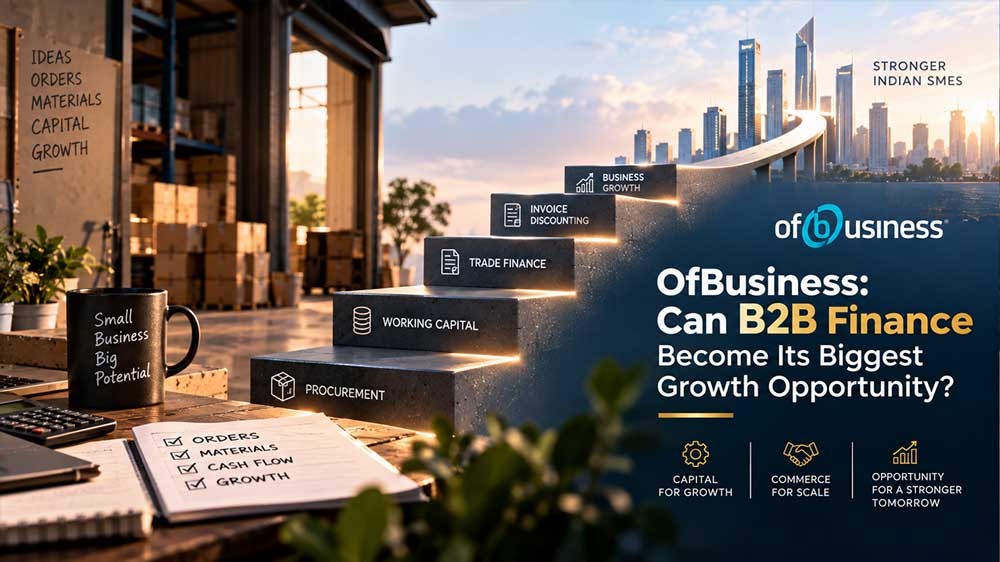
Find an opportunity → win the order → procure materials → finance the working capital → fulfil the order → repeat.
If OfBusiness can keep customers inside this ecosystem, finance can become more than an additional revenue stream. It can increase the value of relationships created through the commerce platform.
But Lending Also Changes the Risk Profile
Finance brings a different set of risks from commerce.
Growing AUM requires capital. Credit losses can increase when economic conditions weaken. Interest costs, regulatory requirements, underwriting quality and collection efficiency become critical.
OfBusiness's FY26 numbers provide some evidence of the current position: Oxyzo reported 0.75% gross NPA, while the group's consolidated PAT reached ₹724 crore.
However, maintaining asset quality while rapidly expanding lending will be more important than simply increasing AUM.
Commerce Still Matters
It would be premature to treat financing as a replacement for OfBusiness's core commerce operation.
The commerce business generated ₹19,174 crore revenue in FY26 and EBITDA of ₹769 crore, while operating cash flow increased to ₹1,302 crore. The business also became free-cash-flow-to-firm positive, generating ₹390 crore of FCFF.
The company is therefore developing two complementary engines: a large operating commerce business and a growing financial-services business.
What Happens Next?
The key question for OfBusiness is not simply whether Oxyzo can become larger.
It is whether the company can use its procurement, business-generation and transaction data to build a differentiated SME financial ecosystem while maintaining strong credit quality.
If it succeeds, B2B finance could become strategically important because it combines recurring financial relationships with the company's existing SME network.
The next indicators worth watching are Oxyzo's AUM growth, credit quality, return on assets, funding costs, customer cross-sell and the proportion of OfBusiness customers using financial products.
OfBusiness's planned IPO also makes these metrics increasingly important because investors will be able to evaluate commerce and financial services not only by revenue growth, but by the quality and sustainability of their respective economics.
Tags