
How Palantir AI Is Becoming Its Biggest Business Opportunity
Share this article
Palantir's AI opportunity is not really about building another chatbot.
The company has spent more than a decade building software that helps governments and businesses organise complicated data and make decisions. The rise of generative AI has suddenly made that foundation much more valuable.
The question now is whether Palantir can turn its existing relationships and data infrastructure into one of the biggest enterprise AI businesses.
From Data to Action
Palantir's original proposition was built around a difficult enterprise problem: organisations had enormous amounts of data, but that information was often disconnected from the decisions employees needed to make.
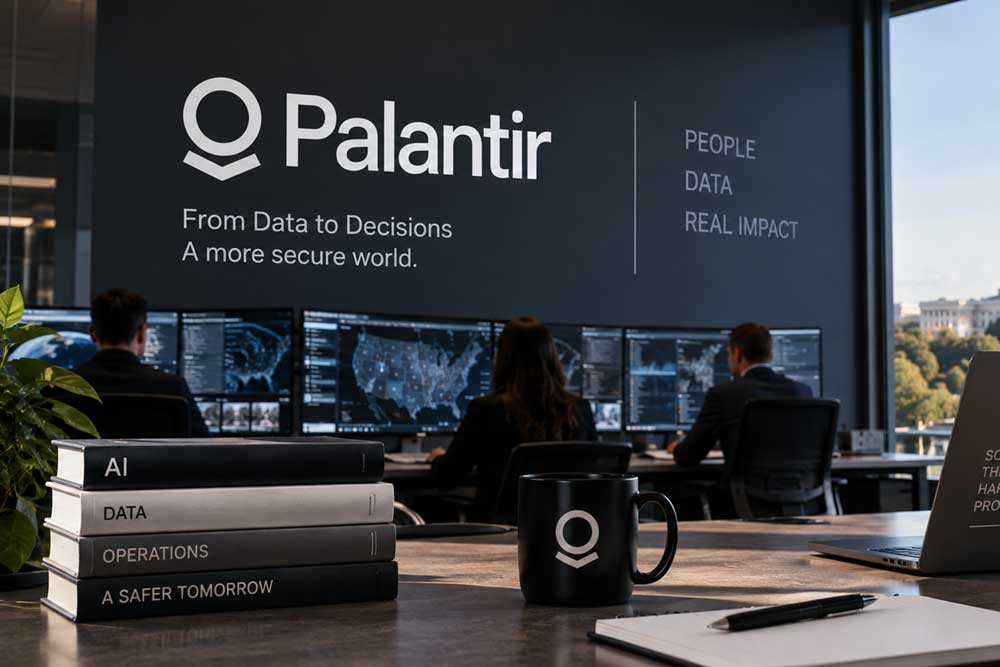
Its Foundry platform was designed to connect data, analytics and operational workflows. AIP extends that model by allowing organisations to bring large language models and other AI systems into those environments, with security and human oversight built into the workflow.
That distinction matters.
Palantir isn't simply selling access to an AI model. It is trying to make AI useful inside the organisation.
The Numbers Have Started to Change
The strategy is producing remarkable growth.
In the second quarter of 2026, Palantir generated $1.94 billion in revenue, up 93% year over year. U.S. commercial revenue grew an extraordinary 149% to $764 million. The company subsequently raised its full-year 2026 revenue forecast to between $8.15 billion and $8.158 billion.
The most important figure may not be total revenue.
It is the acceleration of commercial demand.
For years, Palantir was strongly associated with government contracts. By the end of 2025, however, commercial customers already represented 46% of revenue, compared with 54% from government customers. Palantir had 954 customers globally.
AI is helping the company broaden its commercial opportunity.
Why the Business Model Is Interesting
The economics become more attractive if Palantir can become embedded in critical business processes.
Consider a manufacturer. Instead of simply asking an AI model a question, employees could use Palantir's software to connect production data, supply chains, inventory and operational decisions.
That creates a much deeper relationship than a standalone AI subscription.
Palantir's enterprise AI platform is designed around exactly this connection between organisational data, models and workflows.
Competition Is Getting Serious
Palantir is competing with companies such as Microsoft, Google, Amazon, Snowflake and Databricks.
The hyperscalers have enormous distribution advantages. Data-platform companies already control important parts of enterprise infrastructure.
Palantir's defence is different: integration.
Its software is designed for organisations where security, governance and operational consequences matter. Recent partnerships have also extended AIP into industries such as healthcare, mobility and aviation.
The Real Opportunity
Palantir's AI story is therefore bigger than adding AI features to existing software.
The company is attempting to become the layer where data becomes decisions and decisions become actions.
That could make AI a major expansion of its existing business rather than a temporary technology cycle.
But there is a catch.
At such rapid growth rates, expectations become extremely high. Competition will intensify, customers may demand lower prices and AI technology is evolving quickly.
Palantir therefore has to prove that today's extraordinary AI demand can become durable, recurring enterprise revenue.
The Business Lesson
Palantir's advantage may not be that it owns the best AI model.
Its advantage could be that it already understands where AI needs to operate.
The next phase of enterprise AI may be less about asking machines questions and more about allowing them to participate safely in real business processes.
If Palantir can own that transition, AI could become the company's biggest growth opportunity yet.
Tags