
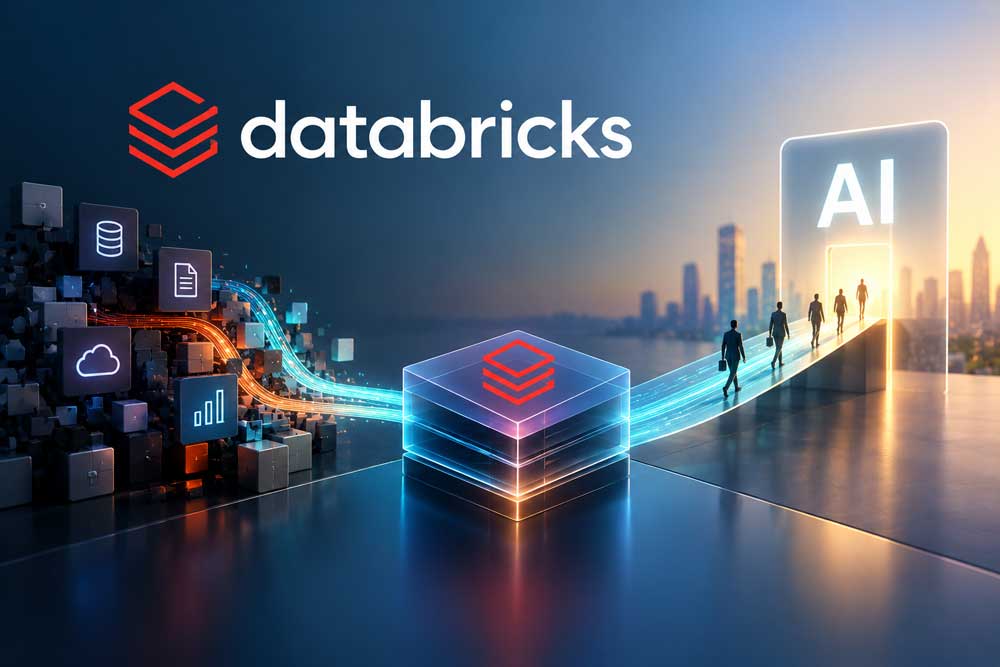
Databricks: Why Data Infrastructure Became an AI Opportunity
Share this article
Artificial intelligence is often presented as a competition between the companies building the most powerful models. But underneath that race is another, less visible battle: who controls the data infrastructure that makes enterprise AI useful?
Databricks has positioned itself directly in that opportunity. What began as a platform for data engineering and analytics has evolved into a broader Data + AI platform, connecting data management, analytics, machine learning and AI applications.
From Data Platform → AI Infrastructure
Databricks was originally built around the lakehouse architecture, combining elements of data lakes and traditional data warehouses. The strategy addressed a major enterprise problem: companies often had data scattered across multiple systems, making analytics and AI development expensive and complicated.
AI has made that problem more important.
An AI model can be powerful, but its usefulness inside a business depends heavily on the quality, accessibility and governance of the company's own data.
Databricks now describes its platform as a unified foundation for data, analytics and AI, with products covering data engineering, warehousing, machine learning and governance.
Funding → Scale
The market increasingly recognises this opportunity.
In August 2026, Databricks raised $5 billion at a $190 billion valuation, up from $134 billion only six months earlier. Reuters reported that the company had achieved more than 80% year-over-year revenue growth in Q2, a $7 billion annualised revenue run-rate and remained cash-flow positive over the previous year.
Those numbers show that investors are no longer viewing Databricks simply as a data-management company.
They are pricing it as an important part of the AI infrastructure layer.
AI Creates a Larger Opportunity
The strategic shift is significant.
Companies deploying AI need more than foundation models. They need secure access to internal data, model deployment, governance, monitoring and applications that can operate within enterprise environments.
Databricks is attempting to connect these pieces.
Its AI portfolio includes Mosaic AI, while newer products such as Lakebase and Genie extend the platform toward databases and AI-powered interaction with enterprise information.
This creates a potentially powerful model:
Data → Analytics → AI Models → AI Applications → Enterprise Workflows
The company that manages multiple layers of that chain can potentially capture more value than a standalone data tool.
Competition → Snowflake and Hyperscalers
Databricks is not alone.
Snowflake is expanding deeper into AI and data workloads, while Microsoft, Google and Amazon have enormous cloud ecosystems.
The competition therefore isn't simply about technology.
It is about enterprise distribution, data lock-in, ecosystem depth and developer adoption.
Databricks' advantage is that it sits close to one of the most valuable assets inside every enterprise: its data.
Its AI infrastructure strategy reflects a broader industry shift in which infrastructure providers are becoming increasingly important as AI adoption expands.
What's Next?
Databricks' biggest opportunity may be turning AI from an experimental project into a normal enterprise workload.
But the risk is equally clear.
AI infrastructure is becoming crowded, and hyperscalers can bundle competing services into broader cloud contracts.
Databricks therefore needs to keep proving that its unified platform delivers better economics and productivity than assembling separate tools.
The Bigger Lesson
Databricks demonstrates that the AI opportunity isn't limited to whoever builds the smartest model.
The companies that organise, govern and activate enterprise data may capture an equally important part of the AI economy.
The AI race may look like a model race from the outside.
Underneath it, increasingly, it is a data infrastructure race.
Tags