
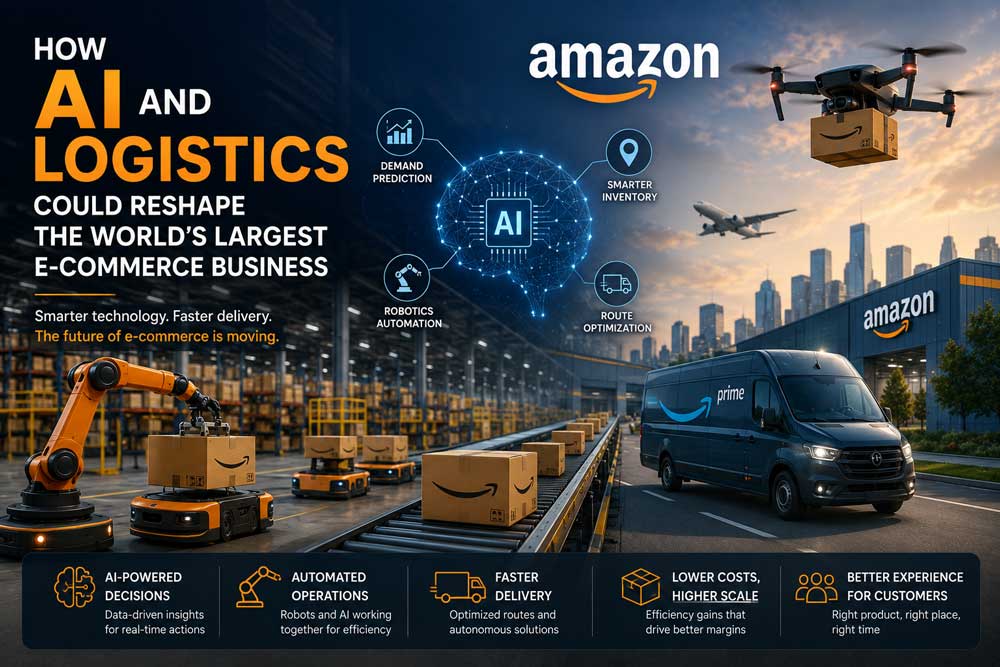
Amazon's AI Logistics: Reshaping E-Commerce's Future
Share this article
Amazon has already changed how the world shops. Its next transformation may happen largely behind the screen—in warehouses, delivery networks and increasingly autonomous logistics systems.
The combination of artificial intelligence, robotics and logistics automation could determine how Amazon manages the next generation of e-commerce growth. The opportunity is enormous, but so is the investment required to build it.
Amazon's Real Competitive Advantage Is Logistics
Amazon's scale is difficult for competitors to replicate. In 2025, the company generated $716.9 billion in net sales, up 12% from 2024. At the same time, fulfillment costs reached $109.1 billion, while shipping costs alone reached $102.7 billion. (SEC)
These numbers reveal an important point: logistics is not simply an operational function for Amazon.
It is a core part of the business model.
Amazon's ability to deliver products quickly while controlling fulfillment and shipping costs directly affects customer loyalty and profitability. That makes every improvement in warehouse productivity, inventory placement or delivery efficiency financially significant.
One Million Robots Changes the Equation
Amazon has already deployed more than one million robots across its operations. The company says its DeepFleet AI model can improve robot travel efficiency by around 10%, potentially helping products move through fulfillment centers more efficiently.
This is where AI becomes more than a software feature.
An AI system can coordinate thousands of machines, predict demand, optimise inventory locations and determine how goods should move through a fulfillment network.
The result could be a logistics system that becomes increasingly self-optimising.
Amazon has also developed AI and robotics systems designed to work alongside employees rather than simply replace them. Its Project Eluna, for example, is an agentic AI system designed to help operations managers make better decisions.
The Bigger Opportunity Is Prediction
Robots may attract the headlines, but prediction could create the bigger economic advantage.
Amazon can use AI to forecast what customers are likely to buy, where demand will emerge and where inventory should be positioned before an order is placed.
That changes the economics of delivery.
Instead of moving a product across a long distance after a customer purchases it, Amazon can potentially position inventory closer to the customer in advance.
The company says it delivered more than 13 billion items the same or next day for Prime members globally in 2025, highlighting how much its logistics network has already evolved toward faster delivery.
The next step is not simply faster transportation.
It is better anticipation.
Delivery Could Become More Autonomous
Amazon is also experimenting with technologies beyond traditional delivery vans.
Prime Air has expanded internationally, with Amazon launching its first drone-delivery site outside the United States in the UK in 2026. Customers within a defined radius can receive eligible products by drone.
Drones will not replace Amazon's delivery fleet anytime soon. Their immediate role is likely to be targeted—particularly for small, lightweight packages and specific geographic environments.
But the strategic significance is larger.
Amazon is building a logistics network in which different delivery methods can be selected according to cost, distance, package type and urgency.
That could eventually make logistics more dynamic and efficient.
The Hidden Challenge: Capital Intensity
There is, however, a less exciting side to the AI-logistics story.
Automation is expensive.
Amazon's technology and infrastructure costs increased 23% to $108.5 billion in 2025, while fulfillment costs also continued rising.
AI models, robotics, data centers, automated facilities and delivery technologies require enormous upfront investment.
Therefore, the critical question is not whether Amazon can automate more.
It is whether each dollar invested in automation eventually produces a higher return through lower costs, greater capacity or faster sales growth.
That is the real test of Amazon's logistics strategy.
Investor Perspective
For investors, Amazon's AI story should therefore be viewed differently from the typical generative-AI narrative.
The potential value is not only in selling AI software.
It is in using AI to improve one of the world's largest physical commerce networks.
If AI reduces fulfillment costs, improves inventory turnover, increases warehouse throughput and lowers delivery costs, the benefits could compound across hundreds of billions of dollars in annual sales.
Amazon's 2025 operating income reached $80.0 billion, compared with $68.6 billion in 2024, showing that scale and operational improvements can already translate into stronger profitability.
The Bigger Industry Implication
Amazon's approach could force the rest of e-commerce to rethink what competitive advantage means.
For years, companies competed through price, selection and customer experience.
The next battleground may be AI-powered logistics density.
The company that can predict demand most accurately, position inventory most efficiently and deliver products at the lowest sustainable cost could gain an advantage that is difficult to copy.
This may also benefit smaller businesses indirectly. As logistics infrastructure becomes more automated, sellers could gain access to faster and more efficient fulfillment without building their own networks.
Amazon's Next Moat May Be Invisible
Amazon's greatest future advantage may not be another shopping feature.
It could be an increasingly intelligent physical network operating behind the website—predicting demand, moving inventory, coordinating robots and selecting the most efficient delivery method.
The important shift is from automated logistics to intelligent logistics.
Amazon already has the scale. The next question is whether AI can make that scale significantly more efficient.
If it succeeds, Amazon will not simply be the world's largest e-commerce company.
It could become one of the world's most advanced AI-powered logistics companies.
Original Analysis
The central argument is that Amazon's AI opportunity is fundamentally different from a conventional AI software business. Its greatest potential value may come from applying AI to its enormous physical infrastructure—turning inventory, warehouses, robots and delivery networks into a continuously optimising system.