
AI Cloud Startup Verda Raises $189 Million
Share this article
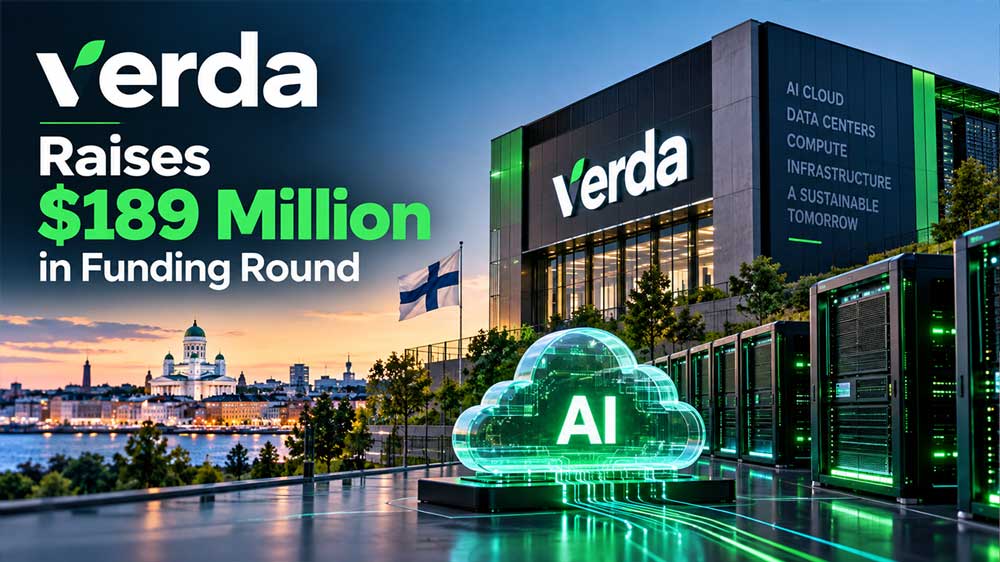
Europe's artificial intelligence infrastructure market is gaining another major player as Helsinki-based Verda has raised $189 million (€163 million) in new funding to expand its full-stack AI cloud and increase computing capacity.
Announced on September 22, 2026, the financing includes an oversubscribed Series B led by Emergence Capital, alongside additional investment from MUFG Innovation Partners, Supermicro, Varma Mutual Pension Insurance Company, Lifeline Ventures, 6 Degrees Capital, byFounders and Tesi. Several angel investors also participated. (Verda)
The latest funding brings Verda's total capital raised to more than $450 million, combining equity and debt financing. The company says the new capital will support expansion across its infrastructure stack, from computing capacity and data centers to cloud platform services and AI workloads.
From DataCrunch to Verda
Verda was founded in Helsinki in 2020 and originally operated under the name DataCrunch. The company began by providing access to GPU computing and later expanded into a broader AI cloud infrastructure business.
In 2025, DataCrunch became Verda and raised $64 million in Series A funding. In April 2026, the company announced another $117 million in funding, followed by an expansion of that financing to $155 million in July after the Nordic Investment Bank joined the group of financial institutions backing the company.
The September funding represents another significant step in that expansion.
Verda now describes itself as a full-stack AI cloud company, managing infrastructure from physical data centers and hardware through the cloud platform and AI research layer.
Why AI Compute Has Become a Major Market
The growth of generative AI has created a significant demand for computing infrastructure.
AI companies need large numbers of GPUs for model training, while production applications require computing capacity for inference. As AI agents and other demanding workloads become more common, infrastructure providers need to support changing and sometimes unpredictable demand.
This is creating opportunities for specialized cloud providers that focus specifically on AI workloads rather than competing across every type of cloud-computing requirement.
Verda is positioning itself in this market through AI cloud infrastructure, combining computing resources, data centers and software services into a single platform.
What Verda Plans to Do With the Funding
Verda says the new capital will be used to accelerate product development and multiply its compute capacity.
One of the company's priorities is inference, which is the process through which trained AI models generate responses or predictions in production. As more AI applications move from experimentation into real-world use, inference can become a significant infrastructure requirement.
Verda also plans to increase its overall computing capacity over the next year. The company says the investment will cover all layers of its platform, including data-center capacity, the cloud platform and its AI Lab.
This indicates that Verda is pursuing a vertically integrated approach rather than simply renting computing capacity from another infrastructure provider.
A Full-Stack Approach
Traditional cloud businesses often separate physical infrastructure from the software layer customers use.
Verda's model is more vertically integrated.
The company says it designs and builds its own data centers, manages the infrastructure inside them and develops the platform running on top. This gives Verda greater control over how computing resources are provisioned and optimized.
The company is also investing in areas such as GPU utilization, inference optimization, compiler development and serving software through its AI Lab.
For AI companies, infrastructure efficiency can be important because GPUs are expensive and workloads can vary significantly.
The ability to use computing resources efficiently can therefore affect both performance and operating costs.
Revenue Growth Adds Another Dimension
The funding announcement comes after strong reported growth.
Verda said it reached a $165 million annualized revenue run rate in July 2026. Earlier in June, the company had announced a $100 million revenue run rate, meaning its reported run rate increased substantially during the year.
The company also says it is serving AI workloads for organizations in more than 50 countries.
Its customers and use cases include AI research, media generation, healthcare AI and robotics. Verda says its infrastructure powers workloads for organizations including Aleph Alpha, Magnific and Epsilon Health, while its website also highlights infrastructure work supporting robotics company 1X. (Verda)
These use cases show how AI infrastructure demand is extending beyond foundation-model companies.
Europe Wants Its Own AI Infrastructure
Verda's expansion also fits into a larger European technology story.
Much of the global AI infrastructure market has been dominated by American cloud companies, semiconductor companies and large technology platforms. European startups are increasingly trying to build infrastructure capabilities closer to home.
Verda's headquarters are in Helsinki, while the company has expanded internationally with offices in London and San Francisco. It says it plans further expansion across Europe, the United States and Asia.
The company has also emphasized renewable energy and lower-carbon computing as part of its infrastructure strategy. In an earlier funding announcement, Verda said its Finnish data centers run on 100% renewable energy.
This gives the company another positioning opportunity as AI computing becomes increasingly energy-intensive.
Competition Will Be About More Than GPUs
The AI cloud market is becoming increasingly competitive.
Specialized AI cloud providers need to compete on access to GPUs, pricing, availability, performance and software capabilities. They also have to secure enough computing capacity to meet customers' demand while maintaining efficient infrastructure operations.
For Verda, the challenge will be scaling its infrastructure without losing the advantages of its specialized model.
The company is attempting to address this by controlling more parts of the technology stack.
Its strategy combines physical infrastructure, cloud software, AI engineering and customer-specific optimization. That approach could allow the company to differentiate itself from providers that primarily offer raw computing capacity.
Funding, Capacity and the Next Phase
Verda has now raised more than $450 million, according to the company's latest announcement. The capital gives the company additional resources to expand infrastructure at a time when demand for AI computing remains strong. (Verda)
But the next phase will require execution across several areas.
The company needs to expand computing capacity, maintain infrastructure utilization, win enterprise customers and continue improving the software layer around its cloud platform.
It also needs to operate across multiple international markets while managing the capital intensity associated with data centers and high-performance computing.
These factors will shape whether Verda can turn rapid AI infrastructure demand into a durable global business.
What Verda's Funding Says About AI Infrastructure
Verda's latest funding round reflects a broader shift in the AI industry.
The competition is no longer limited to companies building AI models or consumer applications. Infrastructure providers are becoming an important part of the AI value chain.
Every AI model needs computing resources, and increasingly sophisticated applications require infrastructure that can support training, inference and real-time workloads.
Verda is targeting this layer directly.
With $189 million in fresh funding, a reported $165 million annualized revenue run rate and more than $450 million raised overall, the company enters its next phase with a substantially larger financial base and an expanding international footprint. (Verda)
The key question now is how effectively Verda can convert that capital into additional computing capacity, customer growth and a scalable AI cloud business.
For Europe's technology ecosystem, the company's progress will also provide a useful indicator of whether specialized European infrastructure companies can build globally competitive businesses around the rapidly expanding AI economy.
Tags