
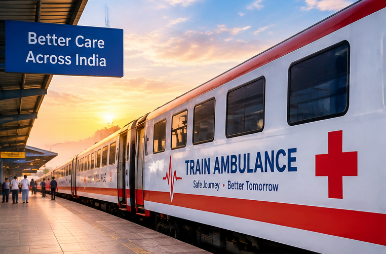
What It Takes to Run a Train Ambulance Service Across India
Share this article
From the outside, a train ambulance transfer looks fairly simple: a patient boards a train with a medical escort and arrives safely at the other end. Behind that simplicity is a fair amount of coordination that most families never see, and it's worth understanding, if only to appreciate why planning ahead genuinely helps.
Before a Single Booking Is Made
Running a train ambulance service in India across a country this size means constantly tracking train schedules, berth availability, and which routes connect well to which cities. A lot of the groundwork — knowing which trains run daily versus a few times a week, which routes have reliable connecting ambulances — happens long before any specific family calls in.
Coordinating Staff Across the Country
• Medical staff need to be available and positioned near enough to the departure point to join in time
• Equipment has to match the specific patient's needs, not a generic standard kit
• Staff need briefing on the patient's condition well before boarding, not at the last minute
• A contingency plan is needed in case a staff member or piece of equipment isn't available as originally planned
What Happens on the Day of Travel
The visible part — ambulance pickup, boarding, the journey itself, drop-off — is really the final stage of a process that started days earlier with reports being reviewed, trains being checked, and a plan being built around the specific patient. A smooth-looking transfer on the day is usually the result of a lot of unglamorous groundwork beforehand.
How This Plays Out Across Our Common Routes
Whether it's a train ambulance service in Bangalore connecting to a Hyderabad, Pune, or Delhi destination, or a train ambulance service in Jamshedpur managing journeys to Kolkata, Ranchi or Bhubaneswar, the same behind-the-scenes coordination applies everywhere we operate — only the specific trains and distances change.
Why This Matters to Families
Understanding this groundwork is partly why booking a little earlier makes such a difference — it gives the team time to do all of this properly rather than compressing days of coordination into a few rushed hours. Urgent transfers are still very much possible, but a planned one simply has more room to get every detail right.
Frequently Asked Questions
How far in advance do you typically start planning a transfer?
As soon as a family reaches out, though a few days' notice gives considerably more flexibility than a same-day request.
Do the same medical staff handle every route, or does it vary?
Staff are positioned based on location and route, so the specific team will vary, though all are trained to the same standard.
What's the hardest part of coordinating a long-distance transfer?
Usually aligning train schedules with hospital discharge timing and ambulance availability at both ends, especially on less frequently served routes.
Does more advance notice really make a noticeable difference?
Yes, it generally allows for better train and berth selection, more preparation time for staff, and a smoother overall experience.
Tags