
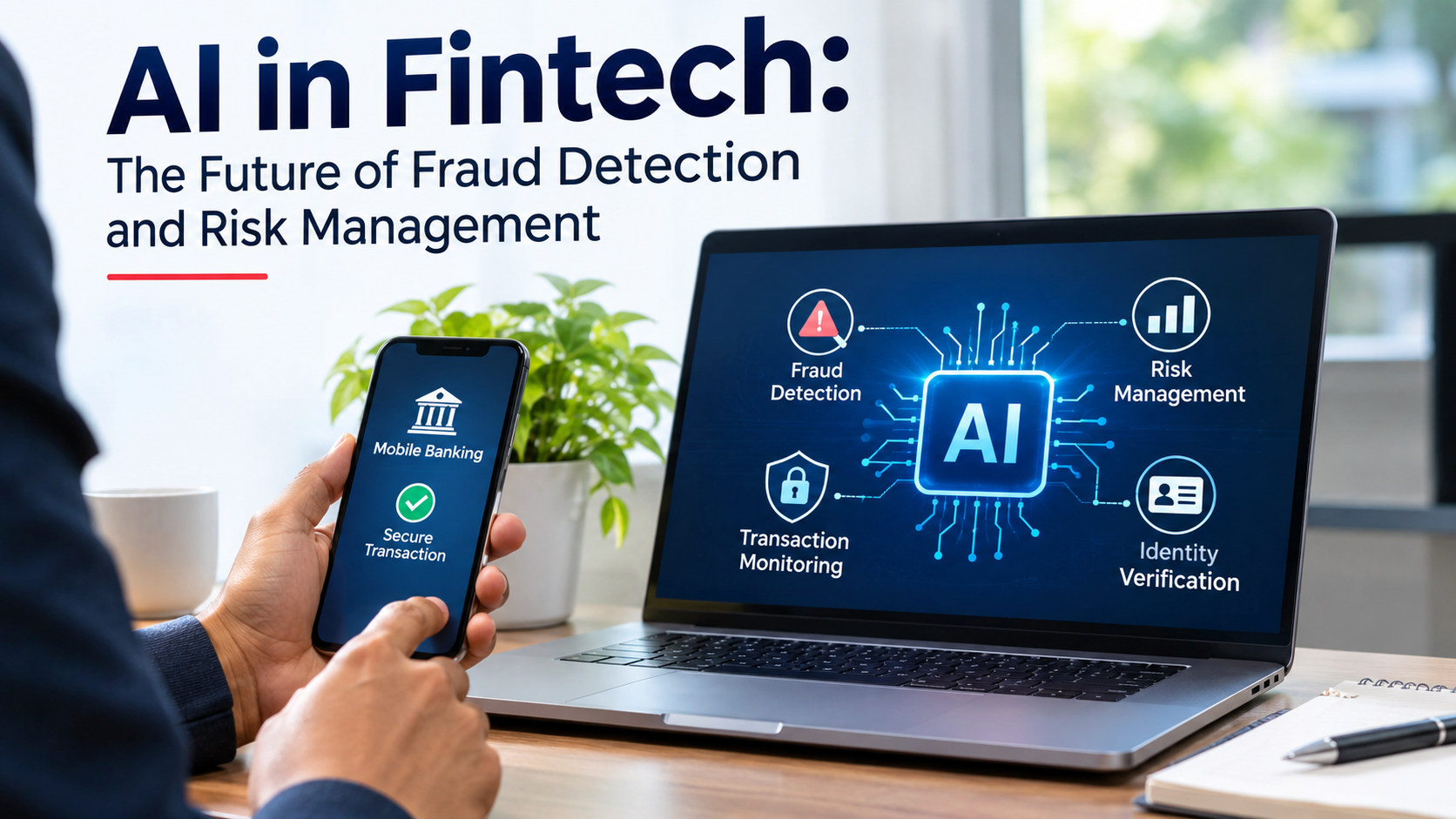
AI in Fintech: The Future of Fraud Detection and Risk Management
Share this article
Artificial intelligence is changing how financial institutions detect fraud, assess risk, monitor transactions, and protect customers. As digital payments, mobile banking, online lending, and fintech services expand, traditional security systems are finding it increasingly difficult to keep pace with sophisticated financial crimes.
AI-powered systems can analyse large volumes of transaction data, identify unusual behaviour, detect suspicious patterns, and help financial institutions respond to potential threats faster. However, these technologies also introduce challenges involving data privacy, algorithmic bias, false positives, and regulatory compliance.
The future of fintech security will not depend on AI alone. It will depend on how effectively financial institutions combine intelligent automation, reliable data, human oversight, and strong risk-management policies.
How AI Is Transforming Fraud Detection
1. Real-time transaction monitoring
Traditional fraud detection systems often rely on predefined rules, such as transaction limits, unusual locations, or repeated payment attempts. These rules are useful, but criminals can adapt their behaviour to avoid triggering them.
AI-based systems can analyse multiple signals simultaneously, including transaction value, payment frequency, device information, customer behaviour, location patterns, and transaction history.
For example, if a customer who normally makes small domestic payments suddenly initiates several high-value transfers from an unfamiliar device, an AI system can identify the activity as unusual and flag it for further verification.
This allows financial institutions to assess risk based on context rather than relying only on fixed thresholds.
2. Detecting unusual behaviour and emerging fraud patterns
Machine learning models can learn from historical transaction data and identify patterns associated with suspicious activity.
These systems can help detect:
Unusual account access and login behaviour.
Rapid transfers between multiple accounts.
Suspicious card and digital wallet transactions.
Account takeover attempts.
Synthetic identity and identity-related fraud.
Unusual payment patterns across connected accounts.
An important advantage is the ability to identify patterns that may not be obvious when individual transactions are examined separately.
3. Identifying mule accounts and fraud networks
Fraudsters frequently use networks of accounts to receive, transfer, and withdraw illegally obtained money. A single suspicious transaction may not reveal the complete operation.
AI combined with graph analytics can examine relationships between accounts, devices, beneficiaries, phone numbers, and transaction histories. It can help investigators identify connected accounts and suspicious movement of funds.
This is particularly relevant to digital payment ecosystems, where money can move across several accounts in a short period.
4. Improving identity verification and authentication
AI can support identity verification by analysing document images, facial matching, device signals, and behavioural patterns.
Financial institutions can use these capabilities during customer onboarding, account access, and high-risk transactions.
Behavioural biometrics can also examine how a person interacts with a device, such as typing patterns, navigation behaviour, and other interaction signals.
However, biometric systems are not foolproof. They require safeguards against spoofing, deepfakes, stolen credentials, and inappropriate use of personal information.
5. Supporting fraud investigation teams
AI can help fraud analysts prioritise alerts, summarise transaction histories, identify relationships between suspicious accounts, and organise relevant evidence.
Generative AI may also help investigators interpret information scattered across transaction records, customer communications, and internal reports.
The Federal Reserve's 2026 discussion of generative AI in fraud mitigation describes how these capabilities can complement traditional rules, predictive models, and graph analytics rather than simply replacing them.
Federal Reserve Financial Services
The objective is not to remove investigators from the process. It is to reduce repetitive analysis and help them focus on cases that require deeper investigation.
AI in Risk Management Across Fintech
Fraud detection is only one part of financial risk management. Fintech companies also face credit risk, operational risk, compliance risk, cybersecurity threats, and third-party technology risks.
AI can support each of these areas.
1. Credit risk assessment
Digital lenders and financial institutions can use machine learning to analyse repayment history, income patterns, transaction behaviour, existing liabilities, and other permitted financial information.
These models can help estimate the likelihood of repayment delays or defaults.
However, more data does not automatically mean better lending decisions. Poor-quality data, biased training information, or unsuitable variables can produce unfair outcomes. Credit models should be tested for accuracy, fairness, and compliance with applicable lending regulations.
2. Anti-money laundering and suspicious activity monitoring
Financial institutions must monitor transactions for potential money laundering, terrorist financing, and other suspicious activity.
AI can help identify unusual transaction patterns, connections between accounts, rapid movement of funds, and behaviour that differs from expected customer activity.
It can also help compliance teams prioritise alerts and review cases more efficiently.
Nevertheless, AI-generated alerts are indicators for investigation, not proof of criminal activity. Final decisions must follow applicable legal and regulatory procedures.
3. Cybersecurity and account protection
Fintech platforms face threats such as phishing, credential theft, malware, account takeover, and payment manipulation.
AI-powered security tools can analyse login behaviour, network activity, device signals, and system events to identify potential attacks.
They can also help security teams detect unusual access patterns and prioritise incidents.
The same technology can be used by criminals to create convincing phishing messages, synthetic identities, and more sophisticated attacks. Financial institutions therefore need to strengthen their security systems as AI capabilities evolve.
4. Operational and liquidity risk
AI can help financial companies identify operational bottlenecks, forecast transaction volumes, monitor payment failures, and detect unusual settlement patterns.
For payment aggregators, wallets, and digital payment providers, these capabilities can support transaction monitoring, reconciliation, settlement planning, and operational risk management.
However, predictive systems should not replace financial controls, reconciliation procedures, or independent audits.
The Growing Importance of AI in India's Fintech Ecosystem
India's digital financial ecosystem has expanded through UPI, mobile banking, digital lending, payment gateways, wallets, and online financial services. This growth creates opportunities for innovation, but it also increases the importance of fraud prevention and consumer protection.
Regulators are paying greater attention to technology-enabled fraud and responsible AI adoption.
In March 2026, the Ministry of Finance reported that revised RBI instructions concerning unauthorised electronic banking transactions had been issued for public and stakeholder consultation. The proposed measures included AI-driven fraud analytics and safeguards relating to mule accounts.
Press Information Bureau
In July 2026, the Ministry also highlighted government and regulatory measures involving cyber safety, AI-based fraud detection, and consumer protection in the fintech ecosystem.
Press Information Bureau
These developments demonstrate the growing importance of intelligent fraud monitoring in India's financial sector. They should not, however, be interpreted as evidence that every fintech company is already using advanced AI systems or that AI can independently prevent digital payment fraud.
For fintech companies, the practical opportunity lies in integrating appropriate fraud detection tools with secure payment infrastructure, effective KYC processes, transaction monitoring, and clear escalation procedures.
Key Challenges of Using AI in Fraud Detection
Despite its advantages, AI adoption in fintech comes with important challenges.
1. Data quality and availability
AI models depend on reliable data. Incomplete transaction records, outdated customer information, inconsistent formats, and inaccurate labels can reduce model performance.
Financial institutions must establish strong data governance and ensure that information used for training and monitoring is accurate, relevant, and secure.
2. False positives and customer experience
A fraud detection system may incorrectly flag a legitimate transaction as suspicious. This can result in declined payments, blocked accounts, delayed withdrawals, and frustrated customers.
If false positives become too frequent, customers may lose confidence in the financial service.
Fintech companies must continuously evaluate model performance and balance fraud prevention with a smooth payment experience.
3. Data privacy and security
AI systems may process sensitive financial and personal information, including transaction histories, identity documents, and behavioural data.
Financial institutions must protect this information through appropriate access controls, encryption, retention policies, and compliance with applicable data protection requirements.
4. Model bias and lack of transparency
Some advanced AI models can be difficult to interpret. This creates problems when financial institutions need to explain why a transaction was blocked or why a customer received a particular risk score.
Biased or poorly designed models can also affect certain customer groups unfairly.
Financial institutions should test models for unintended bias, document important decisions, and provide appropriate human review and customer support.
5. Increasing sophistication of financial crime
Fraudsters are also adopting AI technologies. Deepfake videos, synthetic identities, automated phishing campaigns, and manipulated documents can make financial crimes more difficult to identify.
This creates an ongoing competition between fraud prevention systems and increasingly sophisticated criminal techniques.
The Future of AI in Fintech Fraud Prevention
The next stage of fintech security will likely involve multiple technologies working together rather than a single AI model performing every task.
Several developments are particularly important.
1. Predictive fraud prevention: Systems will increasingly focus on identifying risk signals before suspicious transactions are completed, allowing institutions to introduce additional verification or temporary restrictions.
2. Behavioural intelligence: Continuous analysis of customer and device behaviour may help identify account takeover attempts even when criminals possess valid login credentials.
3. Graph-based fraud detection: Connected transaction networks can help financial institutions identify mule accounts, coordinated fraud operations, and suspicious relationships between entities.
4. Generative AI for investigations: AI assistants may help fraud teams summarise complex cases, organise evidence, and identify relevant patterns across large datasets. Their outputs will still require verification.
5. Collaborative intelligence: Secure information-sharing between financial institutions, payment providers, and relevant authorities may help identify fraud patterns that cannot be detected by analysing one institution's data alone.
What Financial Institutions Should Do Before Adopting AI
Successful AI implementation requires more than purchasing software or integrating an automated fraud detection API.
Financial institutions should consider the following steps:
Identify the problem: Determine whether the main concern is payment fraud, account takeover, mule accounts, identity fraud, credit risk, or compliance monitoring.
Evaluate existing systems: Review current fraud detection processes, transaction monitoring rules, and investigation workflows.
Select appropriate technology: Choose AI models and tools based on the specific use case, available data, operational requirements, and risk level.
Establish data governance: Ensure that customer information is collected, processed, stored, and used responsibly.
Maintain human oversight: Define when suspicious transactions require manual investigation, escalation, or additional verification.
Monitor model performance: Regularly assess detection accuracy, false positives, model drift, and changing fraud patterns.
Strengthen accountability: Document AI decisions, establish clear responsibilities, and maintain appropriate audit and compliance controls.
The Financial Stability Board's sound practices for responsible AI adoption provide an important reference for financial institutions developing AI governance and risk-management frameworks. The guidance covers areas such as data governance, explainability, human oversight, cybersecurity, and third-party dependencies.
Financial Stability Board+1
Conclusion
Artificial intelligence is becoming an important part of modern fintech infrastructure. Its ability to analyse transaction patterns, identify suspicious behaviour, support investigations, and assess financial risks can help institutions strengthen security and improve operational efficiency.
However, AI is not a complete solution to financial fraud. Poor data, model bias, sophisticated cyberattacks, and inadequate governance can create new vulnerabilities.
The most effective approach is to combine AI-powered intelligence with traditional security controls, experienced fraud investigators, transparent policies, and regulatory compliance.
For fintech companies, payment providers, banks, and digital lenders, the competitive advantage will not simply come from adopting AI. It will come from using it responsibly to build safer, more reliable, and more trustworthy financial services.
Tags