
UPI MDR From October 15: What the 0.4% Charge Means
Share this article
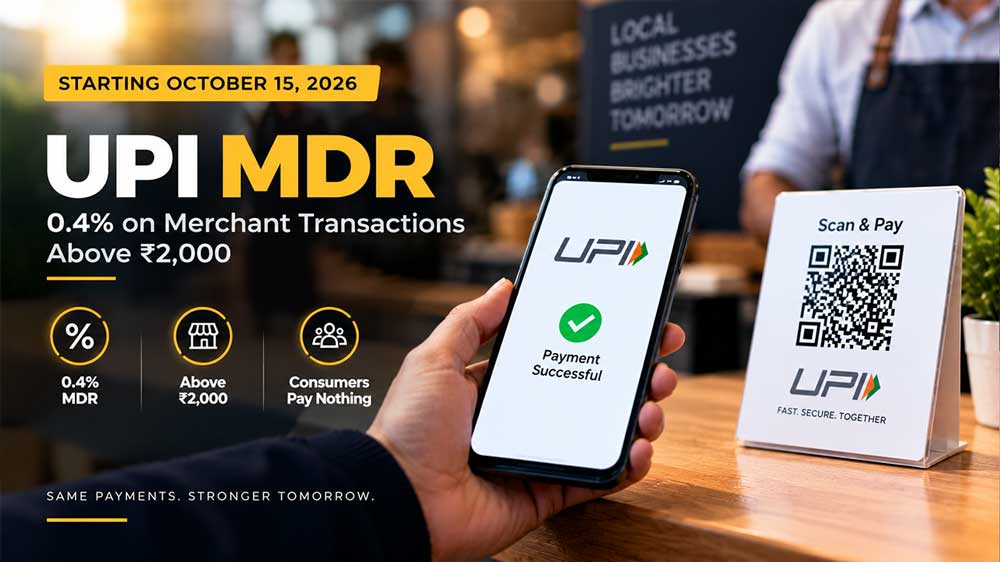
Starting October 15, 2026, India will introduce a new Merchant Discount Rate (MDR) framework for certain UPI person-to-merchant (P2M) transactions above ₹2,000. The standard MDR will be 0.4%, with a maximum charge of ₹300 per transaction for transactions of ₹75,000 or more.
The change is important because UPI has operated under a zero-MDR model for most merchant payments for several years. However, the new framework does not mean that consumers will start paying a UPI transaction fee.
What Is Changing?
Under the new framework, eligible merchant transactions above ₹2,000 will attract a 0.4% MDR.
For example:
UPI Merchant PaymentMDR at 0.4%₹2,000No
MDR
₹5,000 ₹20
₹10,000 ₹40
₹25,000 ₹100
₹50,000 ₹200
₹75,000 ₹300
₹1,00,000 ₹300 maximum
The ₹300 ceiling means that once the transaction reaches ₹75,000, the MDR does not continue increasing at 0.4%.
Customers Will Not Pay the MDR
One of the most important aspects of the new framework is that MDR is a merchant-side charge, not a consumer transaction fee.
The government has clarified that individuals will continue to use UPI free of charge for person-to-person payments, regardless of the amount transferred. Banks have also been advised to ensure that merchants do not pass the MDR directly to customers.
This distinction is important because the headline “UPI charges from October 15” could otherwise create the impression that consumers will have to pay a fee whenever they make a large UPI payment.
Most UPI Merchant Transactions Will Remain Unaffected
The new MDR does not apply to every UPI transaction.
According to the Ministry of Finance, approximately 96% of P2M transactions will remain unaffected. Payments to merchants up to ₹2,000 will continue without MDR, while eligible small merchants receiving up to ₹1 lakh per month through UPI QR codes under the specified small-merchant category will also remain under zero MDR.
Person-to-person transactions remain completely outside the MDR framework.
This means that sending ₹20,000 to a family member or friend through UPI is different from paying ₹20,000 to an eligible merchant.
Special Rates for Certain Sectors
The framework also creates different MDR structures for some categories.
Payments above ₹2,000 involving railways, telecommunications, insurance, fuel and agricultural inputs will attract a flat ₹5 MDR rather than the standard 0.4% rate.
Capital-market-related transactions, including payments involving mutual funds, securities, stockbrokers and dealers, will have a lower 0.02% MDR, capped at ₹300.
These differentiated rates create a separate treatment for sectors where transaction economics or margins may differ from those of conventional retail purchases.
Why Is MDR Being Introduced?
The broader issue is the economics of maintaining and expanding India's digital-payment infrastructure.
The government has described the framework as a way to support the long-term sustainability of the UPI ecosystem, while keeping payments free for individuals and smaller merchants. MDR collected from eligible transactions will be distributed among participants in the payments ecosystem, including banks, payment service providers and UPI application providers. It is not a tax collected by the government or NPCI.
The new framework therefore changes the payment industry's revenue structure without turning UPI into a consumer-paid payment service.
What Does It Mean for Merchants?
The impact will differ significantly by merchant size and transaction profile.
A small retailer receiving mostly ₹500–₹2,000 UPI payments may see little or no direct change if its transactions fall within the applicable exemptions.
A large retailer receiving thousands of high-value UPI payments, however, could face a measurable payment-processing cost.
For example, a merchant receiving 1,000 eligible UPI payments of ₹10,000 each would generate ₹1 crore in transaction value. At 0.4%, the MDR would theoretically amount to ₹40,000, subject to the applicable rules and exemptions.
This makes payment-cost management more relevant for businesses with high-value UPI volumes.
What It Means for India's Digital Payments Market
The October 15 change represents a shift in how the economics of UPI merchant payments are structured.
For consumers, the central proposition remains largely unchanged: UPI continues to be free for person-to-person transactions and smaller eligible merchant payments.
For merchants and payment companies, however, the framework introduces a defined revenue mechanism for selected higher-value transactions.
The long-term significance will depend on how merchants, banks, payment aggregators and UPI applications adapt to the new pricing structure—and whether the additional ecosystem revenue translates into continued investment in payment infrastructure, security, reliability and innovation.
The official government clarification on the framework provides further details on exemptions, sector-specific rates and the distribution of MDR within the payment ecosystem.
The Bigger Business Question
India's UPI story is moving into a different phase. The focus is no longer only on increasing transaction volumes; the economics of supporting that infrastructure are becoming an important part of the discussion.
The new MDR framework attempts to keep everyday digital payments free while placing a limited merchant-side cost on specified higher-value commercial transactions.
For businesses, the key question will be how the new cost affects payment-channel economics, margins and the choice between UPI and other payment methods.
Tags