
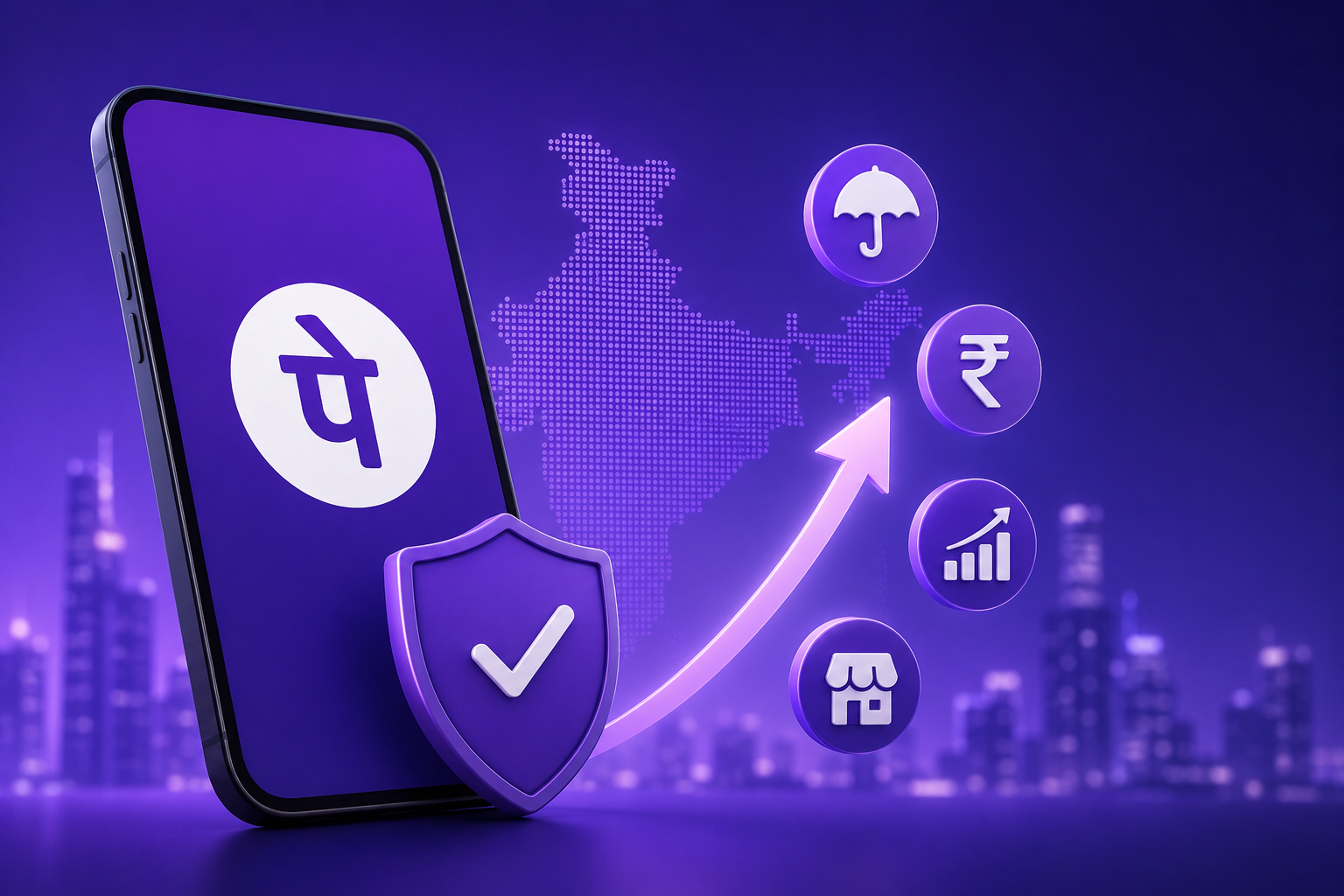
PhonePe Beyond UPI: Can India's Payments Leader Build Its Next Growth Engine?
Share this article
PhonePe has already won one of India's biggest digital battles: becoming the country's leading UPI payments platform. But winning payments may not be enough to justify its next phase of growth.
The bigger question for PhonePe is now whether it can turn its massive payments ecosystem into a broader financial-services business—one that generates meaningful revenue from insurance, lending, wealth management, merchant services and other financial products.
UPI Created the Scale. What Comes Next?
PhonePe's scale is difficult to ignore. The company crossed 600 million active users in 2025, according to its own data. Its updated IPO filing also shows that PhonePe maintained leadership in customer-initiated UPI transactions, with a 46.85% market share by volume in September 2025.
Meanwhile, India's UPI ecosystem continues to expand. NPCI recorded more than 22.7 billion UPI transactions in June 2026, worth about ₹28.9 lakh crore.
This gives PhonePe an enormous distribution advantage.
But there is a structural problem: UPI itself is not a high-margin business.
The payment infrastructure has been designed around low-cost transactions, while the ability to charge merchants remains constrained. Even proposed changes that could eventually introduce merchant fees would not eliminate the need for payment companies to diversify their revenue sources.
Therefore, PhonePe's long-term value cannot depend solely on processing more UPI transactions.
Financial Services Could Be the Next Growth Engine
PhonePe has been steadily expanding beyond payments into insurance, lending and other financial products.
Its IPO disclosures show that financial services increased from just 0.96% of revenue in FY23 to 11.55% in the first half of FY26. Merchant payments also became a much larger part of the revenue mix.
This shift is strategically important.
PhonePe already knows where consumers spend money, how frequently they transact and which financial products they interact with. That creates opportunities to offer insurance, credit and investment products within an existing customer relationship.
In theory, the company does not need to acquire an entirely new customer for every financial product.
The payment relationship can become the entry point for a much larger financial relationship.
The Lending Opportunity—and the Risk
Lending could be particularly attractive because credit products generate significantly more revenue potential than basic payment transactions.
But this is also where PhonePe faces its biggest execution risk.
Payments are primarily a technology and reliability problem. Lending is a risk-management problem.
A successful lending business requires strong underwriting, responsible credit distribution, collections and risk controls. Rapidly converting payment data into credit growth could create serious asset-quality problems if risk models are not sufficiently robust.
For PhonePe, therefore, becoming a financial-services company means accepting a different type of risk from the one it faced while building UPI leadership.
Can PhonePe Compete With Banks and Fintech Rivals?
PhonePe's advantage is distribution.
Banks possess deposits, lending relationships and regulatory infrastructure. Fintech companies compete through technology and customer experience. PhonePe sits between these models with an enormous consumer base and a highly frequent payments relationship.
That creates a potentially powerful position.
However, scale does not automatically create a moat in financial services. Customers may happily use PhonePe for UPI while purchasing insurance, investments or loans from completely different platforms.
The company therefore needs to prove that it can convert payment users into customers of higher-value products.
Investor Perspective: Revenue Quality Matters
PhonePe's FY26 numbers show why this transition is urgent. Revenue from operations increased around 11.5% to ₹7,920 crore, but its net loss widened to approximately ₹2,792 crore.
This is the uncomfortable part of the story.
PhonePe has extraordinary scale, but scale alone has not yet produced consistent bottom-line profitability.
Investors should therefore watch non-payment revenue growth, contribution margins, financial-services monetisation and cash consumption, rather than focusing only on UPI transaction volumes.
The Next PhonePe May Look Very Different
PhonePe's next chapter is unlikely to be about becoming a bigger payments app.
It is about becoming a financial-services platform built on top of payments.
If the company can successfully convert its massive UPI user base into customers for insurance, lending, wealth and merchant services, UPI could ultimately become its distribution layer rather than its primary economic engine.
That is the real opportunity.
PhonePe has already built the railway. The next challenge is making money from everything that travels on it.
Original Analysis
The central argument of this article is that PhonePe's strategic challenge has shifted from payment-market leadership to monetising its existing distribution advantage. The key test is whether higher-value financial products can grow faster than the low-margin payments business without introducing disproportionate credit, regulatory or capital risks.
, UPI, Digital Payments, Fintech, Financial Services, Lending, Insurance, Indian Startups, Fintech Industry, Investor Perspective, Indian Economy
Tags