
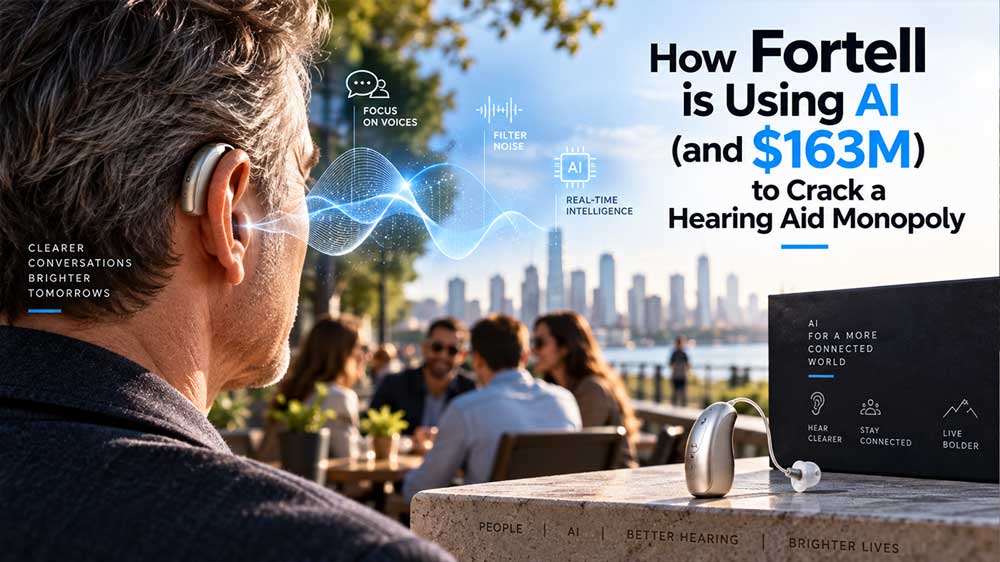
How Fortell Is Using AI and $163M to Crack the Hearing Aid Monopoly
Share this article
For decades, hearing aids have largely followed the same basic formula: detect sound, amplify it and try to reduce unwanted noise.
Fortell is betting that artificial intelligence can change that equation.
The New York-based startup has raised $163 million at a reported $740 million valuation, according to Forbes, as it attempts to build a new generation of AI-powered hearing aids capable of separating the voice a user wants to hear from competing sounds in real time.
The opportunity is significant. The World Health Organization estimates that more than 1.5 billion people globally have hearing loss, while hearing-aid production meets less than 10% of global demand.
Fortell's bet is that the next breakthrough will come not simply from making hearing aids smaller or louder, but from making them better at understanding sound.
The Problem Fortell Is Trying to Solve
Imagine sitting in a crowded restaurant.
You want to hear the person sitting across the table, but there is music playing, other customers are talking and dishes are moving around the room.
For someone with normal hearing, the brain can naturally focus attention on one conversation while filtering competing sounds. This is commonly referred to as the cocktail-party problem.
Traditional hearing aids can amplify speech and reduce certain types of background noise, but separating multiple overlapping voices is considerably harder.
That is where Fortell is positioning its technology.
Rather than treating the entire acoustic environment as one stream, the company uses AI to identify and separate different sound sources.
The objective is not simply:
Make everything louder.
It is:
Understand what matters and make that clearer.
Six Years of Development
Fortell was founded in 2021 by Matthew de Jonge, Andrew Casper, Igor Lovchinsky and Cole Morris.
De Jonge had previously worked at Bridgewater Associates and later at Butterfly Network, where he was involved in developing technology for portable ultrasound. Casper and Lovchinsky also came from Butterfly.
The connection to Butterfly is important because medical hardware requires a different development cycle from conventional software.
The company had to combine:
Machine learning
Custom silicon
Audio engineering
Hearing science
Medical-device development
Clinical testing
Manufacturing
Audiology
That helps explain why Fortell spent years developing the product before launching commercially.
Why Fortell Built Its Own AI Chip
One of Fortell's most important technical decisions was to develop a custom processing architecture rather than relying entirely on conventional hearing-aid chips.
Fortell says its proprietary chip delivers approximately 235 times more compute than conventional hearing-aid processors, performs up to 100 billion operations per second and maintains end-to-end latency below 10 milliseconds.
That latency matters.
Audio processing that takes too long can create a noticeable disconnect between what someone sees and what they hear.
Fortell's approach is therefore based on running AI continuously on the device while keeping processing fast enough to feel natural.
This is an important distinction from many consumer AI products where cloud computing can perform heavy processing.
For a hearing aid, sending audio to the cloud would introduce latency, connectivity requirements and privacy considerations.
The Product Launched in 2025
Fortell launched its first hearing aids in December 2025 at approximately $6,800 per pair. The initial sales model has been deliberately controlled, with fitting through Fortell's own audiology clinics rather than attempting immediate mass distribution.
The company currently lists clinics in New York, Greenwich and Palm Beach, with Boston and other locations planned. (Fortell)
This premium positioning serves two purposes.
First, it allows Fortell to control the fitting and customer experience.
Second, it gives the company access to direct feedback from users and audiologists while it continues improving the technology.
The model resembles a broader trend in medical hardware: control the initial customer experience before attempting large-scale distribution.
The AI Is Already Being Updated
Fortell's product is not being treated as static hardware.
In August 2026, the company released Fortell AI 2.0, an updated AI model trained using real-world audio captured in restaurants, cafés, construction sites, trains, buses, cars and other difficult listening environments.
Fortell's technical evaluation reported an average 2.13 dB improvement in signal-to-noise ratio over AI 1.0 across tested listening modes and noise conditions, with the largest improvement reaching 4.1 dB in competing-talker scenes. (Fortell)
That introduces an important software-like characteristic to a medical device.
The hardware can remain in the customer's ear while the intelligence controlling its sound processing improves over time.
Early Testing Shows a Potential Difference
Fortell has published several clinical and laboratory results supporting its approach.
In a blinded preference study, the company reported that 95% of participants preferred Fortell over top-tier hearing aids from the five major manufacturers tested.
More recently, Fortell announced that independent testing laboratory HearAdvisor gave its devices an overall SoundScore of 6.0 and a speech-in-noise score of 6.4, exceeding the laboratory's previous reported record of 4.5.
Fortell also cited an NYU Langone randomized, double-blind crossover trial in which participants had approximately 19 times the odds of correctly understanding speech with Fortell compared with a competing premium AI hearing aid under the study conditions.
These are important signals, but they should still be interpreted within the limits of laboratory and controlled clinical testing. Real-world adoption at scale will provide a different test.
A Market Dominated by Incumbents
Fortell is entering an industry with powerful established manufacturers.
TechCrunch reports that five companies account for approximately 97% of hearing-aid products.
The established group includes companies such as Sonova, Demant, WS Audiology, GN Store Nord and Starkey.
That concentration creates both an obstacle and an opportunity.
Incumbents have decades of relationships with audiologists, distributors and healthcare systems.
Fortell, meanwhile, can start with a new architecture and a technology-first proposition.
The question is whether technological differentiation will be enough to overcome the distribution advantage of incumbents.
$163 Million Changes the Equation
The funding is significant relative to Fortell's current commercial scale.
The company has raised $163 million, with Founders Fund, Thrive Capital and Valor Equity Partners among the investors. The reported valuation is approximately $740 million.
For a medical hardware startup, this capital can support several expensive activities simultaneously:
R&D → Clinical research → Manufacturing → Regulatory work → Clinics → Audiologist hiring → Geographic expansion
Fortell's CEO has identified hiring audiologists as one of the constraints on expansion. Forbes reported that the company planned additional locations in Boston, San Francisco and Palo Alto.
That means the next bottleneck may not be technology.
It may be distribution and service capacity.
The Regulatory and Business Challenge
The U.S. hearing-aid market has already changed because of the FDA's creation of an over-the-counter category for adults with perceived mild-to-moderate hearing loss.
The FDA says OTC hearing aids can be purchased without a prescription or medical examination, while prescription devices remain available for broader levels of hearing loss.
That creates more room for technology companies to experiment with consumer-oriented hearing products.
But Fortell is pursuing a different route.
Its current model emphasizes audiologists and personalized fitting rather than simply putting a device online and shipping it to consumers.
That could make the company more operationally intensive, but it also gives Fortell greater control over the quality of the initial customer experience.
The Apple Question
Apple's AirPods have also changed how consumers think about hearing technology.
In 2024, the FDA authorized Apple's Hearing Aid Feature for compatible AirPods Pro devices, allowing them to function as OTC hearing aids for adults with perceived mild-to-moderate hearing impairment.
For Fortell, that creates an interesting competitive environment.
On one side are traditional medical-device companies.
On another are consumer technology companies such as Apple.
Fortell is attempting to occupy the middle: medical-grade hearing technology with modern AI and consumer-oriented product design.
What Happens Next?
Fortell's biggest challenge is no longer demonstrating that AI can be applied to hearing.
It needs to prove that its technology can become a scalable hearing business.
That means answering several questions:
Can Fortell manufacture at significantly larger volumes?
Can it recruit enough audiologists?
Can the $6,800 price eventually reach a much wider customer base?
Can clinical performance translate into everyday user satisfaction?
Can software updates create sustained technological differentiation?
Can Fortell build distribution against established manufacturers?
Can it expand beyond a premium early-adopter market?
The company's $163 million funding round gives it substantial resources to pursue those questions.
But capital alone will not break an entrenched market.
The bigger opportunity is the combination of AI, custom hardware, clinical evidence and a different customer experience.
If Fortell can turn that combination into a scalable product and distribution model, hearing aids could become another category where AI changes not just the software layer, but the underlying architecture of the device.
Business Lesson
Fortell's strategy illustrates a broader pattern in AI startups.
The most defensible opportunities may not always be building another general-purpose AI application. They can emerge when AI is combined with specialized hardware, proprietary data, domain expertise and a difficult real-world problem.
Hearing is particularly interesting because the environment is messy, the latency requirements are strict and the product must work continuously in the physical world.
Fortell is therefore not simply trying to make a smarter hearing aid.
It is attempting to rebuild the hearing-aid architecture around AI.
Whether that is enough to change a market dominated by established manufacturers will depend on what happens after the funding round: manufacturing, clinical validation, distribution and adoption.
Tags