
Every Employee Gets an AI Co-Worker: What Changes?
Share this article
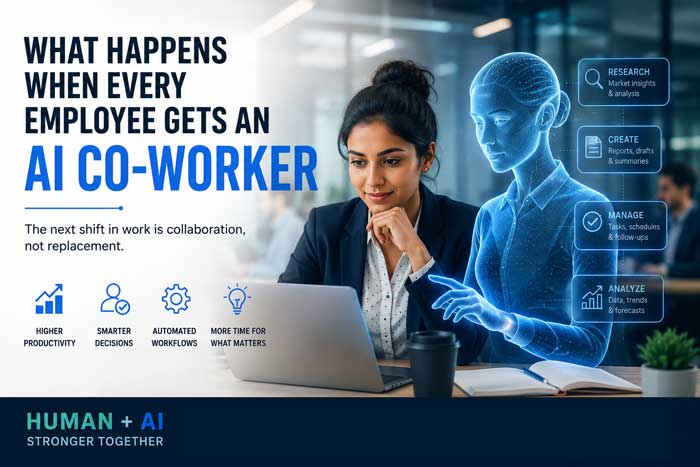
The next major shift in the workplace may not be about replacing employees with artificial intelligence. It may be about giving every employee an AI co-worker.
AI assistants are already moving beyond answering questions and generating text. Newer AI agents can research information, analyse documents, prepare reports, manage workflows and execute multi-step tasks. Microsoft’s 2026 Work Trend Index describes this emerging model as a workplace where AI and agents take on more execution while humans increasingly direct work and own outcomes.
If this model becomes mainstream, the biggest change may not happen inside individual jobs. It could happen to the structure of companies themselves.
From AI Tool to AI Co-Worker
Traditional software waits for employees to tell it what to do.
An AI co-worker can potentially take a goal, break it into tasks and complete parts of the workflow with limited human intervention.
A marketing employee could have an AI agent analyse competitors, identify customer trends and prepare a campaign brief. A finance employee could use one to reconcile data and flag unusual transactions. A sales employee could have an agent research prospects and prepare personalised proposals.
This changes the employee's role from doing every task to directing, reviewing and improving the work.
Microsoft's research shows how quickly this idea is developing. Its 2025 Work Trend Index found that 82% of leaders expected AI agents to expand workforce capacity within 12–18 months.
The Productivity Opportunity Is Real—but Not Automatic
The strongest argument for AI co-workers is productivity.
Anthropic's Economic Index found that AI use initially leaned more toward augmentation than automation, with 57% of observed usage involving collaboration between humans and AI versus 43% involving direct automation. Its 2026 research also found that AI usage is spreading across a wider range of workplace tasks.
That suggests the immediate future may look less like "AI replaces everyone" and more like one employee producing the output previously associated with several people.
But there is a critical assumption here: companies must redesign workflows around AI.
Simply giving employees an AI subscription will not automatically produce major productivity gains.
The Real Change Could Be the End of the Traditional Org Chart
If every employee has several specialised AI agents, a small team could potentially perform work that previously required a much larger department.
A product manager might coordinate research, analytics and documentation agents. A small business could have AI systems handling customer support, marketing and bookkeeping alongside a handful of employees.
This could reduce organisational layers and make smaller companies more competitive.
Microsoft's 2025 research anticipated the emergence of "agent bosses"—employees who delegate work to and manage AI agents rather than simply using AI as a conventional software tool.
The implication is significant: management skills may increasingly include managing digital labour.
But There Is a Hidden Problem
More AI does not automatically mean better work.
If employees delegate tasks to unreliable agents, organisations could simply produce mistakes faster.
AI-generated reports may contain incorrect assumptions. Automated decisions may reflect biased data. Agents with access to internal systems could create security and privacy risks.
This is why human oversight remains essential.
Recent industry discussions have emphasised that AI agents require strong governance, clean data and clear human accountability. (The Economic Times)
The uncomfortable truth is that companies may discover their biggest AI problem is not the AI itself.
It is poorly designed processes.
Automating a broken workflow simply creates a faster broken workflow.
The Jobs Question
The impact on employment will probably be more complicated than a simple rise or fall in jobs.
Some repetitive tasks will disappear. Other jobs will expand because employees can manage larger workloads. New roles will emerge around AI governance, agent management, data quality and workflow design.
The more important distinction may eventually be between employees who can effectively manage AI and those who cannot.
Two people with similar qualifications could therefore have dramatically different productivity depending on how well they work with their AI co-workers.
Investor Perspective
For businesses and investors, the most important metric will not be the number of AI tools deployed.
It will be economic output per employee.
If AI allows companies to increase revenue without proportionally increasing headcount, margins could improve. But if AI increases software costs, infrastructure spending and management complexity without generating measurable productivity, the financial benefit could be much smaller.
This creates a new corporate question:
How much economic value does each AI co-worker actually create?
Companies that can answer that question will have a significant advantage over those simply announcing large AI investments.
The Next Workplace May Be Human + AI
The most realistic future is unlikely to be humans versus AI.
It will be humans working with increasingly capable digital colleagues.
The winning organisations will probably not be those with the most AI tools. They will be those that redesign jobs, workflows and accountability around the technology.
That could make the next corporate productivity revolution less about eliminating employees and more about dramatically increasing what one employee can accomplish.
The biggest competitive advantage of the AI era may therefore become surprisingly simple:
Not having AI—but knowing how to manage it.
Original Analysis
The central argument is that the economic impact of AI co-workers should be measured through output per employee, workflow redesign and incremental profitability, rather than AI adoption rates alone. The real competitive divide may emerge between organisations that merely deploy AI tools and those that successfully redesign work around human-agent team
Tags